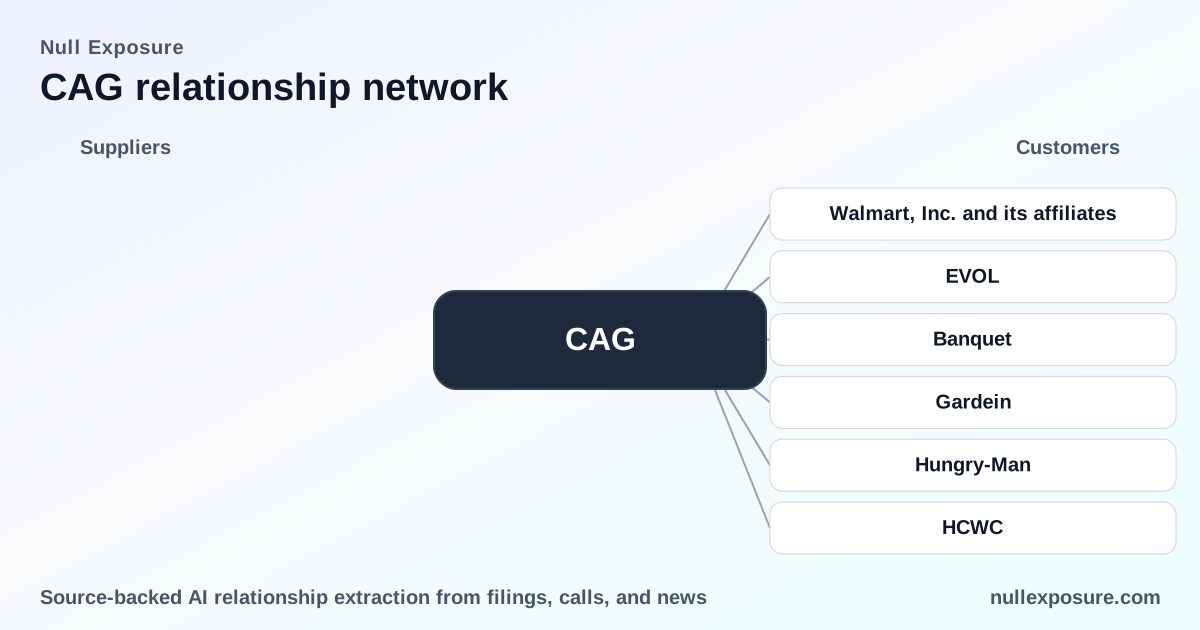
Conagra Brands (CAG): Customer Map, Concentration and Operational Implications
Conagra is a branded consumer packaged foods company that monetizes primarily by producing and selling packaged food products to retailers, foodservice operators, distributors and e‑commerce channels. Revenue is generated through direct sales to large national retailers, broker and distributor arrangements, and incremental service fees when the company provides transition or support services. For investors, the critical lens is customer concentration, channel mix (direct vs. distributor/reseller), and the operational footprint that supports national CPG distribution. Learn more at https://nullexposure.com/.
What the customer roster tells investors about Conagra’s operating model
Conagra operates as a classic branded CPG manufacturer with a hybrid go‑to‑market: direct national accounts for scale buyers and a distributor network for breadth and foodservice. This posture creates predictable recurring revenue from grocery channels but also concentrates exposure to a handful of large retail customers.
- Customer concentration is material and structural. Conagra reports that Walmart and its affiliates represented a large share of sales, giving a single retailer significant pricing and placement leverage. This concentration is a strategic strength for volume but a risk for margin and negotiating power.
- Channel mix shows maturity and scale. The company’s revenue streams span grocery, club, convenience, pharmacy, foodservice and government customers, indicating a diversified channel footprint even as retail concentration remains high.
- Geographic footprint is primarily North American. Operations are principally in the United States, which simplifies supply chain management but concentrates macro and regulatory exposure.
- Contracting posture blends seller/distributor roles. Conagra sells directly to major retailers while also relying on distributors, brokers and resellers to reach other channels; the company also provides transition services when divesting assets, illustrating a capability to act as a short‑term service provider when required.
Key takeaway: Conagra’s model trades higher volume and scale economics against concentrated counterparty power and U.S.‑centric exposure — a favorable margin structure if the company preserves retail relationships and execution.
Relationship-by-relationship: who Conagra sells to and why it matters
Walmart, Inc. and its affiliates
Walmart is Conagra’s single largest customer, accounting for approximately 29% of consolidated net sales in FY2025, making this relationship material to Conagra’s revenue and a central negotiating counterparty for assortment and pricing. According to Conagra’s FY2025 10‑K, Walmart accounted for 29% of net sales in fiscal 2025 and a similar share in prior years (FY2024 and FY2023).
evol (EVOL)
Conagra’s Fayetteville facility produces ready‑to‑eat meals for multiple brands including evol, indicating Conagra’s role as manufacturer for both owned and partner brands in the refrigerated/ready‑meal space. A TalkBusiness report on the Fayetteville expansion (March 2026) notes evol as one of the labels produced there.
Gardein
The Fayetteville plant also produces ready‑to‑eat meals under the Gardein label, signaling Conagra’s participation in plant‑based and alternative protein categories through manufacturing and brand support at its facilities (TalkBusiness, March 2026).
Hunt’s
Conagra’s Mexican manufacturing operation produces products for brands including Hunt’s and is a material driver of local volume; Food Business News reported that the plant generates 94% of Conagra’s total sales volume in Mexico (May 2026), underscoring the plant’s regional importance to branded tomato and canned categories.
Banquet
Banquet is a core frozen/ready‑meal label produced at Fayetteville, reflecting Conagra’s footprint in value frozen meals and the operational need to support high‑volume, temperature‑controlled manufacturing (TalkBusiness, March 2026).
Hungry‑Man
Conagra manufactures Hungry‑Man ready‑to‑eat meals at Fayetteville, demonstrating continued exposure to value‑oriented frozen meal consumers and the distribution/slotting needs that come with big box and supermarket channels (TalkBusiness, March 2026).
ACT II
Conagra’s Mexico plant makes ACT II popcorn products among its portfolio, highlighting regional production specialization and the importance of local manufacturing scale to supply snack categories in that market (Food Business News, May 2026).
Del Monte (DMPLF)
The Mexico plant also produces products for Del Monte, indicating co‑manufacturing or private‑label/service manufacturing relationships in Mexico; Food Business News (May 2026) lists Del Monte among brands produced there.
HCWC
Healthy Choice/Wider HCWC labels are produced at the Fayetteville facility, reflecting Conagra’s role in the refrigerated and frozen health‑positioned meal segment and the operational consolidation of multiple brands at a single site (TalkBusiness, March 2026).
Healthy Choice
Healthy Choice is explicitly produced at Fayetteville and represents Conagra’s presence in the better‑for‑you ready‑meal segment, which requires distinct formulation and supply‑chain controls relative to value frozen meals (TalkBusiness, March 2026).
How constraints shape risk and opportunity for investors
The documented constraints provide company‑level signals that explain operating behavior and risk profile:
- Materiality/concentration is high. The explicit disclosure that Walmart represents ~29% of sales signals that Conagra’s pricing, shelf placement and promotional economics are heavily influenced by a single retail counterparty; this compresses margin flexibility but supports volume scale.
- Counterparty mix includes government and foodservice. Conagra explicitly sells to government and institutional buyers, which diversifies end markets beyond retail and can create steady, contractually driven demand streams.
- Channel roles are multi‑modal (seller, reseller, distributor). Conagra’s reliance on direct sales forces, brokers and distributors indicates a layered commercial model: direct contracts with national accounts plus distributor/reseller reach for breadth.
- Geographic concentration in North America. The principal U.S. operations focus reduces complexity but increases sensitivity to U.S. consumer trends, input‑cost inflation and regulatory shifts.
Risk profile: High counterparty concentration at the retail level, operational dependence on key manufacturing sites (e.g., Fayetteville, Mexico plant), and U.S.‑centric exposure.
Opportunity profile: Scale economics with large national retailers, capacity to co‑manufacture for external brands, and a diversified channel mix that cushions pure retail volatility.
Explore a deeper customer‑level map and subscription analytics at https://nullexposure.com/.
Investment implications and near‑term considerations
- Earnings sensitivity: Margins will be sensitive to retail negotiations and promotional intensity driven by major accounts; watch gross profit trends and SG&A cadence in quarterly reports.
- Capex and plant investments matter. The announced Fayetteville expansion and Mexico plant upgrades are capital allocation signals that prioritize frozen/refrigerated and regional manufacturing capacity — monitor execution and incremental utilization.
- Portfolio stability through brands. Established labels (Hunt’s, Banquet, Healthy Choice) provide steady cash flow even as the company adapts to consumer shifts such as plant‑based alternatives (Gardein, evol).
Bottom line
Conagra’s customer landscape is characterized by high retail concentration, a hybrid direct/distributor commercial model, and manufacturing concentration in key plants that support multiple brands. For investors, the tradeoff is clear: scale and brand durability versus negotiating risk with a dominant retail customer and operational exposure to a limited set of manufacturing sites. Continuous monitoring of account concentration metrics, plant utilization and retail promotional dynamics will be decisive in assessing upside to margins and cash flow.