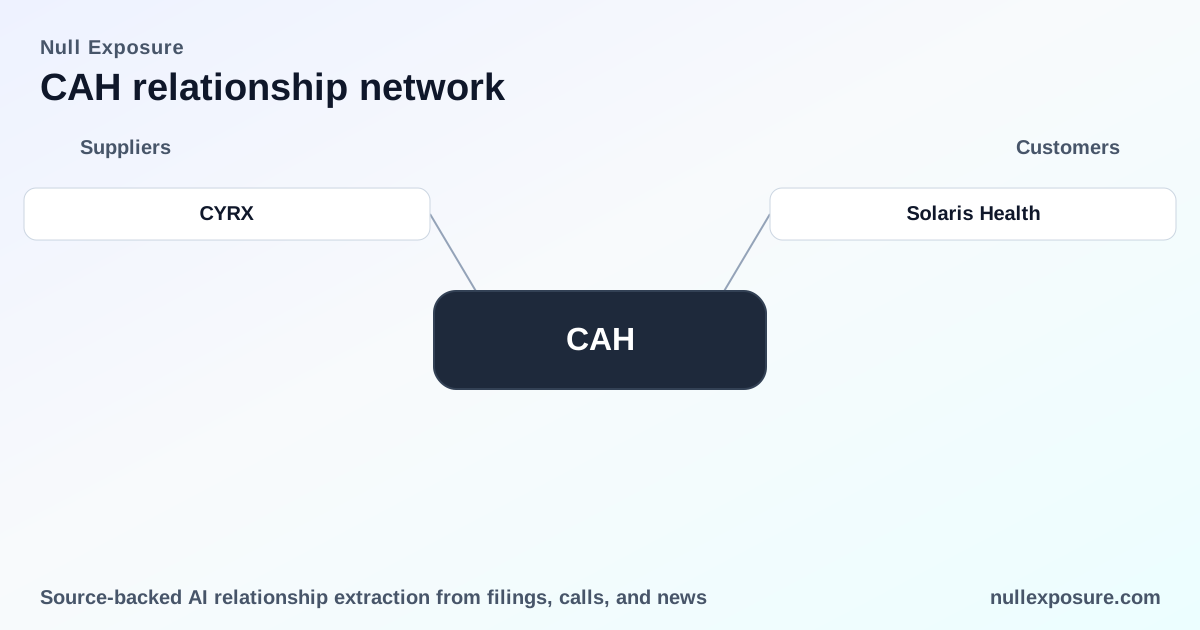
Cardinal Health (CAH) — Customer Relationships, Distribution Reach, and Strategic Implications
Cardinal Health operates as one of the largest healthcare distributors and services companies in the U.S., monetizing through large-scale pharmaceutical distribution, branded and private‑label medical product manufacturing, and value‑added services to hospitals, pharmacies, and specialty drug manufacturers. With roughly $250.7 billion in trailing twelve‑month revenue, Cardinal’s core economics depend on wholesale distribution margins, specialty distribution fees, manufacturing unit margins, and recurring service contracts that create high revenue throughput but concentrated counterparty exposure. For investors evaluating customer relationships, the balance of broad distribution scale and a handful of strategically critical partners defines both upside (network leverage for specialty products) and downside (concentration and receivable risk). Learn more at https://nullexposure.com/.
Why these customer links matter for valuation and risk
Cardinal’s customer relationships are not transactional one‑offs; they reflect the company’s position as a primary U.S. channel for both commodity pharmaceuticals and high‑value specialty products. The constraints extracted from company disclosures indicate several operating model characteristics that drive valuation and risk:
- Concentration and counterparty risk: Corporate filings identify very large customers (for example, CVS Health accounted for 30% of fiscal 2025 revenue), signaling outsized exposure to a small set of buyers and corresponding receivable concentration that is material to cash flow and working capital.
- Global scale with North American dominance: Cardinal’s manufacturing and GMPD activities operate globally, while its Pharma distribution is concentrated in the U.S., giving the company scale benefits for international sourcing and North American distribution leverage.
- Multiple commercial roles: Cardinal operates simultaneously as distributor, manufacturer, and service provider, which supports cross‑sell of distribution services to manufacturers and the sale of Cardinal‑branded products into hospital and retail channels.
- Operational maturity and active engagement: The business shows mature, active relationships with customers and recurring accounts receivable dynamics (reserves and disputes are recurring items in recent fiscal years), reflecting an established but working‑capital intensive model.
These signals underline a classic wholesaler economics profile: thin operating margins but massive revenue throughput, high customer concentration, and embedded value in specialty distribution capabilities.
Relationship-by-relationship read — who Cardinal serves and how
Autolus Therapeutics (AUTL)
Cardinal Health is the designated U.S. commercial distribution partner for Autolus’s Aucatzyl CAR‑T product, handling the channel between the drugmaker’s U.K. manufacturing site and U.S. customers. This positions Cardinal as a critical logistics and commercialization partner for an advanced‑therapy product with specialized distribution needs (FiercePharma, March 2026).
Cryoport Systems / Cryoport (CYRX)
Cryoport noted in its Q4 2025 earnings commentary that it expanded global partnerships with Cardinal Health and Parexel, with both firms leveraging Cryoport’s cold‑chain solutions, indicating Cardinal’s role in specialty logistics for cell and gene therapies. This confirms Cardinal’s strategic extension into high‑touch supply chain services for temperature‑sensitive biologics (Cryoport Q4 2025 earnings call, reported March 2026).
Telix Pharmaceuticals (TLX)
Telix’s corporate analysis highlights Cardinal Health as one of its distribution partners in the U.S., with Cardinal operating a leading radiopharmaceutical network that distributes Illuccix to PET imaging sites. Cardinal’s network therefore captures value from radiopharmaceutical commercialization and the expanding diagnostic/imaging market (Morningstar company report, March 2026).
ANI Pharmaceuticals (ANIP)
ANI’s 2024 Form 10‑K explicitly states it conducts business with the three major U.S. wholesalers — including Cardinal Health — confirming Cardinal’s role as a core wholesale channel for branded and generic manufacturers. This underlines the company’s place in routine pharmaceutical logistics and wholesaling for contract manufacturers (ANI 10‑K, fiscal 2024).
Solaris Health (Solaris Health, non‑ticker)
Analyst commentary on Cardinal’s performance references the Solaris Health integration as a driver of incremental distribution revenue in a high‑case scenario, indicating Cardinal’s active M&A and integration playbook to expand specialty distribution capabilities and capture additional margin from acquired channels (Tikr blog analysis, March 2026).
What the mix of relationships implies for strategy and risk
- Distribution of specialty products is a growth vector. Cardinal’s ties to cell and gene therapy logistics (Cryoport), CAR‑T commercialization (Autolus), and radiopharmaceutical distribution (Telix) signal a deliberate push into higher‑margin, higher‑complexity distribution services where Cardinal can charge premium fees for reliability and compliance.
- Receivable and concentration risk remain tangible. The company disclosure that a single large customer accounted for 30% of fiscal 2025 revenue is a reminder that top‑line throughput exposes Cardinal to payment and renewal cycles that can rapidly affect working capital and reported earnings. This is a material risk for investors.
- Integrated roles create cross‑selling optionality. Operating as manufacturer, distributor, and service provider allows Cardinal to internalize margin capture across the product lifecycle, but it also concentrates operational and regulatory risk under one corporate umbrella. Diversification by product type reduces but does not eliminate counterparty dependency.
- Mature but active contracts. Recurring reserves for service charges and customer disputes indicate long‑standing commercial relationships that are actively managed and can produce volatile quarter‑to‑quarter revenue recognition effects.
If you are modeling Cardinal’s future cash flow, emphasize specialty distribution revenue growth assumptions while stress‑testing top‑customer concentration and working‑capital swings.
Learn more about how these relationship signals are aggregated at https://nullexposure.com/.
Practical takeaways for investors and operators
- Positive: Cardinal holds a defensible distribution moat for specialty products that require regulated cold‑chain logistics and commercial expertise, creating a pathway to higher margin services.
- Negative: Revenue concentration and sizable receivables tied to a few customers create downside volatility in cash flow and earnings if large buyers reduce purchases or seek pricing concessions.
- Operational focus: Monitor receivable aging, reserve trends, and disclosure around major customer contract renewals; newly announced specialty partnerships (CAR‑T, radiopharm) are meaningful but operationally intensive.
Bottom line
Cardinal Health’s customer relationships span the full spectrum of pharmaceutical commerce — from routine wholesaling (ANI) to specialty logistics and commercialization partnerships (Autolus, Cryoport, Telix) and acquisition‑driven distribution expansion (Solaris Health). For investors, the core tradeoff is clear: the company’s massive distribution platform and specialty network provide a pathway to higher‑margin growth, but material concentration and working‑capital exposure require careful modelling and active monitoring of large counterparty dynamics.
For a consolidated view of Cardinal’s partner and customer signals across filings and market coverage, visit https://nullexposure.com/.