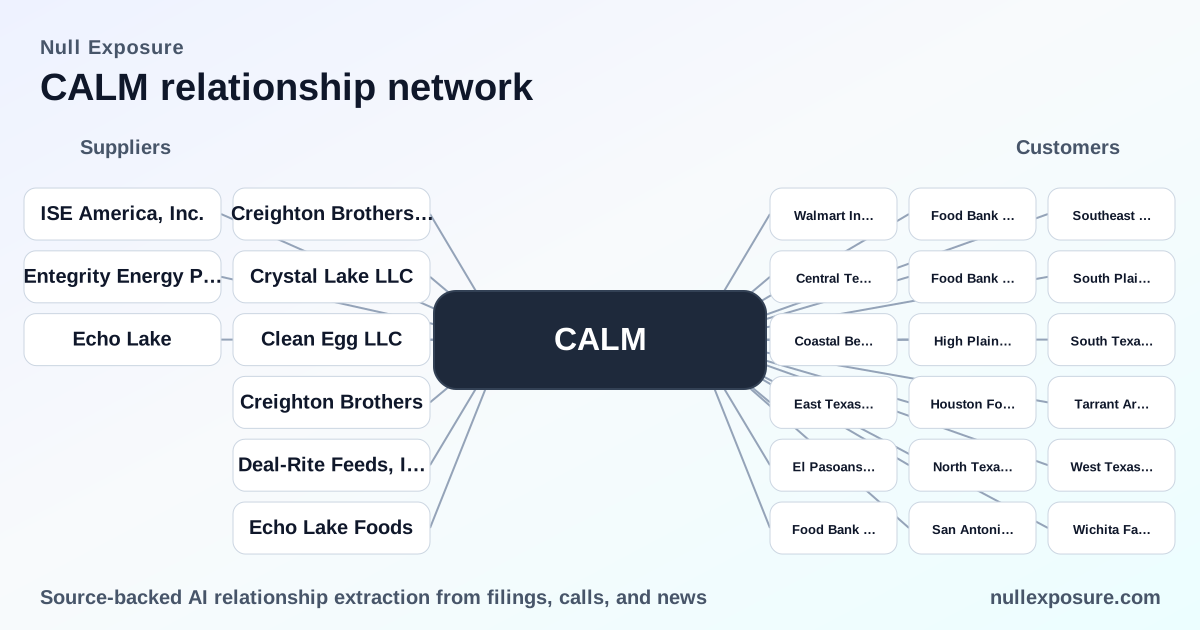
Cal‑Maine Foods (CALM): Customer relationships you need to know
Cal‑Maine Foods sells, grades, packs and distributes fresh shell eggs across the United States and monetizes through high‑volume, low‑margin product sales to grocery chains, club stores, foodservice distributors and other large buyers. The company's economics depend on scale in production and distribution, market‑linked pricing for conventional eggs, and a small number of very large customers that drive an outsized share of revenue. For investors and operators, the core questions are customer concentration, contracting posture, and the operational flexibility Cal‑Maine retains to shift volumes across buyers.
If you want a quick company snapshot before reading on, visit the Null Exposure homepage: https://nullexposure.com/
How Cal‑Maine sells eggs and how that shapes risk
Cal‑Maine operates as the largest U.S. producer and distributor of fresh shell eggs, selling product into wide national channels. Most sales are executed on short payment terms (7–30 days) and on pricing frameworks tied to independently quoted regional wholesale market quotes, which makes Cal‑Maine’s revenue sensitive to short‑term commodity price movements but preserves flexibility to reallocate supply. According to its FY2025 10‑K filing, the company sells across 40 states and maintains state‑of‑the‑art operations located close to customers to support rapid fulfillment.
Key operating signals from company disclosures:
- Short‑term contracting posture: The majority of eggs are sold based on daily or short‑term needs, and most established accounts have payment terms in the 7–30 day range (company 10‑K, FY2025).
- Market‑linked pricing frameworks: Conventional eggs are typically sold under frameworks that reference independently quoted regional wholesale prices (company 10‑K, FY2025).
- Large‑enterprise counterparties: Cal‑Maine’s customer base includes national grocery chains, club stores and foodservice distributors—consistent with selling to large enterprise buyers (company 10‑K, FY2025).
- Material concentration: The top three customers accounted for roughly 49.2% of net sales in FY2025, making counterparty concentration a persistent financial risk and negotiating lever for large buyers (company 10‑K, FY2025).
- Mature relationships but not exclusivity: The company reports long‑standing customer relationships, but customers are free to source eggs elsewhere—so loyalty is durable but not contractually locked (company 10‑K, FY2025).
Why customer concentration matters for valuation and operations
Cal‑Maine’s unit economics rely on throughput and stable access to retail and club shelf space; losing scale with one or more top customers would hit utilization and margins given the material concentration. Conversely, the market‑linked pricing model provides pass‑through protection when wholesale prices rise, but it also transmits downside in soft markets. Institutional ownership is significant (over 96% institutional), which elevates sensitivity to near‑term earnings volatility and any shifts in major retail buying patterns.
The roster: every customer relationship in the record and what it means
Below I enumerate every relationship pulled from the coverage for investor due diligence. Each entry is a concise, plain‑English statement with source attribution.
Walmart Inc.
Cal‑Maine’s single largest buyer is Walmart (including Sam’s Club), which accounted for 33.6% of net sales in fiscal 2025 and roughly the same share in the prior two years, underscoring a persistent dependence on one retail giant (Cal‑Maine FY2025 10‑K, filed May 2025).
Texas and regional food‑bank recipients (result of a March 2026 settlement)
A March 9, 2026 news report summarized a settlement requiring Cal‑Maine to donate eggs across multiple Texas food banks; the coverage lists the following recipients and allocations:
- Central Texas Food Bank — Cal‑Maine is required to donate at least 20,000 dozen eggs to this local bank under the settlement (KVUE, March 9, 2026).
- San Antonio Food Bank — Included in the same Central Texas allocation of 20,000 dozen eggs specified in the March 2026 report (KVUE, March 9, 2026).
- Tarrant Area Food Bank — Also part of the 20,000 dozen Central Texas distribution mandated by the settlement (KVUE, March 9, 2026).
- North Texas Food Bank — The company must donate up to 30,000 dozen eggs to North Texas Food Bank as noted in the settlement coverage (KVUE, March 9, 2026).
- Houston Food Bank — The settlement requires donation of up to 30,000 dozen eggs to the Houston Food Bank (KVUE, March 9, 2026).
- East Texas Food Bank — Cal‑Maine must provide at least 10,000 dozen eggs to this recipient under the March 2026 terms (KVUE, March 9, 2026).
- Food Bank of the Rio Grande Valley — Included in the 10,000 dozen allocation for regional recipients in the March 2026 report (KVUE, March 9, 2026).
- El Pasoans Fighting Hunger Food Bank — Listed among recipients receiving at least 10,000 dozen eggs per the settlement description (KVUE, March 9, 2026).
- Coastal Bend Food Bank — The report lists up to 5,000 dozen eggs allocated to this food bank (KVUE, March 9, 2026).
- Southeast Texas Food Bank — The settlement covers up to 5,000 dozen eggs for this organization (KVUE, March 9, 2026).
- South Texas Food Bank — Named to receive up to 5,000 dozen eggs under the settlement (KVUE, March 9, 2026).
- South Plains Food Bank — Included among recipients for up to 5,000 dozen eggs (KVUE, March 9, 2026).
- Food Bank of the Golden Crescent — The company will donate up to 2,000 dozen eggs to this organization under the settlement report (KVUE, March 9, 2026).
- West Texas Food Bank — Listed to receive up to 2,000 dozen eggs per the news coverage (KVUE, March 9, 2026).
- Food Bank of West Central Texas — Also covered by the up to 2,000 dozen allocation described (KVUE, March 9, 2026).
- Wichita Falls Area Food Bank — The settlement calls for up to 2,000 dozen eggs to this organization (KVUE, March 9, 2026).
- High Plains Food Bank — Included in the up to 2,000 dozen donation group in the March 2026 report (KVUE, March 9, 2026).
(Each of the above food‑bank allocations was aggregated from KVUE’s March 9, 2026 reporting on a settlement requiring Cal‑Maine to donate specified egg quantities to multiple Texas food banks.)
What these relationships mean for credit and operational risk
- Concentration risk is the dominant commercial exposure. Walmart single‑handedly represents roughly a third of sales and, together with two other top customers, forms roughly half of revenue—this creates bargaining asymmetry for large buyers and downside if buying patterns shift (Cal‑Maine FY2025 10‑K).
- Short‑term contracts increase revenue volatility but preserve flexibility. The short payment terms and market‑linked pricing frameworks permit rapid reallocation of volumes when spot demand changes, but they also transmit price swings quickly into margins (Cal‑Maine FY2025 10‑K).
- Regulatory/legal events can produce reputational and operational obligations. The recent settlement requiring donations to regional food banks is a reminder that quality or compliance incidents create obligations that hit supply and community relations (KVUE, March 9, 2026).
Actionable conclusions for investors and operators
- For investors: discount for concentration risk and factor in earnings cyclicality driven by wholesale price swings; Cal‑Maine’s low trailing P/E reflects current profitability but institutional ownership will react quickly to earnings surprises.
- For operators and procurement teams: maintain channel diversification and defensive supply agreements with major retailers to protect volumes in soft markets, while leveraging the company’s distribution density to win incremental shelf space.
If you’d like a structured scoring of Cal‑Maine’s customer risk profile or a comparison to peers on concentration and contract posture, see our research portal: https://nullexposure.com/
Bold takeaways: Walmart is a dominant counterparty, Cal‑Maine sells primarily on short‑term, market‑linked terms, and top‑three customer concentration is material (~49.2% of sales in FY2025) — all of which should drive valuation and risk discussions in any investment or operational review.