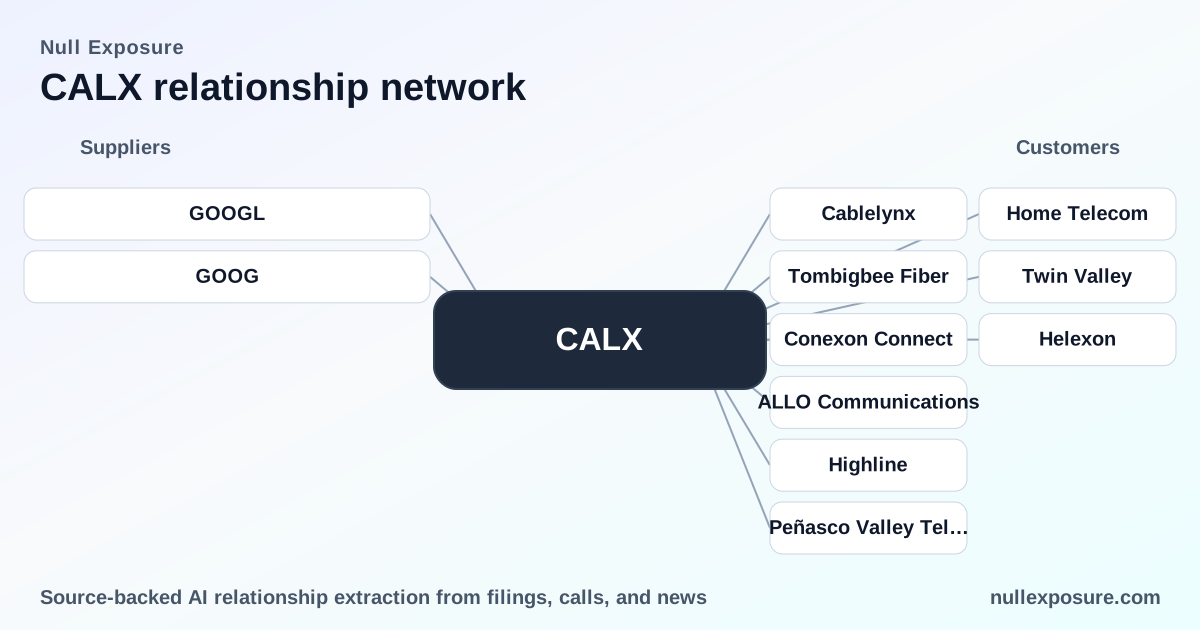
Calix (CALX): Customer Relationships Illuminate a Subscription-Driven, North‑American Growth Play
Calix sells a cloud-native software platform, subscriber premise systems and managed services to broadband service providers, monetizing through a mix of hardware sales, software licenses, cloud subscriptions, and multi‑year managed services contracts. Investor returns will track platform adoption (Calix One, SmartMDU, SmartHome, Calix Agent Workforce), the pace of service-provider upgrades, and the company’s ability to convert installed hardware customers into recurring software and support revenue.
Explore the complete Calix customer map and signals at https://nullexposure.com/ for further diligence.
Why customer relationships matter to the thesis
Calix is a vendor to broadband experience providers (BEPs) where scale, product stickiness and recurring software economics determine long-term margin expansion. The relationships documented across FY2026 press coverage show two investment levers: (1) growing ARPU and adoption for customers that deploy Calix One and Smart* services, and (2) large BEAD-funded rural buildouts and MDU rollouts that generate multi‑year hardware and services revenue. Customer wins translate directly into recurring ARR and professional services backlog, and the promotional cadence in early‑2026 demonstrates both breadth (large, mid, small, municipal) and depth (multi-product deployments).
For a deeper institutional view, visit https://nullexposure.com/.
Operating model signals and constraint-driven risks
Calix’s disclosures and the relationship evidence define an operating model with clear characteristics:
- Contracting posture: Revenue mixes include upfront hardware sales plus ratable recognition for cloud subscriptions, maintenance and managed services; the company uses multi‑year subscription agreements and committed usage tiers that underpin predictable ARR growth.
- Customer concentration vs. revenue dispersion: One customer represented a large share of accounts receivable (23% in 2024) even as no single customer exceeded 10% of revenue across 2022–2024; this creates receivables concentration risk without straightforward revenue concentration.
- Counterparty breadth and criticality: Calix serves large, mid‑market, small independent operators and municipalities, supporting 1,600 active service‑provider customers, which reduces single‑point risk while raising execution demands across varied operator sophistication.
- Geographic focus and international growth: Primary revenue comes from North America with smaller footprints in EMEA, APAC and Latin America, implying growth upside tied to U.S. broadband investments and a measured international expansion path.
- Product portfolio maturity: Hardware sales remain important for network buildouts while software/subscription economics ramp as customers migrate to Calix One and related SaaS offerings.
These constraints shape the risk/reward profile: predictable subscription cashflows offset capital intensity from hardware, but receivable concentration and broad go‑to‑market complexity are material operating considerations.
Customer roster: what each relationship signals for investors
Below are the relationships observed in FY2026 coverage with a concise plain‑English takeaway and the source for verification.
-
Cablelynx
Cablelynx (WEHCO Video’s broadband arm) deployed Calix SmartBiz for small businesses and SmartTown for community Wi‑Fi, reporting substantial ARPU gains in key markets after adoption. Source: Sahm Capital commentary and FinancialContent press release (Mar–May 2026). -
WEHCO Video, Inc., doing business as “Cablelynx Broadband”
The corporate identity for Cablelynx is cited directly in a Calix press release describing a 7X increase in small-business connections after implementing SmartBiz. Source: Calix press release on FinancialContent (May 2026). -
BBT (broadband provider)
BBT reported strong year‑over‑year ARPU growth tied to a rapid rollout of Calix‑powered small‑business services, providing concrete evidence of Calix platform monetization. Source: Sahm Capital research note (Apr 2026). -
ALLO Communications
ALLO is listed among early adopters of Calix One and the Calix Agent Workforce, indicating enterprise adoption of Calix’s AI‑native contact and operations tooling. Source: BizWire / FinancialContent (Feb 17, 2026). -
Tombigbee Fiber
Tombigbee Fiber is an early implementer of the Calix Agent Workforce on Calix One, reflecting uptake among regional fiber operators. Source: BizWire / FinancialContent (Feb 17, 2026). -
Conexon Connect
Conexon Connect announced steps to implement the Calix Agent Workforce, highlighting penetration into rural and cooperative operator segments. Source: BizWire / FinancialContent (Feb 17, 2026). -
Twin Valley
Twin Valley integrated HomeOffice IQ and SmartHome features built on Calix gear to support lifestyle-based broadband offers intended to lift ARPU and customer loyalty. Source: StockTitan and Aithority reporting (Mar 2026). -
Helexon
Helexon selected Calix One and Calix Agent Workforce for a BEAD‑funded, multi‑year rural fiber buildout across multiple Midwestern states — a high‑value, multi‑year systems and services engagement. Source: Calix press release and coverage on FinancialContent / StockTitan (Feb–May 2026). -
Highline
Highline reported ARPU improvements after implementing Calix’s engagement cloud, cited as achieving double‑digit ARPU uplift within six months. Source: Intellectia / Calix engagement cloud coverage (Mar 2026). -
Home Telecom
Home Telecom reported a 17% ARPU increase within six months of deploying the personalized engagement tools and SmartHome packages. Source: Intellectia / Calix engagement cloud coverage (Mar 2026). -
Peñasco Valley Telephone Cooperative
Peñasco Valley reported a 7% ARPU increase tied to implementation of Calix personalization and marketing capabilities. Source: Intellectia / Calix engagement cloud coverage (Mar 2026). -
CLFD (Clifton?)
CLFD’s 10‑Q referenced a historical 2018 asset purchase from Calix for Telcordia‑certified outdoor powered cabinet products, documenting prior equipment transfers and legacy product relationships. Source: Quarterly Report (10‑Q) filed on Advfn (publication indexed 2026). -
Aervivo
Aervivo is expanding use of Calix One and SmartMDU to accelerate managed Wi‑Fi deployments across multi‑dwelling units, indicating traction in the MDU vertical. Source: Calix press release and SimplyWall.St coverage (May 2026). -
Blue Stream Fiber
Blue Stream Fiber is deploying Calix One with SmartMDU to grow MDU market share, signaling enterprise and multi‑property wins that support recurring subscriptions. Source: Calix press release and Sahm Capital notes (Mar–May 2026). -
XMission
XMission expanded SmartMDU deployments using Calix One to serve multi‑dwelling properties, illustrating regional ISP adoption in diverse property classes. Source: Calix press release and Sahm Capital notes (Mar–May 2026). -
Zentro
Zentro, an MDU‑focused MSP, is accelerating deployments with SmartMDU on the Calix Broadband Platform — a channel/partner adoption case. Source: FinancialContent press release (May 2026). -
CDE Lightband
The municipally owned CDE Lightband reported rapid success with Calix SmartBiz and the Calix Broadband Platform, showing municipal operator adoption. Source: Calix press release on FinancialContent (May 2026). -
CoastConnect
CoastConnect is leveraging the Calix Broadband Platform and Calix Success services to improve operational efficiency and scale AI‑enabled operations. Source: Calix press release on FinancialContent (May 2026). -
ATNI (coverage referencing ACS SmartHome)
Reporting on ACS SmartHome indicates it is powered by Calix GigaSpire Wi‑Fi 7 systems, which points to upstream OEM/provider dependency on Calix hardware for differentiated in‑home experiences. Source: QuantiSnow / reporting on Alaska Communications (Mar 2026).
Investment implications and final view
The FY2026 relationship map shows broad adoption across operator sizes and use cases — MDUs, rural BEAD projects, municipal networks, and small‑business services — and a clear tilt toward converting hardware installs into recurring software and managed services. Key investment considerations:
- Upside: Recurring subscription lift as Calix One adoption reaches more customers; large BEAD wins like Helexon translate into hardware plus long‑term services revenue; MDU traction supports higher‑margin, scalable services.
- Risk: Receivables concentration and execution complexity across 1,600 diverse operators create working‑capital and operational execution risk; international coverage remains small versus North America.
For institutional diligence, review customer rollout cadence and subscription renewal metrics. Continue tracking ARPU outcomes from reported operator case studies as the clearest near‑term read on monetization velocity.
Stay updated on Calix customer momentum and model implications at https://nullexposure.com/.