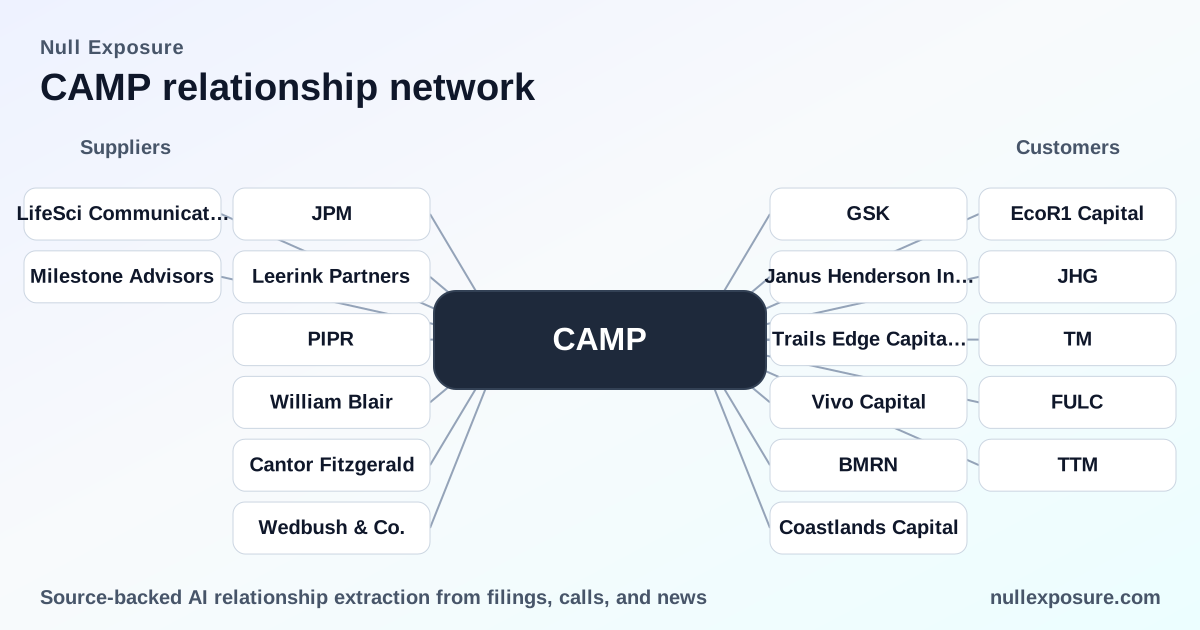
CAMP4 Therapeutics: Customer relationships that fund a discovery-first RNA platform
CAMP4 Therapeutics develops regulatory RNA-targeting therapeutics and monetizes through collaborative licenses and target discovery services: the company leverages its RAP Platform® to identify antisense oligonucleotide (ASO) candidates, then contracts with larger biopharma partners for development and commercialization in exchange for upfront payments, staged milestones and tiered royalties, while supplementing cash with equity financings supported by institutional investors.
For a compact due-diligence readout on every customer and counterparty signal in the available feed, review the relationship summaries below and the operating-model implications that follow. For platform-level investor intelligence and additional company coverage, visit https://nullexposure.com/.
How CAMP4’s customer economics are structured — the headline view
CAMP4’s revenue model is collaboration-first: the firm recognizes revenue primarily from licensing and research agreements where partners pay meaningful up-front fees and then assume later-stage development risk and commercial responsibility. This contracting posture produces a business profile with several distinct characteristics:
- Concentration around a few large strategic partners: validation and near-term revenue depend on a small set of pharma collaborators that buy discovery output and licenses.
- Cash profile driven by up-front payments: large upfront fees (for example, the $17.5M GSK payment) materially affect near-term liquidity and de-risk early-stage R&D spend.
- Commercial criticality is asymmetric: CAMP4 retains discovery/IP value while partners like GSK and BioMarin lead clinical development and commercialization.
- Early maturity of revenue streams: contracts are discovery-stage and license-focused rather than product revenue, resulting in lumpy, milestone-driven recognition and limited recurring sales today.
Key company-level signals from constraints: licensing is an explicit, documented revenue mechanism (evidence in 2023–2024 license agreements); the company recognizes counterparties as customers under ASC 606; and third‑party reimbursement and government payer dynamics are a standing commercial risk for eventual product launches.
Material customer and counterparties — concise summaries with sources
Below are every relationship reflected in the provided feed, each described in plain English with the original reporting cited.
GSK
GSK entered a strategic research, collaboration and license agreement with CAMP4 on Dec 18, 2025 to apply CAMP4’s RAP Platform® to discover ASO candidates for neurodegenerative and kidney diseases; CAMP4 received a $17.5 million upfront payment and is eligible for additional milestone payments and tiered royalties while GSK will lead development and commercialization. (GlobeNewswire press release Dec 18, 2025; CAMP4 FY2025/FY2026 corporate disclosures and press reporting in March–May 2026)
BioMarin Pharmaceutical (BMRN)
BioMarin has a strategic research collaboration giving it the right to select targets identified by CAMP4’s RAP Platform to advance into clinical development; the initial agreement included a $1.0 million upfront with program-level milestones and royalties. (GlobeNewswire corporate update Jan 7, 2025; FierceBiotech coverage FY2025)
Fulcrum Therapeutics (FULC)
CAMP4 granted Fulcrum an exclusive license in July 2023 with a $0.4 million upfront payment; later public notes in 2026 indicate Fulcrum discontinued the licensed program and terminated the CAMP4 license as it reprioritized its portfolio. (Company SEC/press disclosures and TradingView/Investing coverage, 2023–2026)
Janus Henderson Investors (JHG)
Janus Henderson participated as an institutional investor in CAMP4’s December 2025 underwritten common-stock offering, providing equity capital alongside other funds. (GlobeNewswire / company offering pricing release Dec 18, 2025)
EcoR1 Capital
EcoR1 Capital is listed among participating investors in CAMP4’s Dec 2025 equity offering, representing strategic institutional support for the company’s financing. (Company offering announcement Dec 18, 2025; public news coverage)
Coastlands Capital
Coastlands Capital joined the December 2025 underwritten offering as a participating investor, contributing to the $30.0M placement that bolstered the company’s balance sheet. (Company offering announcement Dec 18, 2025; investing.com/Finance Yahoo summaries)
Trails Edge Capital Partners
Trails Edge Capital Partners participated in the December 2025 share offering alongside other institutional investors, providing equity support for CAMP4’s runway extension. (Company offering announcement Dec 18, 2025; press reporting)
Vivo Capital
Vivo Capital is another institutional investor listed among the participants in the Dec 2025 underwritten offering, demonstrating continued venture/biotech investor interest. (Company offering announcement Dec 18, 2025; public summaries)
Coastlands / Investor group (collective observation)
The December 2025 underwritten offering (priced at $6.00 per share for $30.0M nominal proceeds) included a mix of new and existing institutional investors, indicating market willingness to provide growth capital while CAPEX for development remains concentrated in partner-funded programs. (GlobeNewswire / company press release Dec 18, 2025; multiple news outlets Dec 2025–May 2026)
Toyota (TM)
Company remarks on a 2024 Q3 earnings call documented a Toyota Genuine certification that enables CAMP4’s solutions to be installed at Toyota ports, presenting an avenue for geographic and channel expansion in vehicle-related offerings referenced in that call. (CAMP4 Q3 2024 earnings call transcript)
Jaguar Land Rover
The same earnings call noted Jaguar Land Rover endorsement of CAMP4’s Stolen Vehicle Recovery system as a recommended solution in the UK, reflecting OEM-level validation for that segment of the company’s product set in earlier corporate history. (CAMP4 Q3 2024 earnings call transcript)
Cryoport (CYRX)
A 2019 PR Newswire release described a research collaboration between CalAmp and Cryoport to combine shipping and sensor technologies for supply-chain visibility; the item appears in the feed and is logged as a historical counterpart reference. (PR Newswire release, 2019)
What these relationships mean for investors and operators
- Revenue is partnership-driven and lumpy. The GSK and BioMarin deals are classic discovery-to-license arrangements: upfront cash now, milestones later, and royalties on commercial products. Expect volatility in quarterly recognition and heavy sensitivity to new partner signings.
- Concentration risk is material. A small number of strategic partners drive most near-term collaboration revenue and validation; loss or non-renewal of any major collaborator would materially alter near-term cash flow prospects.
- Financing complements partner economics. The December 2025 $30M underwritten offering—supported by the institutional investor group—signals market appetite but also dependence on equity to fund operations while partners advance programs.
- Operational priorities tilt to IP generation and out-licensing. CAMP4’s operating model is discovery-focused: it retains platform/IP value and transfers development burden to partners under license agreements, which improves R&D leverage but limits direct control over clinical development timelines.
Constraints recap — how contract types and counterparty signals shape downside and optionality
- Licensing is an explicit, high-confidence contract type in CAMP4’s model; BioMarin and Fulcrum agreements illustrate exclusive license grants with recognized up-front revenue under ASC 606.
- Company-level signals indicate government and third-party payor exposure as a commercial constraint for any eventual product launches.
- The feed records counterparties treated as licensees/customers and shows some active collaborations with deferred revenue recognized in recent financial statements.
For a focused institutional briefing, historical deal terms, and ongoing monitoring of partner milestones and investor participation, see the CAMP4 coverage hub at https://nullexposure.com/.
Conclusion: CAMP4’s value proposition is platform-driven discovery monetized through licensing and collaboration economics backed by sporadic institutional equity financings; investors should weight the upside from big‑pharma validation against concentration and milestone execution risk.