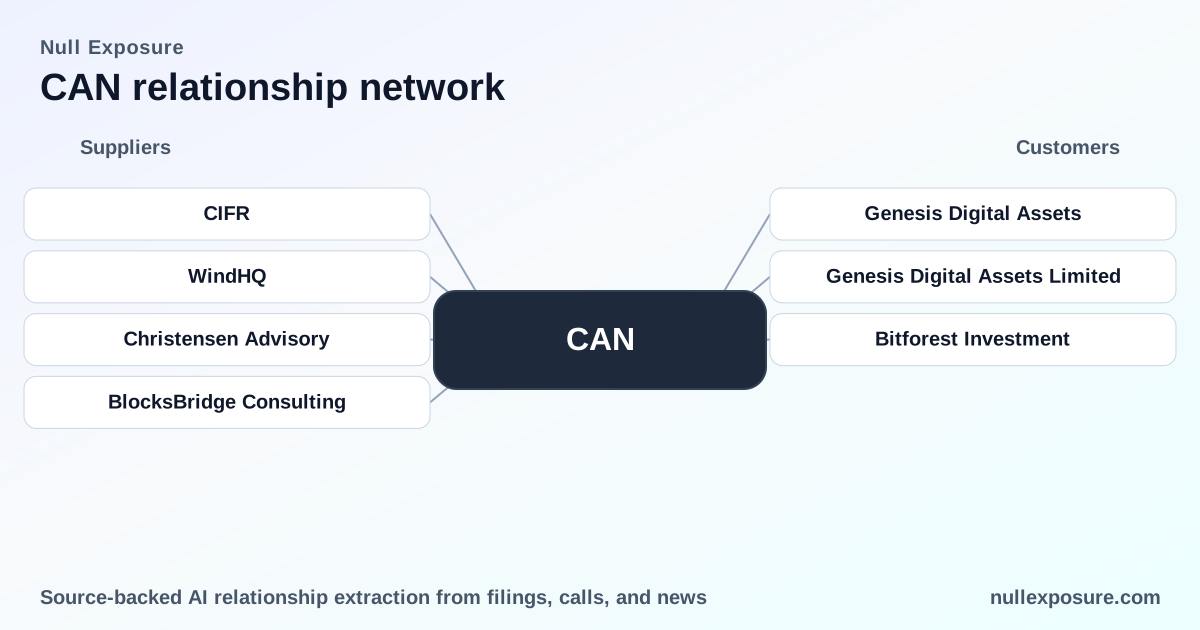
Canaan Inc (CAN): Customer Map and Commercial Implications
Canaan Inc designs and sells bitcoin-mining integrated circuits and system-level mining rigs, monetizing principally through hardware sales and project deployments to large-scale miners and infrastructure operators. Its commercial model rests on repeat purchase orders, strategic long-term partnerships, and occasional asset-level transactions that convert miner deployments into alternate compute use (AI/HPC) — a mix that produces episodic revenue spikes and concentrated counterparty exposure. For a concise view of Canaan’s customer relationships and why they matter to investors, visit https://nullexposure.com/.
Quick investment takeaways
- Revenue is driven by large, lumpy orders from mining operators and infrastructure projects rather than steady subscription streams.
- Customer concentration is material: a handful of large miners and project operators account for meaningful order value.
- Commercial posture is transactional but strategic: Canaan executes spot orders and structured, long-term purchase agreements that include follow-ons and hardware customizations.
- Commercial maturity is mixed: customers span established industry miners and experimental projects converting mining assets into AI/HPC deployments.
How Canaan wins business (company-level operating signals)
Canaan sells ASICs and complete rigs to customers that procure equipment by purchase order or site-level project agreement. The company’s public reporting and news coverage show repeated follow-on orders and strategic purchase orders, which signal contracting that blends spot sales and multi-period agreements with technical customization for large partners. The dataset contains no explicit contract text or constraint disclosures, a company-level signal: Canaan does not publish comprehensive, structured contract constraints in the sources cited, which increases investor reliance on deal announcements and customer update disclosures for visibility into revenue durability.
Customer relationships and what they mean for CAN
Genesis Digital Assets / Genesis Digital Assets Limited
Canaan secured a strategic, long-term partnership and a purchase order from Genesis valued at up to US$93.63 million for next-generation AvalonMiner A1246 rigs, representing a sizable, single-counterparty order that will materially influence near-term hardware revenue. (Bitcoin Magazine, Mar 9, 2026; TradingView release, Mar 9, 2026 — https://bitcoinmagazine.com/business/genesis-buys-93-million-of-canaan-asics, https://www.tradingview.com/symbols/TRADEGATE-35J/ideas/page-4/)
CIFR (Cipher-related disclosures)
Multiple sources indicate complex interactions with Cipher/CIFR: Canaan acquired interests in sites through an all-stock transaction and has purchased rigs that were originally deployed at Cipher’s Black Pearl site; 6,840 Avalon A15Pro-AVG-221T units are explicitly referenced as part of these transactions. This dual role — buyer of site interests and counterparty to rig transfers — illustrates transactional flexibility and balance-sheet-level deal-making beyond simple hardware sales. (CIFR earnings call excerpt, 2025 Q4; Bitcoin Magazine, Mar 2026 — cfr earnings call doc, https://bitcoinmagazine.com/news/canaan-acquires-ciphers-stake)
Cipher Mining
Canaan purchased an additional 6,840 mining rigs that Cipher had previously acquired and deployed at its West Texas Black Pearl site, demonstrating Canaan’s role in secondary market movements of deployed capacity and its willingness to re-acquire deployed hardware. This creates optionality for redeployment or repurposing of assets. (The Block, May 2026 — https://www.theblock.co/post/390926/canaan-cipher-mining-west-texas-bitcoin-mining)
Tether
Tether placed a follow-on order with Canaan for customized bitcoin-mining hardware and is working with Canaan (and ACME Swisstech) on modular, board-level mining system designs rather than pre-built rigs, signaling demand for system-level customization and higher technical collaboration. These developments show Canaan’s ability to sell differentiated, higher-margin solutions beyond commodity rigs. (The Energy Magazine, May 2, 2026; Yahoo Finance coverage, May 2, 2026 — https://www.theenergymag.com/news/market-news/canaan-tether-customize-bitcoin-chip, https://finance.yahoo.com/news/tether-develops-modular-bitcoin-mining-155800346.html)
Soluna Holdings (SLNHP / SLNH)
Soluna’s project disclosures reference a 20 MW Canaan deployment at Project Dorothy 1A and related construction expectations, positioning Canaan as the hardware supplier for utility-scale mining projects. These project-level commitments reflect larger, multi-megawatt deployments that drive meaningful revenue when executed. (Bastille Post project updates, Mar 2026; TimothySykes news, Oct 2025 — https://www.bastillepost.com/global/article/5608742-soluna-announces-monthly-business-update-6, https://www.timothysykes.com/news/soluna-holdings-inc.slnh-news-2025_10_16/)
Bitforest Investment
Canaan announced a 3.0 MW proof-of-concept (PoC) project with Bitforest Investment in Manitoba, Canada, representing business development into geographically diversified PoCs that can seed larger deployments if successful. This is an example of Canaan using small-scale projects to validate site performance and hardware interoperability. (InsiderMonkey coverage, Jan 6, 2026 — https://www.insidermonkey.com/blog/canaan-can-growth-momentum-strengthens-following-3-0-mw-proof-of-concept-project-announcement-1673120/?amp=1)
CIFR (10-K mention of historical purchaser relationships)
A CIFR filing confirms they have purchased miners from Bitmain, SuperAcme, and Canaan, underscoring that Canaan competes alongside other ASIC suppliers in customer procurement decisions and that buyers mix multiple OEM sources. This is evidence of customer procurement diversity at the buyer level, which pressures pricing and necessitates differentiation. (CIFR 10-K, FY2024 — cifr-2024-12-31 filing)
Implications for revenue, margins and risk
- Revenue volatility: Large, lumpy orders (Genesis $93.63M PO; multi-megawatt deployments) create quarter-to-quarter volatility.
- Margin opportunity from customization: Tether’s bespoke hardware and system-level modularity work indicate potential for higher-margin, differentiated products.
- Concentration risk: A small number of large counterparties can swing results materially; investors should monitor the timing and fulfillment cadence of these orders.
- Balance-sheet activity: Asset-level transactions (re-acquisition of deployed rigs, site interest purchases) show Canaan is willing to use different instruments beyond straightforward sales to manage inventory and market positioning.
- Competitive dynamics: Buyers’ multi-supplier procurement (e.g., CIFR’s purchases from Bitmain and SuperAcme) stresses the need for Canaan to compete on efficiency, delivery, and product customization.
For more on how these customer dynamics map to credit and commercial exposure, see our platform at https://nullexposure.com/.
Bottom line for investors
Canaan’s revenue profile is driven by large miners and infrastructure customers, with clear signs of strategic partnership deals and product customization that support margin expansion. The trade-off is concentration and execution risk tied to the cadence of large orders and the company’s limited public disclosure of contract terms. Active monitoring of order fulfillment and counterparty financial health is essential for a conviction on CAN.
Key risks to monitor: delivery schedules against announced purchase orders, the pace of repurposing rigs into AI/HPC workloads, and competitive price pressure from other ASIC suppliers.