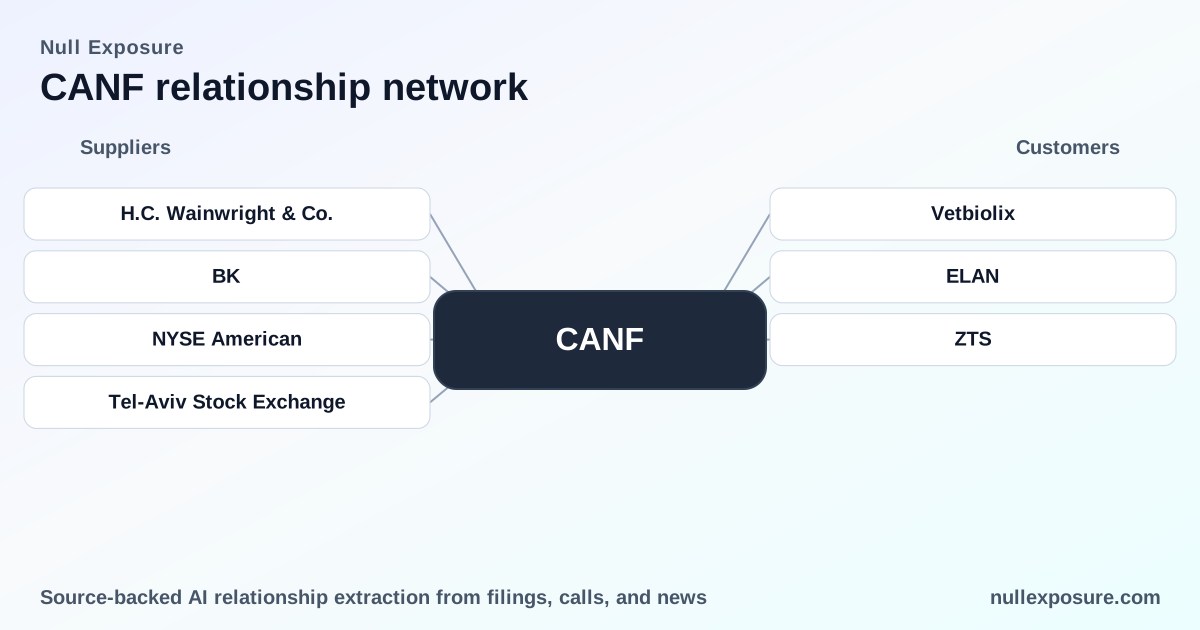
Can-Fite (CANF) — Partner Map and What It Means for Revenue and Risk
Can-Fite Biopharma is a clinical-stage Israeli biotech that monetizes primarily through licensing, distribution agreements and milestone/royalty structures for its small-molecule therapeutics (notably Piclidenoson and Namodenoson). The company drives near-term cash flow through advance payments and distribution deals with regional pharmaceutical companies while pursuing value creation via out‑licensing (including a recent veterinary push), making partner performance and revenue recognition the central levers for the equity case. For a concise view of Can‑Fite’s partner footprint and how it shapes financial outcomes, read on.
For more structured partner intelligence, visit https://nullexposure.com/.
How Can‑Fite contracts and where risk concentrates
Can‑Fite’s business model is partner-centric: the company outsources commercialization and much development risk to licensees and distributors, and it recognizes revenue largely through advance payments and subsequent recognition under those contracts. That structure produces lumpy, counterparty‑dependent revenue, which aligns with the recent financial commentary showing a drop in recognized revenue when advance-payment recognition shifted. Company-level financials reinforce the partner-driven model: Revenue TTM is only $405k, market capitalization is roughly $7.1M, and operating margins are deeply negative, indicating that licensing and distribution receipts are materially more important to cash flow than product sales today.
Operational constraints and maturity signals for investors:
- Contracting posture: Predominantly licensing and distribution agreements with upfront/advance payments and contingent royalties, which shifts commercialization execution to partners while concentrating revenue recognition decisions at the company level.
- Counterparty concentration: A small number of distributor/license partners drive the majority of partner-sourced revenues and advance payments, creating single‑counterparty sensitivity in realized revenue.
- Criticality of partners: Partners that control distribution in key regions (Ewopharma, Gebro, Chong Kun Dung, Cipher) are critical to short‑term revenue flows; veterinary licensees like Vetbiolix can materially change long‑term royalty profiles.
- Maturity: Clinical‑stage development and limited current revenue indicate the company remains pre-commercial for its core indications; licensing and veterinary pivoting are strategic de‑risking moves rather than evidence of commercial maturity.
Partner-by-partner read: each relationship that matters
Vetbiolix — veterinary licensing for Piclidenoson / Namodenoson
Can‑Fite signed a veterinary partnership that converts Piclidenoson and Namodenoson into potential veterinary products, with the arrangement described as worth up to $325 million in royalty revenues for Can‑Fite and Vetbiolix responsible for development and regulatory activities after exercising an option. The company reported Vetbiolix completed enrollment in a Phase‑2 osteoarthritis study in dogs and had exercised its option to enter a full licensing agreement. Sources: GlobeNewswire press releases (Nov 24, 2025; Mar 30, 2026) and related StockTitan coverage (Mar 9, 2026).
Cipher Pharmaceuticals (CPHRF) — distribution agreement / advance payments
Can‑Fite disclosed that a portion of revenues is tied to advance payments under distribution agreements, explicitly naming Cipher Pharmaceuticals among partners for which a lower portion of advance payments was recognized, driving part of the year‑over‑year revenue decrease. This positions Cipher as a revenue timing counterparty rather than a purchaser of product in market today. Source: Can‑Fite FY2025/FY2026 financial release via GlobeNewswire (Mar 26, 2026).
Ewopharma — long‑standing distribution agreement (entered 2021)
Ewopharma’s distribution agreement, entered in 2021, is another contract where Can‑Fite recognized advance payments; the company reported a lower portion of those advance payments being recognized in the referenced reporting period, contributing to the revenue decline. This is a clear example of how advance-payment accounting drives reported sales volatility. Source: GlobeNewswire company release (Mar 26, 2026).
Chong Kun Dung Pharmaceuticals — regional distributor partner
Chong Kun Dung Pharmaceuticals is cited among distribution partners whose advance payments’ recognition decreased, again underscoring the timing sensitivity of revenue from distribution contracts. The relationship functions as a distribution channel that affects Can‑Fite’s reported revenue profile rather than a traditional royalty stream. Source: GlobeNewswire financial commentary (Mar 26, 2026).
Gebro — distribution agreement, revenue timing impact
Gebro is another distribution counterparty named in the company’s revenue discussion; like the others, Gebro’s contract terms have resulted in variable advance-payment recognition and contributed to the year’s lower revenue. Collectively these distributor agreements drive short-term cash recognition and therefore stock reaction around financial updates. Source: GlobeNewswire press release (Mar 26, 2026).
Elanco Animal Health (ELAN) — business development meetings at BioFIT
Can‑Fite reported holding partnering meetings with major animal‑health multinationals, including Elanco, at BioFIT to explore moving Namodenoson into veterinary development, indicating active business development outreach to scale the veterinary program beyond Vetbiolix. Source: GlobeNewswire announcement on Can‑Fite’s BioFIT activities (Nov 24, 2025).
Zoetis (ZTS) — exploratory partnering discussions
Zoetis was listed among major multinational animal-health companies Can‑Fite engaged at BioFIT as it sought veterinary development partners for Namodenoson, signaling a strategic push to test interest from top-tier animal-health commercial platforms. Source: GlobeNewswire conference release (Nov 24, 2025).
What the partner map means for investors — actionable takeaways
- Revenue volatility is structural. Advance payments under distributor and licensing agreements produce lumpy recognition; the March 26, 2026 financial release makes this an explicit driver of the recent revenue decline.
- Veterinary licensing is the most visible de‑risking pathway. The Vetbiolix deal converts clinical assets into a royalty runway and shifts development burden to the licensee; successful vet trial readouts will materially re‑rate the commercial optionality.
- Concentration and counterparty execution matter more than product demand today. With small reported revenue and negative operating margins, the company’s near‑term valuation is sensitive to partnership calendars, advance-payment schedules, and milestone realizations.
- Balance sheet and cash monitoring are essential. Given limited revenue scale and sizeable operating losses, investors should prioritize updates on cash, warrant exercises, and partner receipts that affect runway.
Visit https://nullexposure.com/ for more in-depth partner exposure analytics and to track upcoming commercial milestones.
Monitoring checklist for the next 12 months
- Vetbiolix Phase‑2 osteoarthritis dog data (expected Q3 2026) — primary binary for the veterinary royalty path.
- Next quarterly report for detail on advance‑payment recognition from Ewopharma, Gebro, Chong Kun Dung and Cipher.
- Any announced commercial licensing to larger animal‑health players (Elanco/Zoetis) that would change distribution scale assumptions.
- Cash runway updates and the impact of recent warrant exercises on liquidity.
In sum, Can‑Fite’s near‑term investment case is built on partner performance and accounting timing: license/milestone receipts and the success of its veterinary pivot are the principal drivers of upside, while concentrated distributor relationships and persistent operating losses are the primary risks to monitor.