CrossAmerica Partners (CAPL): Customer Relationships That Drive a Wholesale Fuel Merchant
CrossAmerica Partners LP operates a geographically diversified wholesale distribution and retail convenience convenience-store business that monetizes through fuel distribution agreements, rent and lease income on retail sites, and margin capture on fuel and convenience merchandise sales. Revenue flows come from long-dated distribution contracts, dealer and commission-agent relationships, and company-operated retail sites—a model that produces steady cash flow but exposes the partnership to lease-termination dynamics and customer concentration on a contract-by-contract basis. For a concise vendor-risk and revenue-sourcing view, investors should focus on customer concentration, contract tenor, and the economic fallout from lease terminations. Learn more at https://nullexposure.com/.
Why customer relationships matter for this business model
CrossAmerica’s economics are driven by recurring, contract-based fuel distribution and retail rental income rather than one-off transactions. Distribution contracts are typically long-term (seven to 15 years), which creates durable revenue streams but increases the economic importance of counterparties on those contracts. The company reports operations across multiple U.S. states, which reduces single-market regulatory exposure while preserving exposure to national fuel demand cycles and merchant margins.
Key operating-model signals:
- Contracting posture — long-term: Distribution agreements are typically seven to 15 years in length, which locks in volumes and prices under negotiated terms and raises the economic stakes of counterparty defaults or terminations.
- Geographic diversity — national U.S. footprint: Operations span more than 30 states for wholesale and retail, providing geographic risk diversification across fuel demand patterns and state-level regulatory regimes.
- Role and criticality — distributor and seller: CrossAmerica functions both as a wholesale distributor to dealers and as a retail operator/seller at company and commission-agent run sites, creating multiple, interlocking revenue streams.
- Commercial maturity — established cash flows with concentrated pockets: The wholesale business produces substantial recurring sales, but individual large customers can generate significant revenue bands, so monitoring major counterparties is essential.
- Spend-size signal — mid-to-high revenue relationships: The firm records customer-level revenues in the tens of millions, a spend band that implies commercially important bilateral arrangements even if not company-defining.
If you want a deeper, relationship-by-relationship risk map and source summaries, see the rundown below — and for a working dashboard of counterparties and clauses, visit https://nullexposure.com/.
Relationship-by-relationship: the customers you need to watch
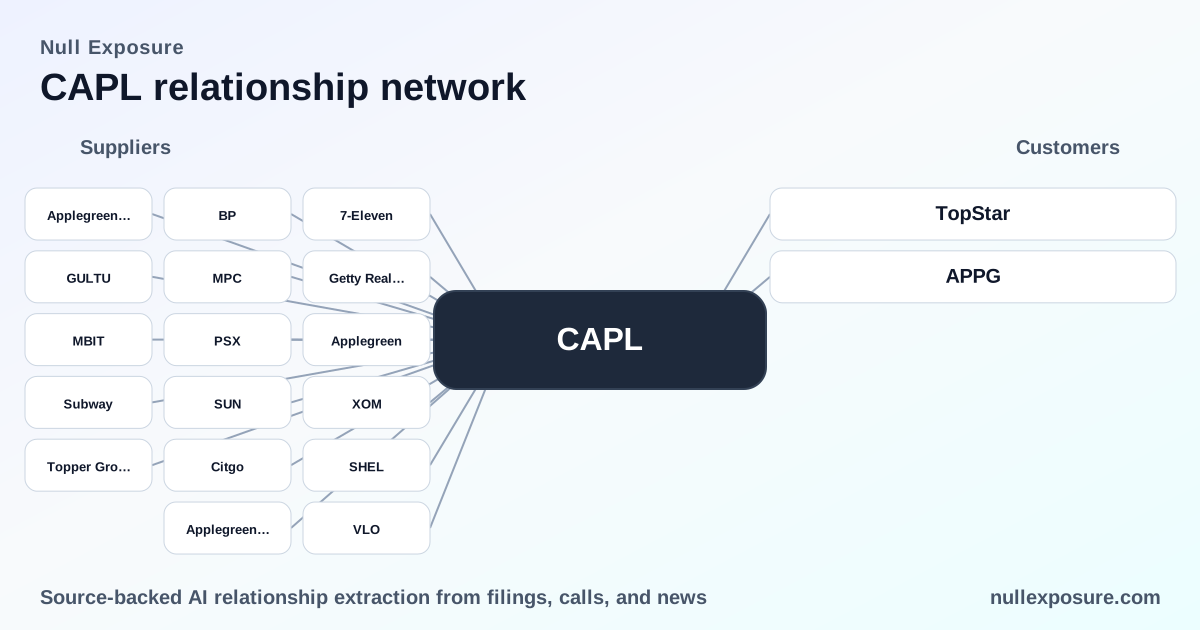
TopStar
TopStar generated $43.1 million of revenue for CrossAmerica in FY2024, down from $50.7 million in 2023 and $74.2 million in 2022; accounts receivable were $0.6 million at December 31, 2024. This places TopStar in the mid-range of CrossAmerica customer revenue bands and makes it a visible but not dominant counterparty. Source: CrossAmerica Form 10‑K (FY2024).
APPG
CrossAmerica recorded a $16.0 million loss on lease terminations with Applegreen (APPG) during the nine months ended September 30, 2024, which included a $1.5 million non‑cash write‑off of deferred rent income; the charge reflects meaningful economic impact from contract unwinds. Source: CrossAmerica third-quarter results press release, GlobeNewswire (Nov 5, 2025).
Applegreen
Applegreen is the named operator associated with that lease‑termination charge; the company’s exit or lease renegotiation generated a material one-time loss that impacts near-term earnings and highlights residual lease termination risk in CrossAmerica’s portfolio. Source: CrossAmerica third-quarter results press release, GlobeNewswire (Nov 5, 2025).
Circle K
Circle K is listed among the end-customers and channel partners supplied by CrossAmerica’s wholesale segment, which explicitly distributes motor fuel to lessee dealers, independent dealers, commission agents, DMS, Circle K, and through company-operated retail sites. This confirms Circle K as a component of CrossAmerica’s wholesale revenue mix rather than a standalone supplier relationship. Source: market profile referencing CrossAmerica wholesale segment (MEXC stock profile, May 2026).
What these relationships imply for investors
- Revenue predictability is strong when contracts remain in force. Long-term distribution agreements create stable cash flows and support a partnership-style payout profile.
- Lease and termination risk are real earnings drivers. The Applegreen lease-termination charge demonstrates that counterparties exiting leases can produce sizable, nonrecurring P&L impacts that reduce distributable cash in the short term.
- Customer concentration is moderate but worthy of monitoring. Individual customers can produce tens of millions in annual revenues; continued visibility on top counterparties is necessary to model downside scenarios.
- Geographic diversification is a strategic hedge. Operating across 30+ states mitigates single-state shocks but does not eliminate exposure to fuel price cycles and national demand shifts.
Practical takeaways for portfolio and operations teams
- Monitor top-customer revenue trends and accounts receivable balances quarterly; declines in a mid-size customer like TopStar will show in AR and revenue reconciliation.
- Stress-test distributable cash against realistic lease-termination events similar in scale to the Applegreen charge; a single large lease flip can materially reduce free cash flow in a reporting period.
- Maintain a watchlist of long-term contract expirations and renegotiation windows given the 7–15 year tenor profile; contract rollover economics are a primary driver of medium-term revenue growth or contraction.
Bottom line
CrossAmerica’s customer base underpins a stable, contract-driven wholesale and retail fuel model that delivers predictable revenue streams but carries concentrated counterparty and lease termination risks at the relationship level. Investors should weigh the resilience of long-dated contracts and geographic diversification against the demonstrated earnings volatility produced by major lease terminations. For ongoing monitoring and granular counterparty disclosures, consider CrossAmerica’s filings and our platform for relationship-level intelligence: https://nullexposure.com/.