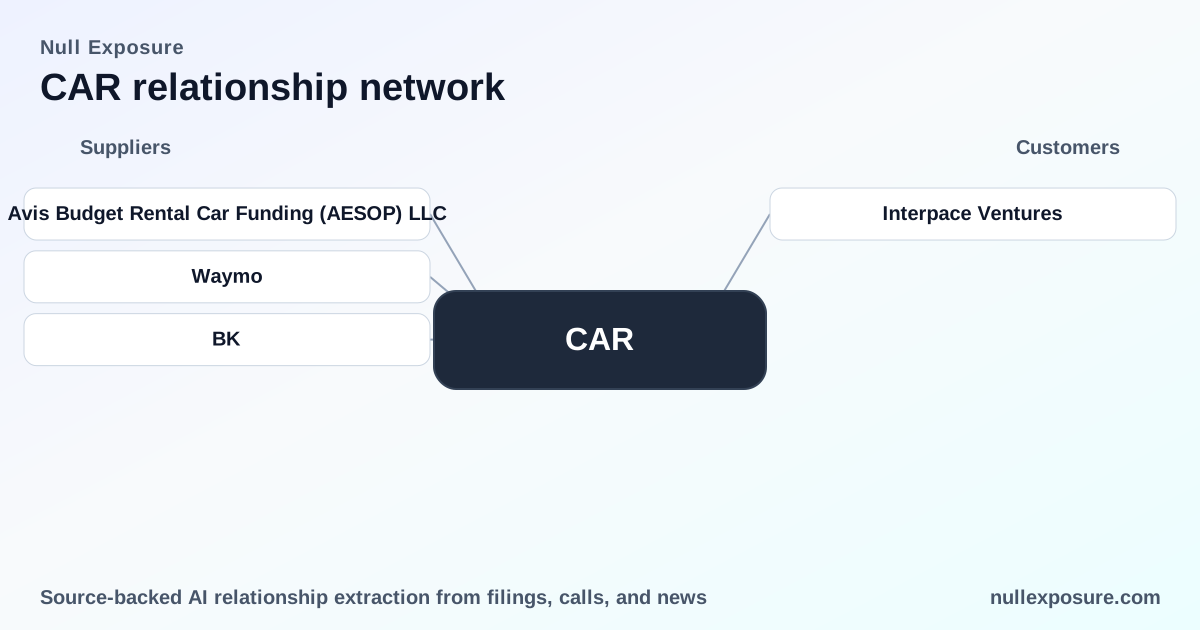
Avis Budget Group (CAR) — Customer Relationships: Waymo, Interpace Ventures, and What Investors Need to Know
Thesis: Avis Budget Group monetizes a global mobility platform through short-duration vehicle rentals, brand licensing and fleet services; it converts high-frequency transactional demand (average rental ~five days) into scale advantages for fleet management and ancillary revenue, while pursuing strategic partnerships—most notably with Waymo—that extend its service-provider economics into autonomous mobility. For a focused read on customer-driven revenue drivers and partner exposure, visit https://nullexposure.com/.
How Avis actually makes money from customers
Avis Budget is a transactional rental business supplemented by recurring licensing and fleet-management fees. The company derives primary revenue by renting vehicles to consumers and small businesses, with rentals recognized evenly over short rental periods (about five days). Licensing agreements give third parties the exclusive rights to operate Avis, Budget and Zipcar brands in assigned territories, creating a steady low-capex revenue stream alongside high-turnover, asset-heavy operations. The firm also provides fleet and administrative services to partners and licensees, positioning itself both as a seller of mobility and a service provider for large-scale operators.
Customer relationships that matter (by name)
Waymo — enabling autonomous ride-hailing in Dallas
Avis Budget has a multi-year partnership with Waymo to support an autonomous ride-hailing launch in Dallas, where Avis provides fleet management and supporting mobility services for Waymo’s autonomous vehicles. This arrangement positions Avis to monetize operational expertise and fleet scale rather than driver-based margins. Sources include SimplyWallSt’s coverage (May 2, 2026) and TradingKey reporting (April–May 2026) documenting the planned 2026 launch and strategic rationale.
Interpace Ventures — asset rotation and an EV-related impairment
Avis disclosed an impairment tied to the acceleration of EV rotation in connection with the Interpace Ventures transaction, recording approximately $518 million of impairment in its Americas segment related to certain U.S. EV rental vehicles. The impairment reflects an active reallocation of fleet assets and the cost of accelerating electrification within rental inventory. This detail is reported in Avis Budget’s fourth-quarter and full-year results press release (GlobeNewswire, February 18, 2026).
What the relationship set tells investors about operating constraints
Avis’s relationship portfolio and the company disclosures produce several company-level operational signals that drive revenue durability and risk:
- Contracting posture: short-term, high-frequency — Rental revenue is recognized over brief rental periods (average ~five days). This creates high gross transaction volumes and sensitivity to utilization and pricing, and makes revenue strongly cyclical by travel patterns and macro conditions.
- Licensing as a stabilizer — License agreements grant exclusivity to operators in certain territories and contribute recurring fee income with lower capital intensity than fleet ownership, diversifying cash flow away from pure rental economics.
- Counterparty mix: individuals and small businesses — Core customers are consumers and small-business renters, supported by loyalty and corporate small-business programs; this yields a broad revenue base but also exposes the company to leisure and SME demand cycles.
- Geographic breadth: truly global — Avis and its licensees operate in about 180 countries, with substantial revenue concentration in the Americas but material operations in EMEA, APAC and LATAM. Geographic diversification reduces single-market concentration while adding operational complexity and FX exposure.
- Role complexity: licensor, seller, and service provider — Avis simultaneously sells short-term mobility, licenses its brands, and provides fleet and administrative services to partners; this hybrid model creates multiple monetization levers but requires different operational capabilities and risk profiles.
- Relationship stage and segment maturity: active and service-led — Disclosures emphasize ongoing active relationships and continued provision of fleet and administrative services, signaling an operationally mature services segment that supports partner launches such as Waymo’s autonomous deployment.
Investment implications — upside, risks, and what to watch
- Upside: monetizing fleet expertise beyond rentals. Partnerships like Waymo convert capital-intensive fleet know-how into fee-based service revenue, improving margins if scaled. Avis can extract value from vehicle lifecycle management, charging, maintenance and logistics rather than direct consumer pricing alone.
- Headwind: capital intensity and EV transition. The $518 million impairment related to Interpace Ventures demonstrates the near-term P&L impact of accelerating EV rotations and the cost of refitting fleets to new use cases. Investors must price in inventory rebalancing charges and potential resale variability.
- Revenue volatility from short-duration rentals. The average rental tenor drives sensitivity to utilization and seasonal travel patterns; pricing power in peak travel can deliver strong operating leverage, while downturns compress utilization quickly.
- Diversification through licensing. Licensing reduces fleet capex exposure and provides recurring, territory-based revenue—important for smoothing volatility from core rental operations.
- Balance-sheet and valuation context. Avis reports meaningful EBITDA and multi-billion revenue scale (Revenue TTM ~$11.75B, EBITDA ~$1.525B) while showing negative EPS and elevated leverage dynamics; investors must reconcile operational scale with episodic impairments and profitability volatility.
Checklist for monitoring the customer franchise
- Track utilization and average rental duration month-over-month to gauge revenue momentum.
- Monitor further disclosures on Waymo commercialization metrics (vehicle count, run-rate fee revenue).
- Watch for additional EV-related impairments or resale losses tied to fleet rotations.
- Assess growth in licensing and service agreements that generate lower-capex recurring revenue.
- Follow geographic revenue mix for shifts toward international recovery or concentration.
For a practical way to monitor partner-driven revenue catalysts and impairment risk across Avis’s customer base, consider a focused research brief at https://nullexposure.com/.
Bottom line
Avis Budget’s customer relationships reveal a hybrid mobility business: high-frequency, short-term rentals underpin scale economics while licensing and service contracts—exemplified by Waymo—offer higher-margin, recurring avenues. The Interpace-related impairment underscores that electrification and fleet reallocation are real cost events that temper near-term profitability, even as strategic partnerships create long-term optionality. Investors should weigh the company’s operational scale and service capabilities against capital intensity and execution risk when assessing CAR as a mobility platform exposure.