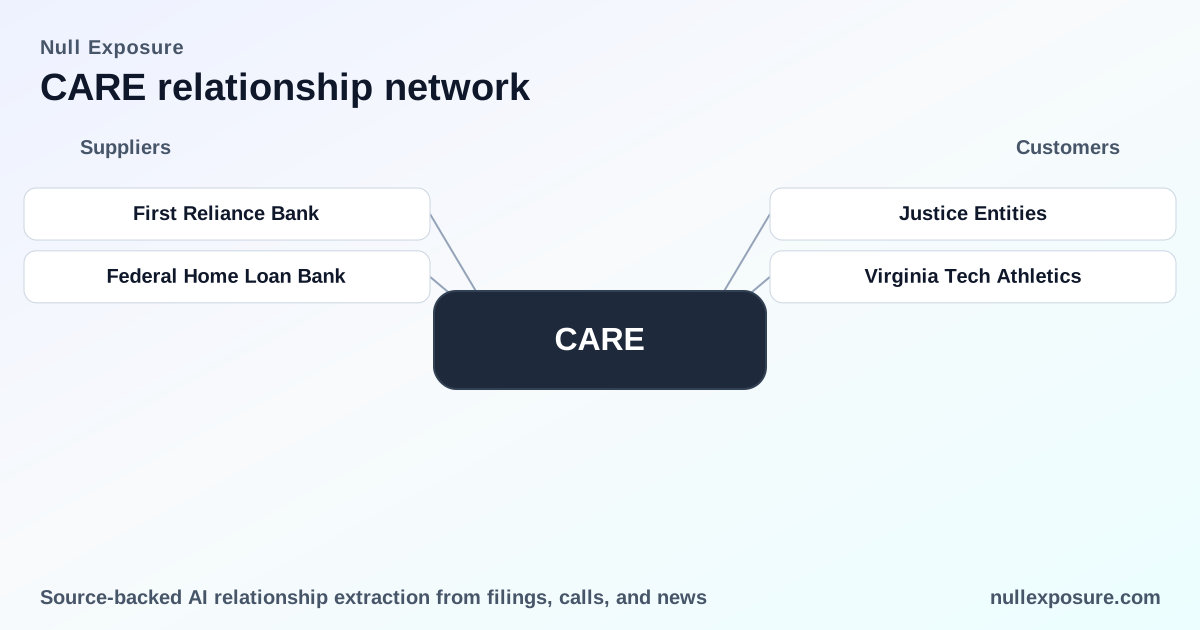
CARE: What customer relationships reveal about Carter Bank & Trust’s operating leverage
Carter Bank & Trust (CARE) operates as a regional community bank, monetizing through net interest margin on loans and deposit spreads, fee income from retail and commercial services, and occasional noninterest gains; the bank’s customer relationships show a business model built on granular retail deposits and a small number of large commercial credit exposures that drive both earnings upside and idiosyncratic risk. For investors, the interplay between short-term funding dynamics (mortgage commitments and CDs) and concentrated credit outliers is the principal lens for valuation and risk assessment.
Learn more about our coverage at https://nullexposure.com/.
Why customer detail matters: revenue drivers and concentration risk
Carter Bank & Trust’s revenue profile is straightforward: interest income from loans and investment securities plus deposit-funded margins on a largely retail deposit base. The bank operates 65 branches across Virginia and North Carolina, delivering community banking services that reinforce deposit granularity. At the same time, public filings highlight a material single-credit concentration in nonperforming loans that directly affects asset quality metrics and capital planning.
This duality—broad retail deposit depth versus concentrated commercial credit exposure—is the core operating characteristic investors should price. The bank’s profitability ratios (profit margin ~41.8%, ROE ~23.9% on the latest TTM figures) reflect effective margin management, but asset-quality episodes tied to a few large loans can rapidly change capital adequacy and earnings outlook.
Operating constraints that define the business model
Carter’s customer and contract profile imposes structural constraints that shape execution and strategy:
- Contracting posture: mixed tenor. The bank runs both short-term commitment lines (rate-locks on mortgage loans and investor-funded mortgages with typical windows of 15–90 days) and longer-duration deposit products such as CDs. This mix creates a liquidity management requirement that is active and transaction-driven, as mortgage flow funding and deposit migrations can shift funding costs over quarters.
- Counterparty composition: retail-dominant. Roughly 78.5% of deposits are retail, signaling a granular funding base that supports stability but also ties revenue to local economic conditions across Virginia and North Carolina.
- Geographic concentration: regional footprint. Operations are concentrated in Virginia and North Carolina (65 branches), which is strategically coherent but exposes the bank to regional economic cycles and property markets.
- Concentration and materiality: single large credit relationship. The bank reports a largest credit relationship representing 96.9% of nonperforming loans and about 7.0% of total portfolio loans at year-end 2024, which is a significant idiosyncratic risk for asset quality and provisioning.
- Service posture: full-range community bank. The company presents itself as a service provider across retail and commercial segments, including mortgage, deposit, and insurance products, which supports cross-sell but also broadens operational execution requirements.
- Spend and exposure band: large-ticket lending. Commitments to extend credit totaled $833.6 million at 12/31/2024, and the largest individual credit exceeded $100 million, indicating meaningful concentrated exposure in the loan book.
These constraints are company-level signals that define capital allocation, provisioning cadence, and liquidity contingency planning.
What the filings say about the Justice Entities relationship
In Carter’s 2024 Form 10‑K, the company discloses that curtailment payments totaling $49.9 million from the Justice Entities reduced the bank’s aggregate nonperforming loan balance from $301.9 million at year-end 2023 to $252.0 million at year-end 2024, reflecting active remediation of a large impaired exposure. According to the 2024 Form 10‑K filing, that relationship comprised the single largest credit with significant share of nonperforming assets (FY2024). Source: Carter Bankshares 2024 Form 10‑K (filed for year ended December 31, 2024).
What the public record shows about Virginia Tech Athletics
Carter Bank & Trust entered a multi-year partnership to become the “Preferred Community Bank of Virginia Tech Athletics”, a marketing and community-engagement relationship announced in August 2021 that supports brand presence and local deposit gathering among the university community. The partnership was reported via a press release distributed on Accesswire and carried by IBTimes on August 30, 2021. Source: Accesswire/IBTimes press release (August 30, 2021).
How these relationships change the investment calculus
- Credit remediation matters more than sponsorships for valuation: The Justice Entities credit remediation and associated curtailment payments materially improve near-term asset-quality metrics and reduce loss provisioning pressure; this is a direct earnings and capital driver. Investors should prioritize monitoring further paydowns and the trajectory of nonperforming loans.
- Brand partnerships underpin deposit and fee growth: Relationships like the Virginia Tech Athletics partnership are accretive to community visibility and deposit acquisition, but they are not principal drivers of credit risk; they support margins indirectly through deposit growth and fee income.
- Liquidity sensitivity is real: The presence of short-term mortgage commitments and active movement into higher-yielding demand and short-term CDs changes the funding mix quickly. Active ALM and contingency funding plans are essential given the bank’s funding profile.
Risk and opportunity map for operators and investors
Carter’s profile presents a clear set of operational tradeoffs:
- Opportunity: Strong retail deposit base and solid ROE create room for modest organic loan growth and margin expansion if regional economic conditions hold.
- Risk: Idiosyncratic credit concentration can reverse earnings and capital trends quickly; the bank’s largest credit accounted for a disproportionate share of nonperforming assets at year-end 2024.
- Execution lever: Speed of problem-loan resolution—payments and restructuring outcomes tied to large credits—will determine capital and provision releases over the next one to two quarters.
- Operational discipline: Maintain tight liquidity controls given the mix of short-term mortgage pipeline commitments and shifting deposit preferences toward interest-bearing accounts and CDs.
Explore more diligence and relationship-level insight at https://nullexposure.com/.
Bottom line for investors
Carter Bank & Trust is a regional franchise with healthy profitability metrics supported by a granular retail deposit base, but the stock’s risk-reward is dominated by concentrated credit exposure and short-term funding dynamics. Earnings upside is credible if remediation continues and deposit trends stabilize, while downside is acute if large-credit healing stalls. Investors should watch balance-sheet repair on nonperforming loans, deposit-cost trajectory, and any further disclosures about the largest credit relationship in upcoming filings.