CarGurus (CARG): Dealer subscriptions, recurring marketplace revenue, and a Canadian foothold
CarGurus operates an online automotive marketplace that connects car buyers and dealers across the U.S., U.K., and Canada and monetizes primarily through dealer subscriptions, digital advertising, and partnerships with finance providers. Its business model is built on high-frequency, auto‑renewing subscriptions and advertising spend tied to site traffic and lead generation, creating a recurring‑revenue profile with short contractual notice periods and geographically concentrated U.S. economics. For investors assessing customer relationships, the company combines scale in traffic and dealer penetration with a subscription contract posture that delivers revenue visibility but limited long-term lock‑in. Learn more at https://nullexposure.com/.
How CarGurus makes money and why customers matter
CarGurus generates marketplace revenue from paid dealer listings and digital advertising, supplemented by partnerships with manufacturers and finance companies. According to the company’s public filings through the quarter ended December 31, 2025, CarGurus reported $906.98 million in trailing revenue and operates with 29.3 million average monthly U.S. visitors, which supports over 30,000 dealer accounts (24,692 paying dealers) on its U.S. marketplace. Those scale metrics underpin both pricing power for listing products and monetization through RPM and targeted ad placements. The firm’s profitability metrics—operating margin ~28.7% and return on equity ~43%—reflect a capital‑light, software‑driven model where customer retention and paid penetration drive upside. (Company filings, latest quarter ended 2025-12-31.)
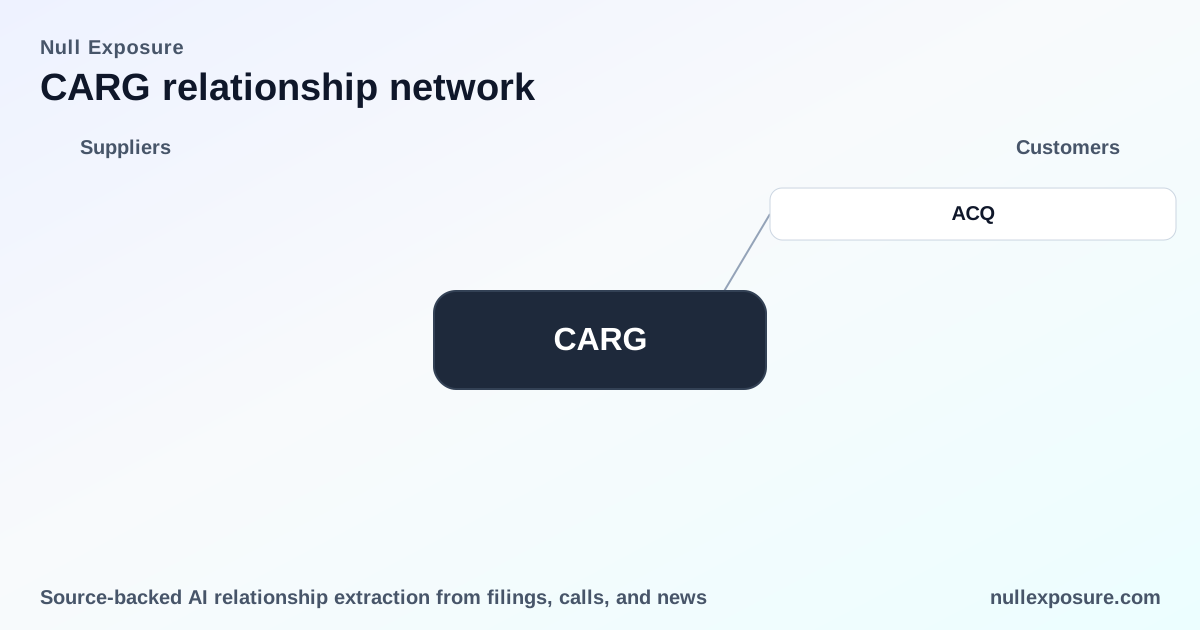
Customer relationship on the record: AutoCanada (ACQ)
AutoCanada (TSX: ACQ) announced that it selected CarGurus as its preferred partner in Canada to power digital marketing and business intelligence, signaling a strategic marketplace partnership for the Canadian dealer group. This is a commercial win that validates CarGurus’ Canadian product offering and expands its footprint among multi‑location dealer groups. (Newswire press release, March 9, 2026.)
What the relationship list says about commercial traction
CarGurus’ recorded customer relationships in the sampled results are focused on strategic dealer group wins rather than single large contracts. The AutoCanada announcement is a clear example of CarGurus continuing to convert multi‑location dealer groups into platform partners in international markets, which supports cross‑border marketplace growth and advertising inventory expansion. (Newswire, March 2026.)
Contracting posture, concentration, and operating constraints
CarGurus’ operating model is best understood through the following company‑level signals drawn from public disclosures:
-
Subscription, short notice renewals. Customer subscriptions generally auto‑renew monthly and are cancellable with 30 days’ advance notice, establishing a recurring revenue base with limited long‑term contractual lock‑in. This delivers predictable monthly cash flows but leaves churn as the primary retention risk. (Company disclosure on subscription terms.)
-
Short billing cycles and working capital profile. Customers are billed monthly in arrears with payment terms commonly 30, 60, or 90 days, which produces modest receivables turnover and working capital sensitivity to collection performance. (Company billing disclosures.)
-
Geographic concentration and international presence. The business is U.S.‑centric—the U.S. marketplace accounts for the bulk of revenue (U.S. $831,473K reported in segment disclosures)—but CarGurus operates internationally (U.K., Canada, and other markets) and reports an international revenue bucket (International $62,911K). This mix gives the company a dominant U.S. position with upside from international dealer expansion. (Segment disclosures, FY2025.)
-
Customer dispersion and low single‑name concentration. No single customer represented more than 10% of accounts receivable as of December 31, 2024, and accounts receivable are dispersed among more than 1,000 customers, indicating low customer concentration and limited counterparty credit exposure. (Annual report disclosures.)
-
Relationship roles and product orientation. Disclosures describe CarGurus as both platform provider and principal for certain services (inspection and transportation where it controls fulfillment) and list primary revenue sources as dealership subscriptions, digital advertising, and financing partnerships—characteristics of a services‑oriented marketplace operator. (Company revenue description.)
-
Active dealer footprint and maturity. With tens of thousands of dealers, and tens of millions of monthly visitors, the marketplace is mature in the U.S. and still scaling internationally; the customer base is active, recurring, and contributes to a predictable top line. (Traffic and dealer count disclosures.)
Taken together, these constraints imply a highly recurring, low‑concentration customer base with short‑term contractual dynamics: advantageous for margin stability but sensitive to churn, competitive pricing, and ad spend cycles.
Investor implications: what to watch in customer relationships
-
Retention and churn metrics are central. Given the monthly auto‑renewal model and 30‑day cancellation terms, maintaining dealer engagement and lead quality is the most direct lever to sustain revenue. Quarterly churn and ARPU trends will drive forward revenue growth more than one‑off enterprise deals.
-
Large dealer group partnerships are incremental. Deals like AutoCanada expand international footprint and ad inventory; they are positive validation events but do not materially change concentration dynamics because the product is sold at scale across thousands of smaller dealers. (AutoCanada press release, March 2026.)
-
Working capital and receivables monitoring. Billing in arrears with extended payment terms introduces some receivables risk if macro conditions stress dealer liquidity; however, receivable dispersion reduces single‑counterparty exposure. (Company receivables disclosure, Dec 31, 2024.)
-
Competition and product differentiation. The core value to dealers is lead quality and conversion; improvements in analytics, RPM, and vertical integration services (e.g., inspection/transport) are the primary tools to defend pricing and reduce churn.
If you want structured, relationship‑level intelligence and to track how partnerships like AutoCanada move the company’s Canadian economics, more granular commercial signals and win pipelines are tracked on our platform at https://nullexposure.com/.
Bottom line
CarGurus is a scaled, recurring‑revenue marketplace with high U.S. exposure, low customer concentration, and a subscription contract posture that favors visibility but not long‑term lock‑in. The AutoCanada partnership is a strategic incremental win that strengthens the company’s Canadian presence and advertising inventory; however, the company’s financial sensitivity will continue to hinge on dealer retention, ARPU expansion, and the ability to monetize traffic internationally. Investors should prioritize churn metrics, ARPU trends, and receivables performance as the best near‑term indicators of customer relationship health and revenue sustainability.