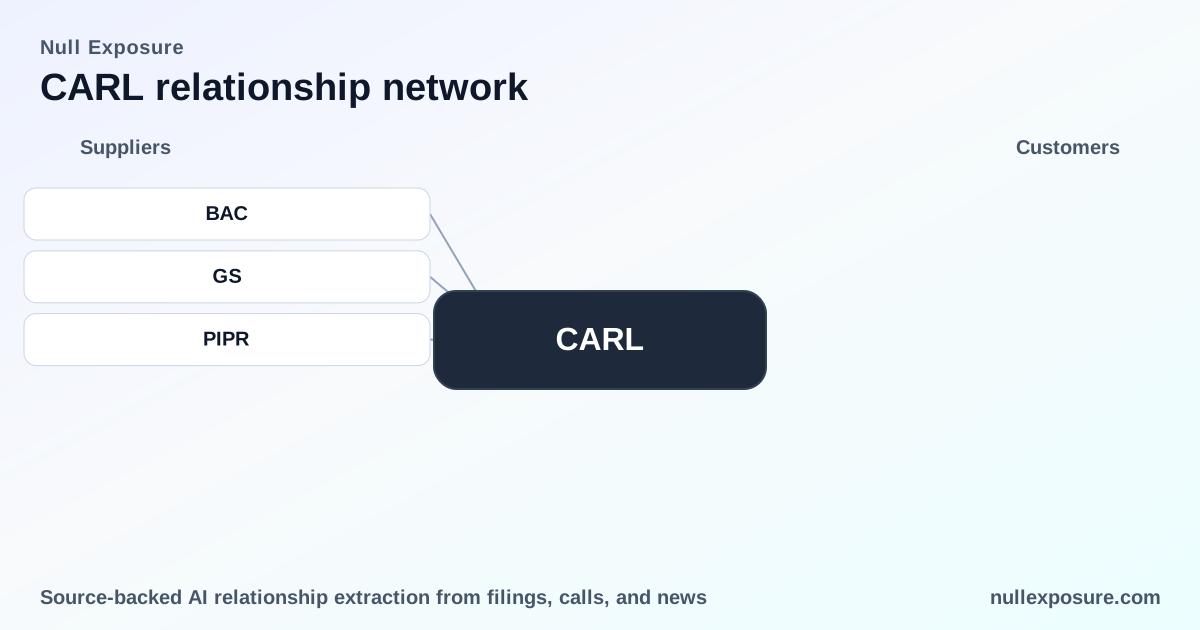
Carlsmed (CARL): Commercial rollout of a patient-specific spine platform and what hospital adoption tells investors
Carlsmed develops a surgical platform for complex adult spinal deformities that combines clinical intelligence, advanced image recognition, and 3D printing to deliver patient-specific implants and procedural planning for spine surgeons. The company monetizes primarily through per-case device and implant sales, high-margin 3D printed components, and associated surgical planning services, with revenue recognized at the point of device delivery or case completion; management’s reported figures through the 2025 quarter show this model generating meaningful gross margins but still operating at a loss as Carlsmed scales. Learn more at https://nullexposure.com/
Why the commercial lens matters now
Carlsmed’s public financials (latest quarter 2025-12-31) show $50.5M in trailing twelve-month revenue and $38.0M gross profit, indicating strong unit-level economics once a case is performed, but the business remains unprofitable with negative EBITDA of $30.3M and operating margin of -61.4%. This combination—high gross margin, negative operating leverage, and concentrated insider ownership (42.7%)—defines a classic commercial-growth stage medical device company: product economics are promising, but the company must scale case volumes and hospital penetration to absorb fixed costs and justify the current EV/revenue multiple (EV/Revenue ~3.28).
The customer footprint: evidence of clinical adoption
Carlsmed’s go-to-market is visible through discrete case announcements and hospital partnerships. Publicized procedures serve as the clearest signal of real-world adoption because the company monetizes at the case level—each announced procedure is also an immediate revenue event and a marketing asset for surgeon adoption.
University of Colorado Hospital
Carlsmed announced the first posterior lumbar spine procedure using the aprevo Lumbar Bi-lateral Posterior System performed by Dr. C.J. Kleck at University of Colorado Hospital in Denver. According to a May 2, 2026 report on ryortho.com, the procedure marked the initial clinical use of the aprevo system at that institution and demonstrates the company’s ability to place its system in major academic hospitals. (Source: ryortho.com, May 2, 2026)
What these customer signals mean for the operating model
- Contracting posture: The product mix—implants, case-specific 3D prints, and surgical planning—drives a transactional, case-by-case contracting posture with hospitals and surgeons rather than large multi-year capital contracts. Carlsmed’s model captures revenue at the procedure level, so growth is directly tied to case volumes and surgeon adoption across centers.
- Concentration and scale: Current public data show an early-stage commercial roll-out; adoption is measured by discrete case announcements and affiliations with academic hospitals. This pattern implies initially concentrated revenue sources that must broaden into a network of hospitals and high-volume surgeons to reach profitable scale.
- Criticality to customers: Patient-specific and image-guided implants raise Carlsmed’s offering above commodity implants because they promise improved fit and potentially better outcomes; that technical differentiation increases clinical stickiness once surgeons and hospitals standardize on the workflow.
- Maturity of commercial execution: The company has demonstrated ability to secure case use in major institutions, a typical milestone on the path from clinical validation to volume commercialization. However, negative operating leverage shows the go-to-market still requires substantive investment to translate clinical wins into consistent revenue growth.
What to watch in customer announcements
Investors evaluating CARL should prioritize signals that correlate with sustainable, repeatable revenue:
- Frequency and scale of case announcements across different hospital systems and regions.
- Movement from one-off cases to standardized adoption across a hospital’s spine program (e.g., multiple surgeons or conversion to an institutional contract).
- Evidence of recurring revenue streams such as repeat orders for patient-specific components or multi-case surgical planning agreements.
- Adoption in large-volume community hospitals beyond academic centers, which indicates a transition to scale.
Key advantages and near-term risks
- Advantages: Patient-specific 3D printing and advanced imaging give Carlsmed a differentiation advantage that translates into high gross margins per case and strong clinical value proposition; recent case placements at major centers validate the technology in a clinical setting.
- Risks: The model depends on accelerating case volumes and broader hospital adoption to overcome fixed cost drag; the company is currently unprofitable and must demonstrate reproducible commercial scale. Insider ownership is high, and float is limited, which can magnify share price moves around commercial news.
Actionable investor checklist
- Monitor the cadence of procedure announcements and the diversity of hospital customers—incremental institution entries are hard evidence of commercial momentum.
- Track quarterly revenue growth relative to disclosed case counts or quarter-to-quarter case volume commentary; this directly tests conversion of clinical wins into recurring economics.
- Watch for institutional purchasing signals (multi-surgeon adoption, repeat orders) that convert transactional revenue into predictable streams.
For focused coverage and timely alerts on CARL customer relationships and clinical rollouts, visit https://nullexposure.com/
Bottom line
Carlsmed’s business is a transaction-driven medical device model with attractive per-case economics but current negative operating leverage. Publicized procedures such as the aprevo case at University of Colorado Hospital validate clinical adoption and are the primary observable signal of commercial traction; the next stage for the equity thesis is consistent expansion of hospital customers and repeat procedural volumes that convert promising unit economics into sustained profitability.