Carrier Global (CARR): customer network, dependencies, and commercial constraints
Carrier Global sells and services heating, ventilation, air conditioning and refrigeration (HVACR) equipment and digital lifecycle solutions, monetizing primarily through point‑of‑sale product sales complemented by a growing services and subscription stream for monitoring, maintenance and logistics. Investors should value Carrier as a capital‑light product leader with an expanding recurring‑revenue tilt driven by digital monitoring and aftermarket services. For a structured view of Carrier’s commercial counterparties and operational constraints, visit https://nullexposure.com/ for ongoing signal coverage.
A concise investment thesis for customers and counterparties
Carrier’s core economics remain driven by new equipment sales (≈72% of net sales) with parts and services contributing the remainder (≈28%), translating to high sales seasonality and inventory sensitivity for distributors and dealers. The company is increasing emphasis on digitally enabled offerings—subscription monitoring and lifecycle services—which improve revenue visibility and raise the strategic value of its distributor relationships. At the same time, Carrier operates at scale globally with concentrated distribution channels in North America, exposing the company to partner concentration and government litigation tail risk.
How Carrier contracts and where commercial risk sits
Carrier’s operating model blends traditional manufacturing distribution with services:
- Primary monetization is product sales recognized at point of control transfer, which maintains working‑capital intensity and dependence on distribution partners for market reach.
- Services and recurring offerings are growing, with explicit evidence of subscription‑style monitoring products for transport and cargo, which increase margins and predictability.
- Carrier is a global operator with significant North American exposure, which diversifies end markets but concentrates certain regulatory and litigation risks in the U.S. These characteristics imply a contracting posture that remains largely transactional but is evolving toward higher criticality for recurring services—raising supplier and customer negotiation leverage over time.
Customer relationships you must track (complete list)
Below are every counterparty cited in the available results, with concise, investor‑oriented takeaways and source references.
HONIV
Carrier’s Access Solutions business is listed among recent transactions in strategic acquisition summaries, indicating divestiture activity that transfers a discrete portion of Carrier’s portfolio to acquirers. According to a PR Newswire release (March 2026), Carrier’s Access Solutions business was named among assets included in a broader list of industrial acquisitions. Source: PR Newswire, March 2026.
Honeywell (HON)
Honeywell’s corporate communications reiterated it acquired the Access Solutions business from Carrier as part of a series of strategic moves to optimize portfolios, signaling active portfolio management and non‑core carve‑outs at Carrier. A PR Newswire release (May 2026) cited the Access Solutions business from Carrier in Honeywell’s acquisition rollup commentary. Source: PR Newswire, May 2026.
Watsco, Inc. (WSO)
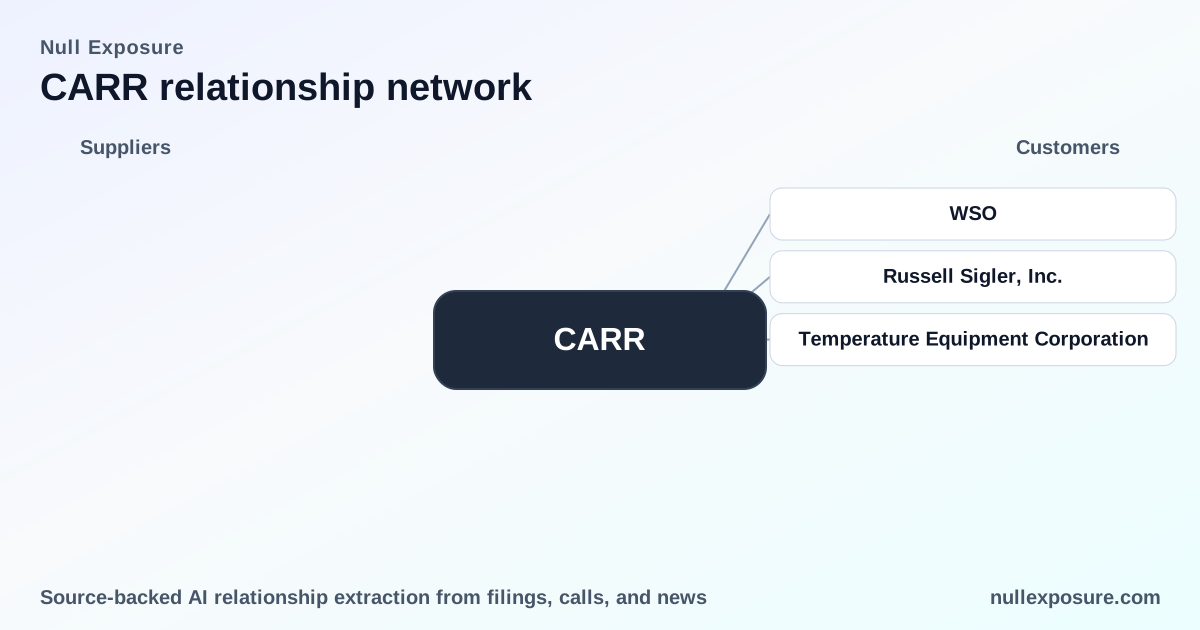
Watsco is a major distributor and strategic partner for Carrier in North America; Watsco’s filings show Carrier accounts for a very large share of Watsco’s purchases—roughly 62% of supplier spend and over 40% of sales pushed through Watsco in prior comments—making this a material single‑partner exposure. Watsco’s FY2026 10‑K and related market commentary document Carrier’s dominant place among suppliers, and earnings call transcripts cite Carrier driving roughly 40–45% of Watsco’s sales. Sources: Watsco FY2026 10‑K filing (reported via StockTitan, March 2026) and Watsco Q3 2025 earnings call transcript (InsiderMonkey coverage, 2025/2026).
Russell Sigler, Inc.
Carrier Enterprise I holds a 38.4% ownership interest in Russell Sigler, an HVAC distributor operating 36 locations in the Western U.S.; Russell Sigler reported about $1.2 billion in 2025 sales, positioning it as Carrier’s second‑largest independent North American distributor and reinforcing Carrier’s strategic partial ownership model to secure distribution. This ownership stake is disclosed in Watsco’s FY2026 filing. Source: Watsco FY2026 10‑K (StockTitan, March 2026).
Temperature Equipment Corporation (TEC)
In 2021 Carrier and Watsco formed a joint venture and acquired selected assets and liabilities of TEC, consolidating distribution footprints across several Midwestern states and strengthening Carrier’s indirect distribution network. This joint‑venture transaction is recorded in Watsco’s FY2026 report. Source: Watsco FY2026 10‑K (StockTitan, March 2026).
Constraints and what they imply about Carrier’s commercial posture
The available operating signals present company‑level constraints that shape Carrier’s customer relationships:
-
Contracting posture: predominantly point‑in‑time product sales, evolving toward subscription. Carrier’s revenue recognition is anchored in product transfers, while the firm explicitly documents growth in on‑demand and subscription‑based monitoring (e.g., cargo and transport refrigeration), indicating a strategic shift to recurring revenue that will increase contract stickiness and service margins.
-
Counterparty mix includes government exposure. Legal disclosures reference historical manufacturing of firefighting foam (AFFF) sold to government and non‑government customers at a Pennsylvania site, which signals federal and municipal litigation and procurement risk concentrated in North America.
-
Geographic footprint is global with North American concentration. Carrier brands itself as a global leader, but several filings and distributor arrangements show significant NA exposure, creating asymmetric regulatory and demand risks tied to U.S. infrastructure and construction cycles.
-
Relationship roles are multifaceted: buyer, seller and service provider. Carrier sells equipment through distributors and also provides audit, design, installation, integration, repair, maintenance and monitoring services, which increases the firm’s role in customers’ operational workflows and heightens contract criticality over time.
-
Segment mix reflects a mature product business plus growing services. With new equipment representing ~72% of net sales and parts and service ~28%, Carrier’s revenue base retains legacy volatility while services offer margin and retention upside—a classic industrial transition from hardware to software‑enabled services.
Investor implications and operational recommendations
-
Concentration risk with distributors (notably Watsco) is a critical operational lever; changes in distributor inventory strategy or a competitive shift could materially affect sales flow. Investors should monitor Watsco‑Carrier purchase shares and JV activity (e.g., Russell Sigler) as leading indicators of future revenue elasticity.
-
Recurring revenue growth is strategically important and will improve valuation multiples if subscription monitoring scales; operational execution on digital solutions is therefore a high‑impact metric to track.
-
Litigation and government procurement exposure requires active monitoring, as AFFF‑related liabilities and supply‑chain regulatory shifts could compress margins or force remediation costs.
-
Portfolio pruning and carve‑outs (Access Solutions) indicate management willingness to optimize capital allocation, which supports a disciplined capital‑returns narrative but changes the stability of legacy product revenue.
For ongoing monitoring of Carrier’s commercial counterparties and signal flows, see https://nullexposure.com/ for continuous coverage and relationship analytics.
Bottom line
Carrier combines a durable product franchise with a deliberate push into services and subscriptions—a duality that tempers short‑term sales cyclicality while creating long‑term upside in recurring margins. The network of large distributors (notably Watsco), minority ownerships (Russell Sigler), and JV consolidations (TEC) defines both Carrier’s market reach and its principal operational risks. Investors should focus on distributor concentration metrics, subscription adoption curves, and government‑related litigation developments as primary drivers of valuation trajectory.