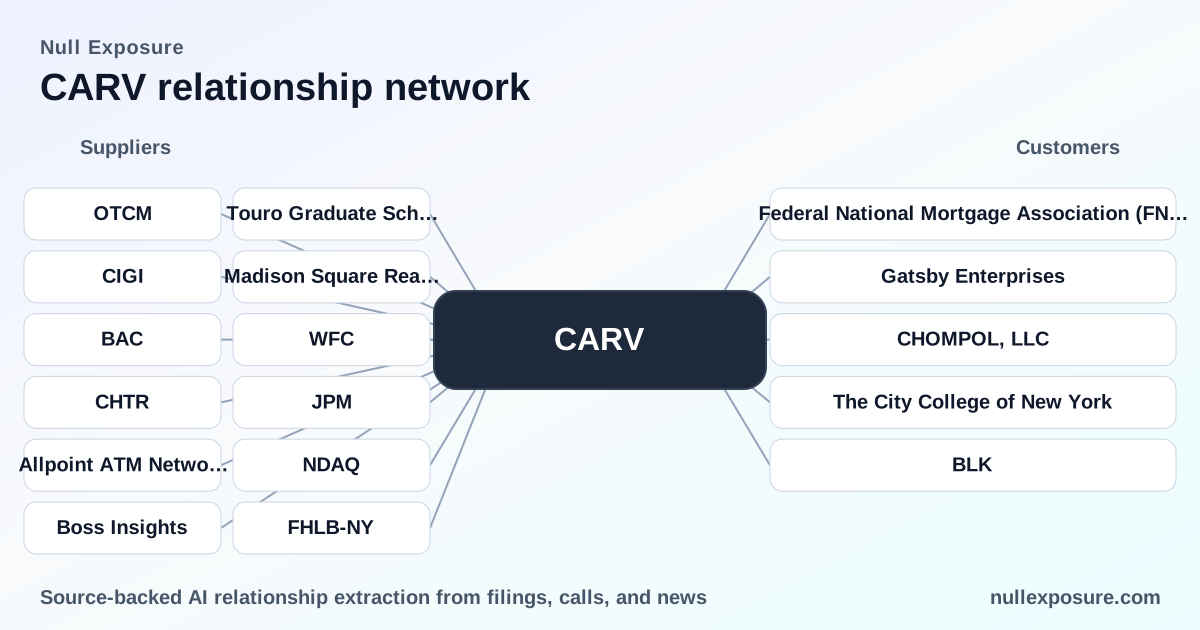
Carver Bancorp (CARV) — Customer relationships, capital links, and what they mean for investors
Carver Bancorp is the holding company for Carver Federal Savings Bank, a New York–centric regional bank that earns net interest margin on mortgage and commercial lending and fees from deposit services. The bank’s business model is deposit-driven: it attracts retail, small-business and institutional deposits through seven borough branches, re-deploys those funds into mortgage loans and commercial credit, and supplements liquidity with structured financing when needed. Investor focus should be on the stability of deposit funding, the bank’s credit origination & servicing posture, and its access to third‑party capital providers that support growth and liquidity. For a concise provider view and partner map, see https://nullexposure.com/.
How Carver’s customer and counterparty footprint shapes the business
Carver operates with a deposit‑centric contracting posture: most revenue streams are earned as services are rendered (monthly/transactional fees) and through interest collected over long‑dated loans. The company-level evidence shows a mix of long-term mortgage contracts (amortizing 15–30 years with potential balloons), subscription‑style recurring service fees, and transaction or usage‑based fee schedules. Those characteristics create predictable, recurring cash inflows but also require active liquidity management because deposits are the company’s most important source of funds.
Carver’s counterparty mix is intentionally local and community-oriented: individuals, small businesses, non-profits, and government/quasi-government agencies in New York City represent core customers. That concentration supports strong customer stickiness and deep community relationships but also limits geographic diversification and ties the bank’s performance to the New York economy. Carver’s business is operationally mature in deposit-taking and consumer/commercial lending, and the firm’s relationships are currently active, according to account and fee recognition disclosures.
Relationship inventory — what each counterparty contributes
Federal National Mortgage Association (FNMA)
Carver disclosed that during 2004–2009 it originated 1–4 family residential mortgage loans and sold those loans to FNMA, demonstrating historical use of agency channels to offload credit risk and create liquidity. This activity is documented in the company’s FY2025 10‑K filing. (Source: Carver FY2025 10‑K, filings covering the period through March 31, 2025.)
The City College of New York
Carver operates an on‑campus ATM at CCNY’s North Academic Center that has served students and staff since July 2022, reflecting a community outreach and deposit access strategy targeted at institutional and student customers. This was announced in a PR Newswire release describing the ATM installation (FY2022). (Source: PR Newswire, City College of New York/Carver ATM announcement, July 2022.)
Gatsby Enterprises
In a 2018 commercial real estate transaction, Gatsby Enterprises acquired Carver’s Harlem office and retail building at 75 West 125th Street for approximately $19.5 million, indicating a strategic sale of owned property. Local reporting captured the transaction and price. (Source: Harlem World Magazine reporting on the Gatsby Enterprises acquisition, FY2018.)
CHOMPOL, LLC
Carver closed a sale of the 75 W. 125th Street property to CHOMPOL, LLC—a Gatsby Enterprises subsidiary—in a sale‑and‑leaseback that strengthened the bank’s Harlem presence while freeing capital from real estate holdings. The sale and leaseback was announced in a PR Newswire release (FY2018). (Source: PR Newswire release on the sale‑and‑leaseback, FY2018.)
BlackRock (Alternative Solutions Group) — BLK
Carver closed a Senior Secured Social Impact Revolving Credit Facility with BlackRock’s Alternative Solutions Group (in partnership with Bank of America), signaling institutional capital support and a linkage to social‑impact financing that supplements traditional deposit funding. The transaction was announced in a joint PR Newswire release (FY2021). (Source: PR Newswire, Carver/BofA/BlackRock closing announcement, FY2021.)
BLK (duplicate listing)
The dataset lists BlackRock again under its ticker BLK with the same transaction detail—the same PR Newswire announcement documents the senior secured revolving credit facility that provides capital for social impact lending and working capital. Treat this as the same institutional counterparty captured twice in public reporting (Source: PR Newswire, FY2021).
National Community Investment Fund
Carver sold 8% of its shares to the National Community Investment Fund for $1.0 million at $2.64 per share, an equity investment that reflects community‑focused capital support and improves tangible capital cushions. The transaction was reported in Banking Dive coverage of Carver’s broader capital moves (FY2024). (Source: Banking Dive coverage of the NCIF equity purchase, FY2024.)
What these relationships imply about risk, concentration and optionality
- Funding and liquidity profile: Deposits remain critical to operations; however, the BlackRock senior secured facility demonstrates that Carver can access institutional liquidity beyond retail deposits when needed. That facility is especially relevant for strategic lending tied to social impact, a niche Carver leverages to differentiate itself.
- Balance sheet strategy: The 2018 sale‑and‑leaseback of 75 W. 125th Street reduced owned real estate on the balance sheet and converted an illiquid asset into lease obligations and cash—an explicit shift toward an asset‑light approach for branch property.
- Capital and governance: The NCIF equity purchase indicates external community capital alignment and modest ownership dilution in exchange for strengthened capital ratios. Insider ownership remains high (almost 40% insider holding), while institutional ownership is very low, increasing the relevance of community investors.
- Customer composition and credit risk: A stated focus on small businesses (annual sales $1–25M), individuals, non‑profits and governmental accounts suggests diversified revenue sources but also concentration in local credit cycles and small‑business credit risk. Mortgage origination history and agency sales (FNMA) show an institutional distribution capability that historically managed mortgage credit and liquidity transfer.
- Contracting and revenue characteristics: Revenue is a mix of long‑term interest cash flows from amortizing mortgages (often with five‑year balloons), recurring service/subscription style fee income, and transaction‑based deposit fees—a predictable but funding‑sensitive revenue mix.
Investment takeaway and next steps
Carver is a small, community‑focused bank with stable, deposit‑led economics augmented by targeted institutional capital (BlackRock facility, NCIF investment) and tactical balance‑sheet moves (sale‑leaseback). For investors, the core signals are high deposit criticality, concentrated New York geography, and active engagement with community and institutional capital partners—all of which drive both resilience and idiosyncratic risk tied to local credit cycles.
- Key strengths: Community franchise, active institutional social‑impact funding, and a pragmatic approach to capital and real‑estate management.
- Key risks: Geographic concentration, modest market capitalization, negative recent earnings per share and return on equity metrics, and exposure to small‑business credit cycles.
For a practical counterparty map and to track changes to Carver’s partner set over time, visit our platform at https://nullexposure.com/. Consider monitoring deposit trends, utilization of the BlackRock facility, and any further equity placements as leading indicators for liquidity and capital trajectory.
Concluding: Carver’s relationships reflect a bank that monetizes traditional deposit and mortgage flows while selectively accessing institutional capital to support mission‑driven lending — a profile that rewards careful monitoring of deposit stability, credit performance, and capital transactions.