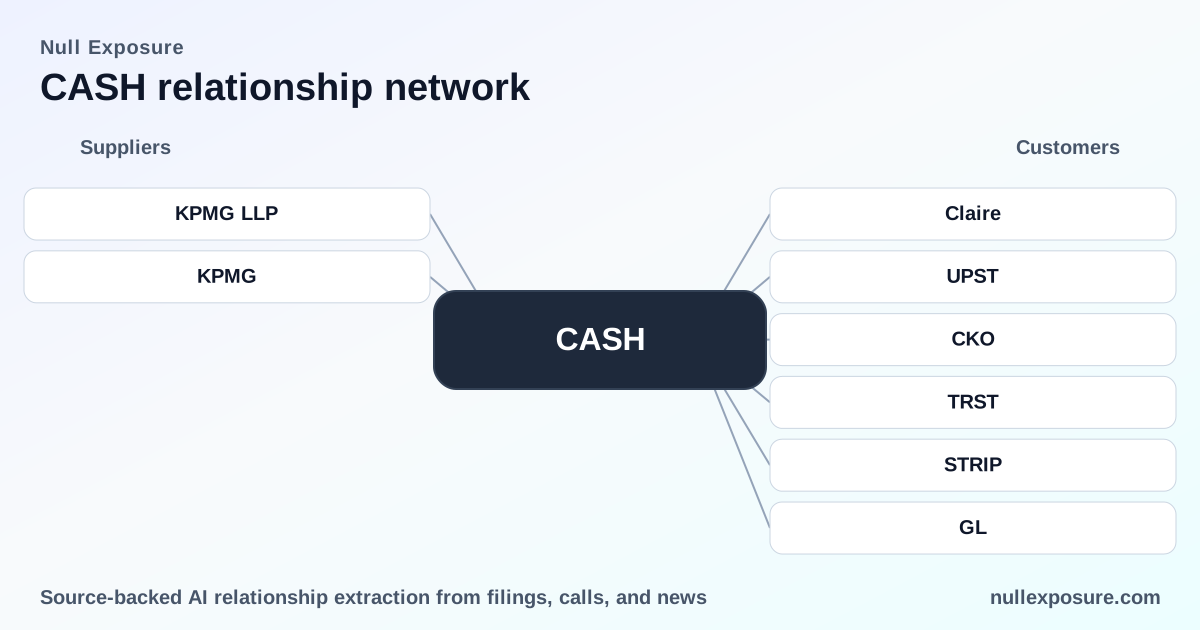
Meta Financial (CASH): customer relationships that drive the payments franchise
Meta Financial Group (CASH) operates as a payments-anchored regional bank (Pathward/MetaBank) that monetizes through sponsorship and payment processing services, card and ATM sponsorship, tax and refund-advance products, and lending partnerships. The business model captures deposit funding, fee income and interest margin by partnering with fintechs and specialty lenders that rely on MetaBank’s charter and infrastructure to originate loans, hold deposits, and provide merchant acquiring and card issuing sponsorships. For investors, the question is not whether Meta can win customers — it does — but how concentrated, contractual, and economically critical those relationships are to earnings and deposit funding.
Explore detailed relationship signals and contract-level implications at https://nullexposure.com/.
Why customer relationships are the strategic lever for CASH
Meta’s value proposition is infrastructure plus charter: third-party platforms outsource regulated banking functions and balance-sheet access to Meta in exchange for fees, deposit flow and asset servicing. That structure produces high operational leverage when partners scale, but also concentrates deposit and fee risk across a limited number of program manager arrangements. The company’s public disclosures repeatedly frame Partner Solutions as a core revenue driver, and management highlights new multiyear sponsorships and platform integrations as growth catalysts.
What the constraints tell investors about the operating model
The available constraint signals frame how to think about contractual posture, concentration and criticality:
- Contracting posture (short-term exposure): Pathward’s Partner Solutions includes short-term refund-advance loans that settle across a small number of IRS cycles, indicating parts of the product set are transactional and short-duration, which reduces long-dated liability duration but increases replacement risk for fee streams.
- Geographic scope (national): The business serves customers nationwide, supporting ATM networks and national loan origination partnerships — a company-level signal that product exposure is broadly distributed across U.S. markets.
- Materiality (company dependence): Management discloses that a significant percentage of deposits, assets and income derive from Payments customer relationships, implying economic concentration and elevated counterparty importance to funding and earnings.
- Business segment (services-heavy): The firm’s revenue mix is materially in services — sponsorship, payment processing, tax and money-movement solutions — which means margin dynamics are a mix of fee growth and credit spread capture on asset products.
- Large single-borrower exposure: A disclosed largest lending relationship of roughly $109.5 million indicates the bank accepts sizeable single-counterparty exposure, a company-level concentration metric that should be monitored for credit and liquidity stress.
Collectively, these constraints paint a picture of a bank whose franchise is service-oriented and national, but materially exposed to a limited number of programmatic partners and short-term products.
Customer relationships and what they mean for investors
Claire
Meta congratulated its partner Claire for onboarding Claire’s on-demand pay into the Intuit Enterprise Suite and QuickBooks payroll ecosystem, indicating Meta’s sponsorship role in enabling embedded payroll and on-demand wage products. This was mentioned during the company’s Q4 2025 earnings call (cash-2025q4-earnings-call).
Oportun (OPRT)
Oportun leveraged MetaBank to expand lending into 30 additional states and explicitly referenced MetaBank as the originating institution for an expanded national footprint; press coverage and filings indicate Meta’s charter enabled Oportun’s geographic scale. See ProPublica and CityBiz reporting and company commentary tied to earlier FY2021/FY2026 disclosures (news coverage 2021–2026).
Upstart (UPST)
Management announced that Meta has gone live with Upstart to offer personal loans through Upstart’s AI lending marketplace, a direct example of Pathward providing balance-sheet or sponsorship services to fintech-originated loan flows, presented in the Q4 2025 earnings call (cash-2025q4-earnings-call).
Checkout.com (CKO)
After the quarter closed in Q3 2025, Meta signed a multiyear acquiring sponsorship agreement with Checkout.com, marking an expansion of merchant acquiring relationships that can generate fee and deposit flows for the bank; the arrangement was disclosed on the Q3 2025 earnings call (cash-2025q3-earnings-call).
Trustly (TRST)
Meta entered into an agreement with Trustly to support expansion of Trustly’s pay-by-bank product, a partnership that underscores the bank’s role in enabling bank-to-bank payment rails and alternative payout methods, disclosed on the Q4 2025 earnings call (cash-2025q4-earnings-call).
Stripe (STRIP)
Management announced a multiyear merchant acquiring sponsorship with Stripe, a win that positions Meta as a sponsor for one of the largest global payments processors and creates a potentially material, recurring fee and deposit source; this was noted on the Q4 2025 earnings call (cash-2025q4-earnings-call).
Greenlight (GL)
Following quarter-end, Meta signed a new contract with Greenlight to support family finance and teen card issuing, expanding Meta’s card-issuing footprint in the consumer fintech segment and reinforcing the bank’s strategy of partnering with niche, high-growth issuers; disclosed in the Q4 2025 earnings call (cash-2025q4-earnings-call).
(Each partner citation reflects public statements in Meta’s Q3/Q4 2025 earnings calls and contemporaneous news reports as noted above.)
Explore aggregated partner exposure and contract-level context at https://nullexposure.com/ for a deeper diligence workflow.
Investment implications — concentrated services, large partners, and funding sensitivity
- Revenue upside tied to partner scale: Multiyear sponsorships with Stripe and Checkout.com and go-lives with Upstart and Trustly create sizable recurring fee and deposit opportunities if transaction volumes scale as management forecasts.
- Concentration risk is real: Management’s disclosure that a limited number of program manager relationships drive a significant share of deposits and income elevates counterparty risk; a loss or re-pricing of a major sponsor would transmit quickly to funding costs and deposit composition.
- Product maturity and tenure vary: The business mixes long-term multiyear deals with short-term refund-advance products and transactional pay-by-bank agreements, creating heterogeneous revenue maturity and differing renewal dynamics.
- Credit and single-borrower exposure: The existence of a >$100 million lending relationship signals that credit risk and exposure limits are active considerations for investors in a rising-rate or credit-stress environment.
Bottom line: a payments-first bank with scale opportunities and concentrated counterparty exposure
Meta Financial’s strategy — monetize a banking charter by sponsoring fintechs and payment processors — delivers a scalable fee-and-deposit model with clear upside when partners scale but also concentration-driven tail risk. For investors evaluating CASH, monitoring partner throughput, renewal terms on multiyear sponsorships, and the stability of program-manager deposit flows is essential to modeling earnings durability and funding risk.
For a concise briefing and ongoing tracking of Meta’s partner disclosures and contract signals, visit https://nullexposure.com/.