CASI Pharmaceuticals: distributor concentration, tactical financing, and an asset sale that rebalances risk
CASI Pharmaceuticals operates as a clinical-stage biopharma that commercializes specialty oncology products in China while advancing a development-stage immunology pipeline (notably CID-103). The company monetizes through product sales via distribution partners for marketed assets and through equity/debt financing and selective asset divestitures to fund R&D and bridge cash flow gaps. Investors should treat CASI as a hybrid commercial/development company where distributor contracts and short-term financing are primary drivers of near-term liquidity and revenue visibility. For a concise overview of our sourcing methodology and comparable relationship intelligence, visit https://nullexposure.com/.
Key takeaways:
- Distribution concentration is real: EVOMELA® is sold in China through a sole distributor, exposing CASI to channel return risk.
- Financing is active and dilutive: Convertible note tranches are already deployed, indicating dependence on capital markets.
- Asset monetization is underway: The Juventas stake sale injects non-operating cash and reduces portfolio complexity.
What this relationship map tells investors about CASI’s operating posture
CASI’s public disclosures and press coverage reveal a company balancing commercial execution in China with aggressive financing and portfolio management. Contracting posture is partner-centric: CASI outsources sales execution to third parties rather than building a large in-country commercial organization, which reduces fixed costs but raises concentration risk. Capital sourcing is transaction-driven, relying on convertible notes and asset sales to extend runway. Strategic maturity is transitional — CASI has a marketed product with active distribution and a development-stage pipeline that requires continued financing to reach meaningful clinical milestones.
- Concentration: Sole-distributor model for EVOMELA® concentrates revenue risk in a single channel.
- Criticality: Distributor performance and contractual terms directly affect near-term revenue recognition and inventory write-down exposures.
- Maturity: The business is not yet cash-flow self-sustaining from product sales; near-term financial stability depends on external capital and one-off asset sales.
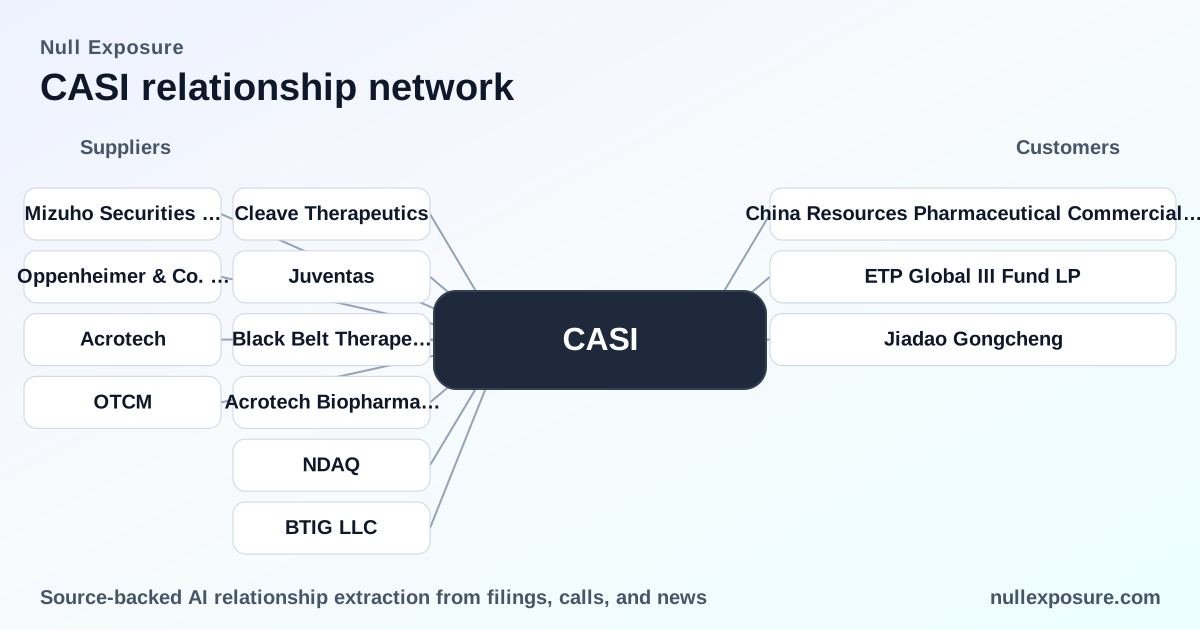
Distributor: China Resources Pharmaceutical Commercial Group International Trading Co., Ltd.
CASI and China Resources Pharmaceutical Commercial Group International Trading Co., Ltd. (CRPCGIT) are the exclusive channel for EVOMELA® in China; in June 2025 the two parties amended their distribution agreement to allow the distributor to return goods that are close to expiration and cannot be sold, shifting inventory expiry risk back onto CASI. According to CASI’s third-quarter 2025 business and financial results reported on InvestingNews (FY2025), the modified agreement explicitly permits returns of near-expiration product stock. See the InvestingNews report on CASI’s Q3 2025 results for details (InvestingNews, FY2025).
Capital partner: ETP Global III Fund LP
CASI completed the issuance of the first tranche of a US$20 million convertible note financing to ETP Global III Fund LP, a partnership controlled by Dr. Wei-Wu He, under a convertible note purchase agreement; the tranche has been executed and funds deployed per the company’s filing. The transaction and tranche completion are documented in CASI’s current reports and were summarized in an SEC-related news posting on StockTitan referencing the FY2025 filing (SEC/Company filing, FY2025).
Asset buyer: Jiadao Gongcheng (Juventas stake sale)
CASI executed a strategic sale to Jiadao Gongcheng, agreeing to sell its stake in Juventas for approximately RMB240.87 million, a transaction reported in FY2026 commentary on market platforms. The sale is presented as a portfolio monetization move to generate liquidity and focus resources (Simply Wall St summary, FY2026).
Why these three relationships matter for valuation and risk
Each relationship affects a distinct vector of CASI’s risk/return profile. The CRPCGIT arrangement directly influences top-line recognition and gross margin through return allowances; inventory returns create earnings volatility and increase working-capital burden. The ETP convertible financing provides immediate liquidity but introduces dilution and conversion-risk that impact equity valuation and future EPS outlook. The Juventas stake sale is an immediate cash inflection that reduces near-term funding pressure and can underwrite clinical programs without additional dilution if deployed for R&D rather than recurring costs.
Operationally, the distributor modification indicates CASI accepts counterparty-driven inventory risk to preserve or expand market access in China. Financially, convertible notes suggest CASI is prioritizing speed of funding over equity raises; investors must price conversion terms and potential cap table dilution into any valuation. The asset sale signal is twofold: management is willing to monetize non-core holdings to fund operations, and the company is executing tactical balance-sheet management.
Monitoring list for investors and operators
- Distributor returns: Track quarterly disclosures for return volumes and reserve build-up tied to CRPCGIT; surges will erode near-term revenue and margins.
- Convertible note economics: Monitor tranche schedules, interest/accretion, and conversion caps to model dilution scenarios and cash runway.
- Use of proceeds from Juventas sale: Watch filings for allocation of RMB240.87M to clinical programs versus operating expenses.
- Regulatory and commercial readouts for EVOMELA® and CID-103: Product uptake and clinical milestone achievements are primary value drivers beyond these counterparty dynamics.
For further comparative relationship intelligence and to track subsequent tranche issuances or distributor performance metrics, visit https://nullexposure.com/ for our real-time monitoring and signal summaries.
Bottom line
CASI operates at the intersection of commercial product sales and an R&D-heavy development pipeline. Investor returns will depend on the company’s ability to convert one-off asset monetizations and short-term financing into sustained clinical progress and commercial scale, while managing distributor-driven inventory risk. The CRPCGIT distribution amendment, ETP convertible tranche, and Juventas divestiture are not isolated events — they form a coherent capital-and-channel strategy that directly informs near-term cash flow and dilution risk. Active monitoring of these relationships is essential for any valuation or operational assessment.