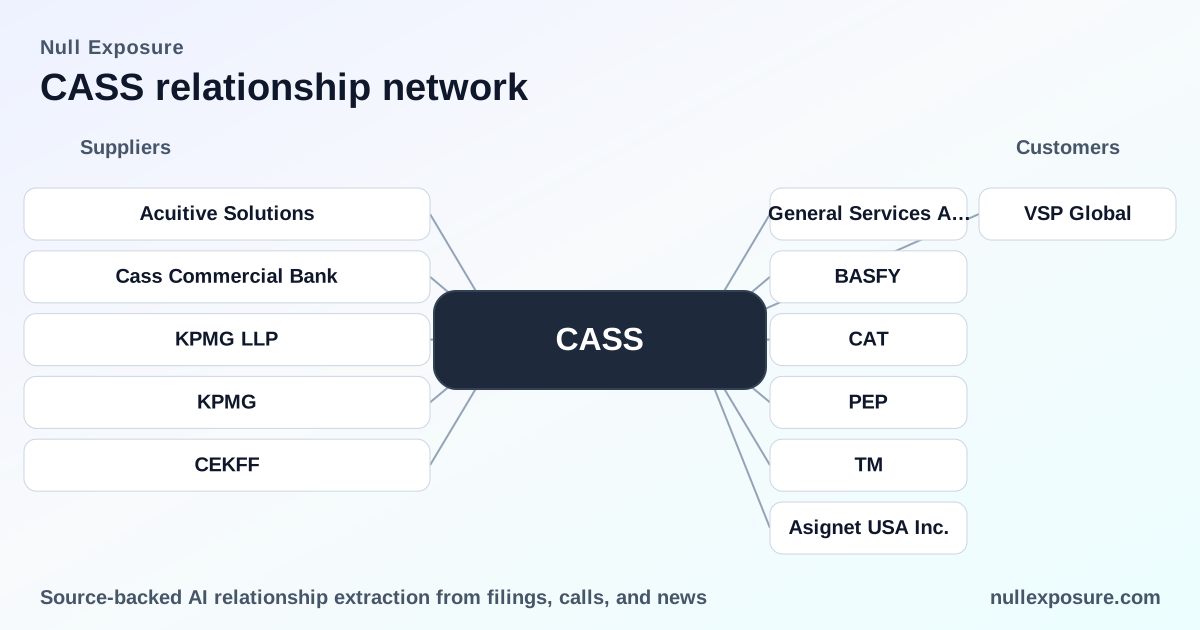
Cass Information Systems: client footprint and contract posture investors should price in
Cass Information Systems runs a two-pronged payments and information-services business that monetizes by processing and paying third‑party invoices (transportation, energy, telecom, environmental) and selling niche software/services to non‑profits and faith‑based organizations. The company earns fee income from invoice audit and payment flows, transaction margins on large-volume freight and energy payments, and recurring subscription/license revenue for its TouchPoint software; that mix yields high operating margins and modest customer concentration. For a compact, relationship‑level read on counterparties and commercial posture, see more at https://nullexposure.com/.
Why client relationships matter for Cass valuation
Cass is a service provider to large enterprises and select non‑profits, operating almost entirely within the United States. This structure produces a predictable revenue stream from recurring invoice volumes but also ties growth to trade and freight activity among large shippers rather than to high‑growth software adoption. The company’s financial profile (mid‑single digit revenue growth, robust operating margin, dividend payer) reflects a mature payments business with low counterparty concentration and high customer scale—factors that reduce single‑client risk but cap upside.
- Contracting posture: Largely transactional and service‑based with multi-year client relationships in payments and managed services; recent GSA award expands public sector access.
- Concentration: Company disclosures and the evidence set indicate no single customer exceeds 10% of consolidated revenue, so customer concentration is immaterial.
- Criticality: For large shippers and utilities, Cass’s audit-and-pay services are operationally important—payments continuity is critical for clients—so switching costs and service reliability are meaningful value drivers.
- Maturity and segmentation: The business sits at the intersection of services and software: predominantly services (invoice processing & payments) with a smaller software/TouchPoint segment for non‑profits.
Client relationships on record (concise, source‑led)
General Services Administration (GSA)
Cass secured a Multiple Award Schedule contract that positions the company to provide freight audit and payment services to U.S. federal agencies, expanding its addressable public sector market. According to a BusinessWire/FinancialContent press release tied to the award (posted online, FY2024), Cass received the GSA Multiple Award Schedule for freight audit and payment services.
BASF
Cass counts BASF among global manufacturing customers whose transportation spend is processed through Cass’s platform; this underscores Cass’s role servicing large industrial payors. A StockTitan news summary (FY2024 referencing 2022 volumes) listed BASF among large companies supported by Cass’s transportation spend management.
Caterpillar
Caterpillar is identified as a corporate customer using Cass’s transportation and spend‑management services, illustrating Cass’s reach into heavy equipment and global supply chains. The client reference appeared in a StockTitan article summarizing Cass’s 2022 processing scale and clientele (FY2024).
PEP (ticker mapping to PepsiCo)
Cass’s processing platform is used by major consumer goods companies, with PepsiCo cited by name as a large transaction client that contributes to the company’s multi‑billion-dollar processing volume. A StockTitan post (FY2024) referenced PepsiCo (listed also under the PEP code) among the large firms for which Cass processes transportation services.
PepsiCo
PepsiCo is explicitly named as a Cass customer in public reporting on client processing volumes, reinforcing the consumer‑goods exposure of Cass’s transportation payments business. The StockTitan summary (FY2024 & referencing 2022) documents PepsiCo as a named client.
Toyota
Toyota is identified among global manufacturers that route transportation invoices through Cass, reflecting penetration into automotive supply‑chain payments. This client mention appears in the same StockTitan coverage highlighting Cass’s 2022 processing scale (FY2024).
Asignet USA Inc.
Cass disclosed the sale of its Telecom Expense Management & Managed Mobility Services business to Asignet USA Inc., an asset disposition that narrows Cass’s operational scope while monetizing a non‑core unit. A StockTitan news item (FY2026) covered the transaction and the divestiture language.
VSP Global
VSP Global partnered with Cass to launch a Bring Your Own Network (BYON) program aimed at improving remote employee connectivity and experience, signaling a partnership‑style managed services engagement. The VSP collaboration was reported in a StockTitan article (FY2026) describing the BYON program rollout.
What these relationships collectively imply for investors
Together, these client references confirm that Cass operates as a B2B payments operator to large, diversified enterprises across manufacturing, consumer goods and public sector channels. The GSA contract is strategically important because it opens a stable federal revenue channel, while relationships with BASF, Caterpillar, Toyota and PepsiCo demonstrate penetration in capital‑intensive supply chains that generate steady invoice volumes. The divestiture of telecom expense management to Asignet and the VSP alliance show Cass is actively pruning and re‑focusing its services mix toward core payments and high‑value managed services.
Key takeaway: Cass’s revenue base is transaction‑driven and high‑margin, but tied to the macrocycle of freight and energy spend among large corporates and government; investors should value stability and yield over explosive growth.
Operational constraints and company‑level risk signals
The evidence set supplies several company‑level constraints that shape the operating model and valuation:
- Counterparty mix is skewed to large enterprises (high confidence). That creates low single‑client risk but links topline growth to the activity of large shippers and national utilities.
- Cass serves non‑profit and faith‑based organizations through a dedicated TouchPoint offering (moderate confidence), giving a small, recurring software revenue stream distinct from core invoice payments.
- All revenues and long‑lived assets are substantially U.S.‑centric (high confidence), which concentrates regulatory and economic exposure domestically while limiting currency and international expansion risks.
- Materiality is immaterial at the single‑customer level (high confidence): no customer accounts for more than 10% of consolidated revenue, supporting balance and resilience.
- The firm’s role is service‑provider centric with an emphasis on payments and managed services rather than pure SaaS; this yields predictable cash flows but slower revenue multiple expansion.
These signals inform a valuation posture: discounting for cyclicality in transportation and energy spend, while recognizing dividend yield and cash conversion as valuation anchors.
Bottom line and investor action
Cass is a predictable, operations‑heavy payments business serving large US corporations and public sector clients, with modest software exposure and low customer concentration—a profile suited to yield‑oriented portfolios that value operational stability over rapid scale. For a detailed view of counterparties and contract language pulled from public sources, visit https://nullexposure.com/.
Bold investors should weigh the defensive cash flows from federal and large enterprise engagements against exposure to freight and energy cycles; for tactical runway and client‑level monitoring, explore the Cass customer dossier at https://nullexposure.com/.