Casey’s General Stores (CASY): Customer Relationships and Operational Profile
Casey’s operates a vertically integrated convenience retail and fuel business that earns revenue primarily from retail fuel sales and in-store merchandise, supplemented by loyalty-driven repeat transactions and strategic acquisitions that expand store count and wholesale fuel capabilities. The company monetizes through high-frequency retail purchases, fuel margins exposed to spot market cycles, and cross-selling through the Casey’s Rewards program — a model that combines steady transactional flow with periodic revenue uplift from M&A. For a concise reference on customer relationships and sourcing, visit https://nullexposure.com/.
Business model in plain terms: retail scale, fuel exposure, loyalty leverage
Casey’s is a convenience-store operator and fuel retailer headquartered in Ankeny, Iowa, operating under the Casey’s and Casey’s General Store banners. Gross revenue is driven by fuel and front-of-store merchandise, while operating margin benefits from national purchasing scale, private-label programs, and loyalty-driven basket increases. The firm reported trailing revenue of roughly $16.98 billion and an EBITDA of about $1.39 billion, with a profit margin near 3.8% (TTM figures). These headline metrics reflect a capital-intensive retail footprint — 2,904 stores as of April 30, 2025 — and an operational posture that balances retail convenience margins against wholesale fuel volatility.
How customers transact and why that matters
Casey’s relationship with its customers is fundamentally retail and spot-focused: most transactions are one-off purchases at the pump or in-store rather than long-term contractual agreements. The company explicitly structures for broad consumer traffic rather than large recurring enterprise contracts. This contracting posture means revenue is high-frequency, low-duration, and sensitive to local demand cycles and fuel price swings. At the same time, Casey’s invests in loyalty — over 9 million Casey’s Rewards members — to increase frequency and average ticket size, which stabilizes revenue per customer and partially offsets spot exposure.
Operating constraints and what they imply for investors
- Contracting posture — spot transactions dominate. Corporate disclosures characterize primary revenue sources as retail fuel and merchandise sold directly to guests, which indicates transactional sale dynamics rather than long-term service contracts. This implies higher revenue volatility tied to fuel cycles and local consumer spending.
- Customer type — individual consumers are the core counterparty. The company treats its guest base as retail consumers, supported by a loyalty program that drives repeat behavior. High retail orientation reduces counterparty credit risk but increases exposure to consumer sentiment and local economic conditions.
- Geographic footprint — concentrated U.S. regional network. Casey’s operates across 20 U.S. states, with roughly half of stores in Iowa, Missouri and Illinois, delivering geographic scale but regional concentration that ties performance to Midwestern economic trends.
- Role and maturity — seller of core convenience products and fuel. The relationship role is seller; this is the company’s core product and reflects a mature retail model with active relationships across thousands of locations.
- Relationship stage — active and operational. Store-level selling is ongoing and represents the core revenue engine, not a nascent line of business.
These signals collectively describe a mature, retail-oriented operator with a dispersed but regionally concentrated store base, transactional contracts that amplify commodity and consumer cyclicality, and a loyalty program that elevates revenue quality.
Material relationship: the Fikes acquisition and what it changed
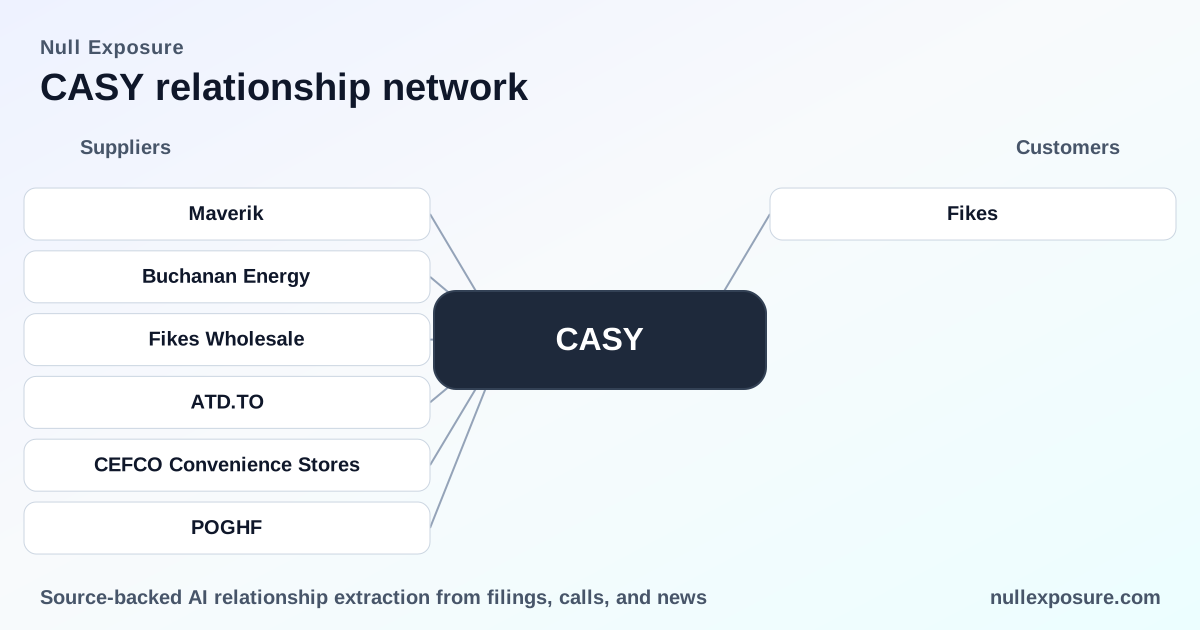
- Fikes — The FY2025 10‑K states that Casey’s benefited from $952,018 of additional revenue resulting from the Fikes acquisition, which added 198 convenience stores and a wholesale fuel network to Casey’s footprint. This transaction increased Casey’s retail scale and introduced wholesale fuel capabilities that can be leveraged for margin management and supply flexibility (Company 10‑K, FY2025).
This acquisition is a direct example of how Casey’s grows its customer base: by integrating entire retail networks and fuel distribution assets that convert into incremental retail sales and expanded supply-side control.
Why the Fikes relationship matters strategically
Acquiring Fikes expanded Casey’s store count materially and added wholesale fuel capacity. That combination delivers two strategic effects:
- Top-line accretion through new retail locations, immediately increasing the number of guest-facing relationships and the velocity of spot transactions.
- Operational optionality via wholesale fuel, which allows Casey’s to influence procurement and potentially smooth fuel margin volatility across its network.
The 10‑K disclosure on the transaction quantifies the immediate revenue pickup and highlights the acquisition’s role in scaling Casey’s retail footprint.
Investor implications: upside, risks, and attention points
- Upside: Scale and loyalty provide steady transactional revenue and cross-sell opportunities. Continued M&A that replicates the Fikes outcome can accelerate revenue growth and add supply-side assets that improve gross margin control.
- Risks: The spot contracting posture exposes earnings to fuel-price swings and local consumption trends; regional concentration increases exposure to Midwestern economic cycles; integration risk for acquisitions is persistent, especially when wholesale fuel networks are involved.
- Operational considerations: The Casey’s Rewards program (over 9 million members) is a strategic asset in reducing churn and increasing basket sizes, but it requires continued investment in digital engagement and promotion economics.
Key takeaway: Casey’s combines the defensive qualities of a high-frequency retail brand with the cyclical sensitivities of fuel retailing; growth-driven acquisitions such as Fikes shift the company toward greater scale and wholesale control, but do not eliminate commodity exposure.
Final view and practical next steps for research
Casey’s is a scale-oriented convenience retailer that monetizes through everyday consumer purchases and fuel margins, augmented by strategic acquisitions that add stores and wholesale capabilities. Investors should monitor fuel margin trends, integration outcomes from recent acquisitions, and loyalty program engagement metrics to assess revenue quality.
For a focused review of customer relationships, transaction descriptions, and source filings that informed this summary, visit https://nullexposure.com/. If you want a tailored briefing on how Casey’s customer relationships influence valuation scenarios, Null Exposure provides structured reporting and curated references.