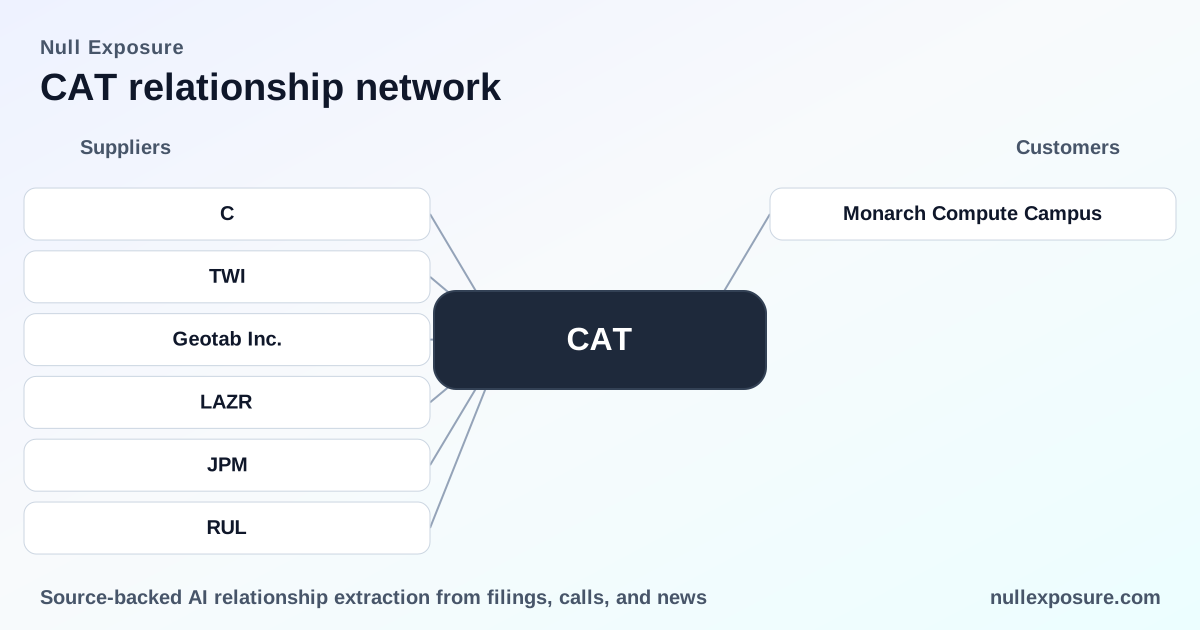
Caterpillar (CAT) customer map — who pays for the machines, the power and the finance
Caterpillar monetizes through three durable channels: manufacturing and selling heavy equipment, selling and leasing power generation assets, and capturing financing and service economics via Cat Financial and the dealer network. For investors this creates a hybrid revenue model where equipment sales drive near-term margins while long-term financing, dealer services and multi-year power frameworks generate recurring revenue and balance-sheet exposure. Explore the customer relationships that matter, the operating constraints that shape them, and the direct signals investors should monitor.
Explore more company relationship intelligence at https://nullexposure.com/
What an investor should watch in one line
Caterpillar’s customer set spans project owners, dealers and energy buyers — large framework power contracts and Cat Financial facilities are both growth levers and sources of credit concentration; dealer distribution gives global reach but limits single-account materiality.
High-level operating model constraints that drive customer economics
- Contracting posture: Caterpillar runs a mix of short‑term, terminable dealer/service agreements (often with ~90‑day exit mechanics) alongside material long‑term performance obligations; the company reported $30.1 billion of unsatisfied performance obligations tied to contracts longer than one year (with roughly one‑third recognized within 12 months of year‑end). This duality creates both flexible dealer relationships and meaningful backlog visibility.
- Geographic footprint: Activity is truly global, with significant North American operations and material sales across EMEA, APAC and Latin America — the dealer network (41 U.S., 109 outside U.S.) underpins distribution and regional revenue sensitivity.
- Concentration and criticality: No single dealer or buyer dominates credit exposure (company disclosure labels concentration as immaterial), yet Cat Financial is critical to supporting equipment purchases worldwide and therefore amplifies Caterpillar’s balance‑sheet linkage to customers.
- Roles and segments: Caterpillar operates as manufacturer, distributor (via dealers), reseller and financing service provider, and presents exposure across manufacturing, distribution and financial services lines — investors should treat each as a distinct margin and risk center.
The customer map — every relationship surfaced in public reports
Below are all relationships identified in the public record, with a concise, investor‑oriented takeaway and a source for follow‑up.
ProPetro Holding Corp. (PUMP / PROPWR)
ProPetro’s PROPWR unit signed a strategic framework agreement to buy up to 2.1 GW of Caterpillar power generation assets and separately expanded a Cat Financial facility to roughly $157 million to finance natural‑gas generators; this positions Caterpillar as both OEM and financier for distributed power deployments. Source: ProPetro filings and news coverage (Morningstar / TradingView, March–May 2026 — https://www.tradingview.com/news/tradingview:611c7e69ca78a:0-propetro-holding-corp-sec-10-k-report/).
Ioneer Ltd (IONR)
Ioneer selected Cat’s MineStar Command and autonomous Cat 785 haul trucks as its exclusive heavy‑equipment partner for Rhyolite Ridge, with Caterpillar also offering finance solutions through Cat Financial. This is a classic OEM + services package for a greenfield mine. Source: industry reporting and company announcements (SmallCaps / IM‑Mining, 2026 — https://smallcaps.com.au/article/ioneer-buy-caterpillar-autonomous-haul-trucks-nevada-lithium-boron-mine).
Titan Machinery Inc. (TITN)
Titan Machinery represents Caterpillar among other OEMs in its dealer model, illustrating the dealer ecosystem that distributes Cat equipment and parts across agricultural and construction end markets. Source: market commentary and filings (MarketBeat, March 2026 — https://www.marketbeat.com/instant-alerts/titan-machinery-nasdaqtitn-stock-crosses-above-two-hundred-day-moving-average-should-you-sell-2026-02-16/).
Wabtec Corporation (WAB)
Wabtec’s settlement with Progress Rail — referenced in market coverage — highlights competitive dynamics among locomotive and heavy‑equipment suppliers where Caterpillar’s rail and power participation is part of the supplier landscape. Source: SimplyWallSt market coverage (2026 — https://simplywall.st/.../wabtec-settlement-with-progress-rail-clears-path-for-rail-gr/amp).
Werner Enterprises (WERN)
Historic fleet purchases included trucks powered by Caterpillar ACERT engines, underlining Cat’s aftermarket and engine supply role in commercial transportation fleets. Source: trucking industry reports (TruckingInfo, referenced 2003 example cited in 2026 summaries — https://www.truckinginfo.com/news/werner-reports-8th-quarter-of-higher-earnings).
Suncor Energy (SU)
Suncor is scaling autonomous hauling technology and other on‑site power and mine solutions where Caterpillar supplies autonomous haul and power technology for large energy and mining projects. Source: FinancialContent market coverage (April 2026 — https://markets.financialcontent.com/stocks/article/marketminute-2026-4-3-suncor-energy-unveils-ambitious-2028-growth-strategy-a-100000-bpd-surge-to-anchor-canadian-energy-leadership).
Atlas Energy Solutions (AESI)
Atlas executed a global framework to buy 1.4 GW of Cat power assets ($840M) with deliveries between 2027–2029 and used proceeds to fund equipment purchases under the Caterpillar agreement, showing Cat’s scale in the distributed power market. Source: analyst and press coverage (RBC / MarketScreener / Yahoo Finance, May 2026 — https://uk.finance.yahoo.com/news/atlas-energy-solutions-announces-executed-110000255.html).
IAMGOLD Corporation (IAG)
IAMGOLD entered a master lease with Caterpillar Financial Services (initially $125M, later increased to $175M) to lease mobile mining equipment — an explicit example of Cat Financial underwriting mine fleets. Source: company press release (Newsfile PR, April 2026 — https://www.newsfilecorp.com/release/284174/IAMGOLD-Reports-Fourth-Quarter-and-YearEnd-2025-Results).
Nova Minerals (NVA)
Nova disclosed the purchase of a Cat front‑end loader for onsite mining operations, illustrating standard end‑user equipment buys in junior mining programs. Source: quarterly activities report (Junior Mining Network / Yahoo Finance coverage, March 2026 — https://www.juniorminingnetwork.com/.../quarterly-activities-and-cashflow-report-december-2025.html).
Kodiak Gas Services (KGS)
Kodiak’s acquisition of Distributed Power Solutions brought a fleet 100% powered by Caterpillar engines and turbines, stressing equipment commonality and supplier alignment benefits with Cat. Source: corporate press and industry reports (Finance Yahoo / GasCompressionMag, March 2026 — https://finance.yahoo.com/news/kodiak-gas-services-buy-dps-092728346.html).
Monarch Compute Campus (project)
Caterpillar secured a landmark 2 GW contract to supply natural‑gas generator sets for the Monarch Compute Campus, positioning Cat as a critical supplier into large AI/data center infrastructure projects. Source: market narrative coverage (SimplyWallSt, March 2026 — https://simplywall.st/.../caterpillar/46wbkiat-caterpillar-inc-cat-the-industrial-architect-leveraging-the-ai-data-center-boom-and-infrastructure-supercycle-in-2026).
RenX Enterprises (RENX)
RenX reported acquisitions including a CAT excavator as part of its pivot to environmental solutions and fleet expansion, indicating steady equipment demand at the small‑cap operator level. Source: quarterly company news (QuiverQuant, March 2026 — https://www.quiverquant.com/news/RenX+Enterprises+Corp.+Reports+Transformational+Year).
Pangaea Logistics Solutions (PANL)
Pangaea’s financials note installment sale proceeds tied to the purchase of Caterpillar equipment, showing equipment financing and sale‑leaseback mechanics at work. Source: company press release (PR Newswire, March 2026 — https://www.prnewswire.com/news-releases/pangaea-logistics-solutions-ltd-reports-financial-results-for-the-fourth-quarter-ended-december-31-2025-302710100.html).
NGS (NGS)
NGS cites Caterpillar among critical OEM vendors for compressor unit engines, highlighting Cat’s role as a key supplier of components for midstream compression assets. Source: 10‑K extract (NGS filing, FY2024 — ngs-2024-12-31).
USA Compression Partners (USAC)
USAC identified lead‑time pressures attributable to Caterpillar engines driven by data center demand, signaling supply chain constraints translating into project delivery risk. Source: earnings‑call coverage (InsiderMonkey, May 2026 — https://www.insidermonkey.com/blog/usa-compression-partners-lp-nyseusac-q4-2025-earnings-call-transcript-1698095).
Vertiv Holdings (VRT)
Vertiv and Caterpillar, together with Solar Turbines, agreed to integrate power and cooling offerings for data centers, illustrating ecosystem partnerships where Cat supplies generation assets into modular solutions. Source: strategic developments coverage (SimplyWallSt, 2026 — https://simplywall.st/.../vertiv-holdings-co/future).
Integra Resources (ITRG)
Integra’s fleet revitalization included Caterpillar 992HL loaders and Cat 785 haul trucks, showing Cat’s footprint in both refurbishment and new equipment procurement for mid‑tier mines. Source: PR Newswire company results (April 2026 — https://www.prnewswire.com/news-releases/integra-reports-fourth-quarter-2025-results-302724018.html).
Sky Quarry (SKYQ)
Sky Quarry owns Solar Centaur Caterpillar gensets (7 MW combined at a PR Spring facility), an example of Cat power assets deployed at project scale for remote operations. Source: finance and company statements (The Globe and Mail / MEXC, March–May 2026 — https://www.theglobeandmail.com/.../pressreleases/81465/kodiak-gas-services-to-acquire-distributed-power-solutions/).
NMG (project partner)
NMG reported partnering with Caterpillar on the development and procurement of a zero‑emission fleet and infrastructure for a future mine, indicating Cat participation in decarbonization and next‑gen mine programs. Source: industry news (NMG coverage, 2025–2026 — https://nmg.com/multiple-offtakes-2025/).
Risk and investment implications
- Credit linkage through Cat Financial: framework purchases often pair equipment supply with financing facilities, increasing Caterpillar’s earnings capture but also balance‑sheet exposure to customers.
- Supply constraints and lead times: buyers note lead‑time pressure for Cat engines and generator sets, which inflates project schedules and can support pricing power but risks order cancellations.
- Dealer distribution insulates concentration risk: the dealer network reduces single‑customer concentration, but dealer inventory cycles influence near‑term revenue delta.
Bottom line
Caterpillar’s customer relationships are broad, global and multi‑dimensional: the company sells hardware, underwrites financing and embeds into multi‑year power frameworks. For investors, the twin signals to monitor are Cat Financial exposure on the balance sheet and the cadence of large power framework deliveries — both drive forward earnings visibility and risk. Learn more about how these relationships influence credit and revenue outlooks at https://nullexposure.com/.