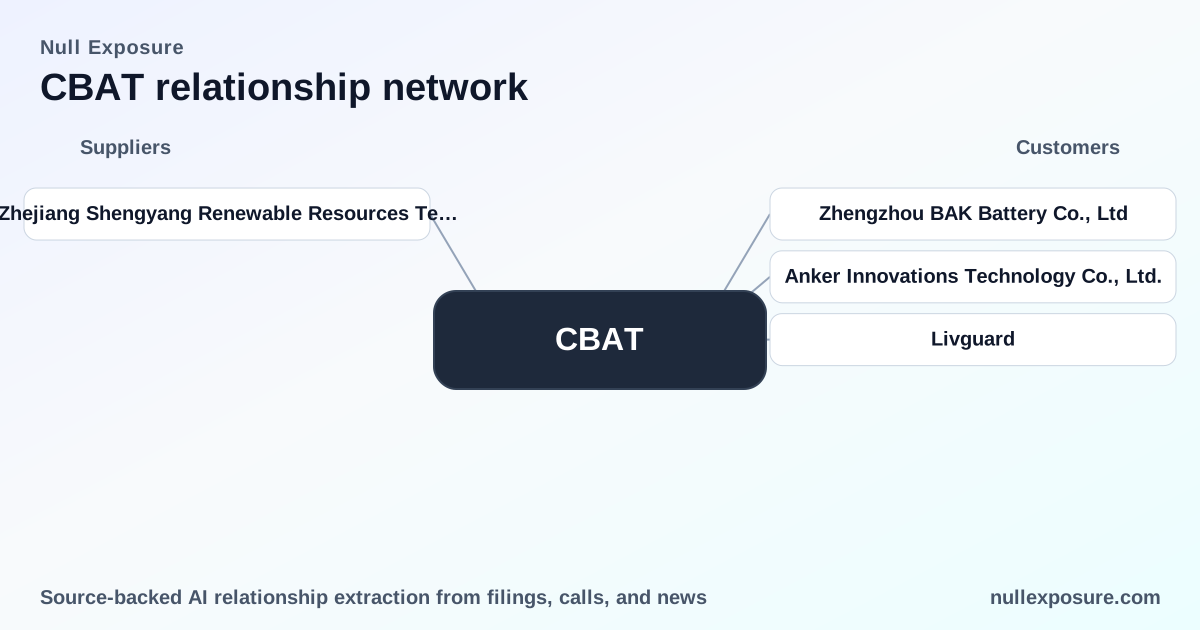
CBAK Energy (CBAT) — Customer Map and What It Means for Investors
CBAK Energy is a China‑based manufacturer of lithium and sodium high‑power batteries that monetizes primarily through the sale of cells, cathode materials and related components to OEMs, distributors and energy‑storage integrators across Asia, Europe and other export markets. Revenue accrues from product sales and follow‑on component contracts, with a customer mix concentrated among a small number of large buyers; that structure drives both near‑term revenue volatility and material operational leverage when volume ramps. For primary research and relationship intelligence, visit https://nullexposure.com/.
Who the customers are and why they matter
CBAK’s public filings and press disclosures identify a compact roster of high‑impact customers that drive the majority of sales. Each relationship below is summarized from company filings and contemporaneous press announcements.
Zhengzhou BAK Battery Co., Ltd
Zhengzhou BAK is a material customer for CBAK: the company’s 2024 Form 10‑K lists Zhengzhou BAK among customers that individually comprised 10% or more of net revenue, and separately discloses sales of cathode raw materials to Zhengzhou BAK of roughly $27.9 million in the period referenced. This is both a concentration and a counterparty credit signal given the scale of purchases. According to CBAK’s 2024 Form 10‑K, Zhengzhou BAK was a top individual revenue contributor for FY2024.
Anker Innovations Technology Co., Ltd.
Anker is a strategic commercial customer and partner for CBAK, explicitly described in company press releases as one of CBAK’s largest customers and the subject of a strategic partnership announced in 2026. The relationship is a multi‑year commercial win in the portable and consumer power segment and is referenced in CBAK press material and FinancialContent coverage in 2026.
Jackery
Jackery is a top‑tier portable power brand that sources CBAK’s 26‑series cells; CBAK reports that these standard cells were the primary driver of 2025 shipment volumes and that select lines were converted to full‑tab manufacturing to better serve customers like Jackery. Industry press and CBAK statements (Bitget coverage, 2026) identify Jackery as a major consumer electronics customer in the portable power supply market.
Livguard
Livguard is an Indian energy‑storage solutions provider that placed a significant follow‑up order with CBAK, explicitly disclosed in market releases and press reports covering 2025–2026 activity. CBAK announced a follow‑up order described as material in MarketScreener and in company press coverage during 2026, underlining traction in South Asia.
Operational signals and commercial constraints investors should factor in
CBAK’s customer relationships are not just names on a revenue table; they shape the company’s operating model.
- Short‑term contracting posture: The company states it does not have long‑term purchase commitments and that sales contracts are typically one year or less; this produces revenue seasonality and quarter‑to‑quarter volatility driven by order timing and customer inventory policies. (Company 10‑K disclosure.)
- Geographic revenue mix is global but APAC‑weighted: CBAK’s revenue is generated from domestic Chinese customers and international buyers — with mainland China and Europe explicitly reported as large markets and stated intent to penetrate India and Vietnam — making CBAK a globally distributed supplier with strong APAC exposure. (Form 10‑K geographic breakdown.)
- Concentration risk is material: The top five customers accounted for roughly 66% of revenue in FY2024, which creates client concentration risk and amplifies the impact if a single large buyer reduces orders. (Form 10‑K customer concentration disclosure.)
- Manufacturer + distributor dynamics: CBAK functions primarily as a manufacturer/seller of cells and cathode materials while also relying on distributors for overseas market access, introducing execution and channel risk related to distributor capability and retention. (Form 10‑K discussion of operations and distribution.)
- Segment posture and scale: The company operates core manufacturing segments tied to battery cells and cathode precursors; disclosed revenues to large customers (for example, the $27.9M cathode sales to Zhengzhou BAK) place many customer relationships in the $10M–$100M spend band, which is meaningful but not monopoly‑scale for global OEMs. (Segment disclosures and sales line items.)
These signals together imply an operating model that can scale quickly when order flow accelerates but is sensitive to short contract cycles and customer concentration.
Investment implications — risks and upside drivers
- Risk: revenue volatility and concentration. Short contract terms plus a top‑five concentration of roughly two‑thirds of sales make near‑term revenue and margin stability dependent on retained ordering from a few counterparties. (Form 10‑K.)
- Risk: margin pressure and profitability. Financials show operating losses and negative EBITDA in recent trailing twelve months, meaning the company needs sustained volume growth or cost improvement to translate revenue into durable profits. (Company financials, TTM data.)
- Upside: product upgrades and strategic customers. Conversion to full‑tab manufacturing and the strategic partnership with Anker provide operational upgrades that improve product fit for portable power leaders (e.g., Jackery) and open cross‑sell or preferred‑supplier dynamics. (Company press releases and 2026 announcements.)
- Geographic expansion as a growth vector. Follow‑up orders from Livguard in India and explicit market penetration efforts into Vietnam and other APAC markets demonstrate a channel play that diversifies geographic concentration over time. (MarketScreener and Form 10‑K statements.)
Bottom line and where to look next
CBAK’s business model is manufacturing‑centric, export‑oriented and customer‑concentrated. For investors evaluating near‑term cash‑flow and credit risk, monitor: order backlogs with top buyers, renewal cadence with Anker and Jackery, and any change in contract length or move toward multi‑year supply commitments. For actionable relationship intelligence and ongoing coverage, see https://nullexposure.com/.
Bold takeaway: CBAK scales with volume from a small set of large customers — that is the source of both its upside and its primary risk.