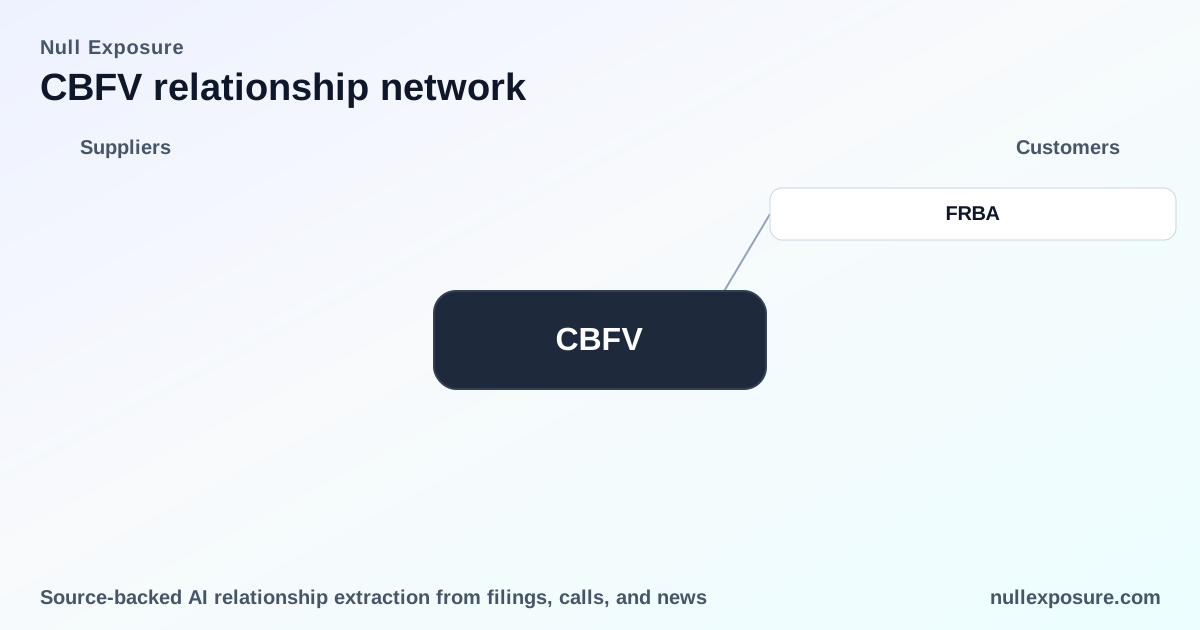
CB Financial Services (CBFV) — Customer Relationships and Operational Signals
CB Financial Services operates as a community bank holding company that earns the bulk of its revenue from traditional banking activities: interest income on commercial, mortgage and consumer loans, fees on deposit services, and incidental income such as insurance commissions. The company monetizes through loan origination and servicing, net interest margin management, and deposit gathering inside a compact southwestern Pennsylvania and West Virginia footprint. For investors, the most relevant customer relationship signals are the firm’s reliance on secured lending facilities and the local concentration of its borrower base.
Learn more about how Null Exposure collects relationship intelligence at https://nullexposure.com/.
The Federal Reserve (FRB) facility that underpins liquidity and collateral management
CB Financial’s 2024 Form 10‑K discloses a Borrower‑In‑Custody of Collateral line of credit with the Federal Reserve Board (FRB) for $84.0 million that is secured by commercial and consumer indirect auto loans, requires monthly certification of collateral, is subject to annual renewal, and incurs no service charge. This facility is a structural backstop for liquidity and demonstrates active collateral management processes. According to the company’s 2024 Form 10‑K filing, the line stood at $84.0 million as of December 31, 2024.
The FRBA tagging—same economic arrangement recorded under an alternate identifier
The public record also lists an entry tagged as FRBA that references the identical Borrower‑In‑Custody line of credit for $84.0 million secured by the same collateral types, with the same monthly certification and annual renewal terms. The duplicate tagging reflects how the 10‑K text and downstream data feeds map the Federal Reserve reference, and both entries trace to the company’s 2024 Form 10‑K disclosure.
What the relationships and filings reveal about CBFV’s operating model
The combination of the Federal Reserve collateral line and the company’s narrative in its 10‑K yields several operational and business model characteristics:
- Contracting posture: The FRB line requires monthly collateral certification and annual renewal, indicating recurring operational obligations and active collateral monitoring rather than a static, long‑term covenantless facility.
- Concentration and geography: Management positions the bank as a community‑oriented institution focused on southwestern Pennsylvania and adjacent West Virginia counties, which creates geographic concentration of both depositors and borrowers and a commercial mix skewed toward local small and mid‑market businesses.
- Customer mix and role: Filings characterize the bank as a direct seller of financial services to individuals, small businesses and mid‑market customers—the company operates as the service provider and primary product seller in its market area.
- Criticality and maturity of funding relationships: A secured $84M Fed line anchored to indirect auto loans is a meaningful liquidity tool; annual renewals and required certifications suggest moderate maturity with ongoing oversight rather than irreversible long‑term commitment.
These points are drawn from language in the company’s 2024 annual report, which frames the bank’s primary market area and product mix and explicitly documents the Borrower‑In‑Custody line arrangement.
All identified customer relationships, stated plainly
- FRB — The bank maintained a Borrower‑In‑Custody of Collateral line of credit with the Federal Reserve Board for $84.0 million, requiring monthly collateral certification, subject to annual renewal, secured by commercial and consumer indirect auto loans, and incurring no service charge (Company 2024 Form 10‑K).
- FRBA — The same $84.0 million Borrower‑In‑Custody collateral line is also listed under an FRBA tag in public results, reproducing the 10‑K disclosure that details monthly certification, annual renewal, and security by indirect auto loans (Company 2024 Form 10‑K).
Both entries trace back to the same disclosure in the 2024 Form 10‑K; the repeated listing reflects alternative entity tagging rather than two distinct economic facilities.
Risk and value considerations for investors
CB Financial’s business profile and the disclosed Fed facility translate into a compact but clear risk/reward picture:
- Value drivers: The bank generates revenue from interest margin and fees within a stable local franchise; the company reports a trailing price/earnings ratio of 26.69 and a forward P/E of 14.64, with an analyst target price near $39.33 per share (company summary metrics). The community banking model supports predictable fee and interest flows when local credit conditions are stable.
- Key risks: Geographic concentration and a customer base skewed to individuals, small businesses and mid‑market borrowers raise sensitivity to localized economic stress. The FRB line’s monthly certification requirement increases operational exposure: deficiencies in collateral coverage or reporting could constrain access to that liquidity.
- Balance between funding flexibility and oversight: The $84M secured Fed line provides meaningful flexibility but is tied to collateral quality and documentation discipline; that makes collateral management operationally critical.
Financial context from filings shows modest profitability with a Return on Equity around 4.47% (Trailing twelve months), market capitalization roughly $177.3 million, and a dividend yield around 2.91% based on current distributions. These figures frame the bank as a small-cap regional franchise with income yield and room for earnings leverage if net interest margins expand or loan growth accelerates.
Practical takeaways and what to monitor next
- Monitor collateral certification cadence and any changes to the FRB facility terms. Monthly certification and annual renewal are operational levers that can tighten or loosen funding depending on loan performance.
- Watch local economic indicators in southwestern Pennsylvania and adjacent West Virginia counties. Given the bank’s concentrated footprint and borrower mix, regional employment, auto loan delinquencies and small business conditions will drive credit trends.
- Track capital and profitability trends. The bank’s ROA and ROE are modest; improvements in net interest margin or fee income conversion would materially change the valuation case.
For a concise feed of customer-relationship signals and to compare CBFV’s counterparties across peers, visit https://nullexposure.com/.
Overall, CB Financial runs a tightly scoped community banking franchise that relies on secured, operationally intensive liquidity arrangements while serving a predominantly local mix of individual and small/mid‑market customers. Investors should evaluate both the stability of the collateral base that supports the Federal Reserve line and the regional credit cycle as primary drivers of near‑term earnings and funding resilience.