Crescent Biopharma (CBIO): Partnership-driven commercialization with near-term cash from licensing
Crescent Biopharma develops next‑generation biologics and oncology candidates and monetizes primarily through licensing deals and contract manufacturing arrangements rather than product sales today. The company converts early‑stage assets into non-dilutive cash and downstream royalties—evidenced by a recent Greater China license that delivered a meaningful upfront and recurring economics—and supplements that model with targeted manufacturing and clinical‑supply contracts. For investors and operators, the thesis is simple: Crescent is a clinical‑stage developer that leverages partner distribution and manufacturing to de‑risk capital needs while retaining upside through milestone and royalty structures.
If you want a concise way to track these partner flows and their strategic value, visit the research hub at https://nullexposure.com/ for a structured view of counterparty exposure and revenue signals.
How Crescent generates value: licensing, supply and staged monetization
Crescent operates as a developer‑first biotech that uses partnerships to realize value before commercialization. Primary monetization channels are:
- Exclusive regional licensing (upfront cash, milestones, royalties).
- Clinical‑supply and manufacturing contracts (fee revenue and price‑per‑unit economics).
- Retained clinical development for select global indications where Crescent preserves clinical rights.
These channels explain the revenue profile: low recurring product sales today, lumpy licensing receipts, and a balanced mix of cash upfronts and backend royalties. The company’s FY2026 disclosures show large dependence on partner upfronts—important to model explicitly when projecting cash flow and valuation.
The strategic customer relationships you need to know
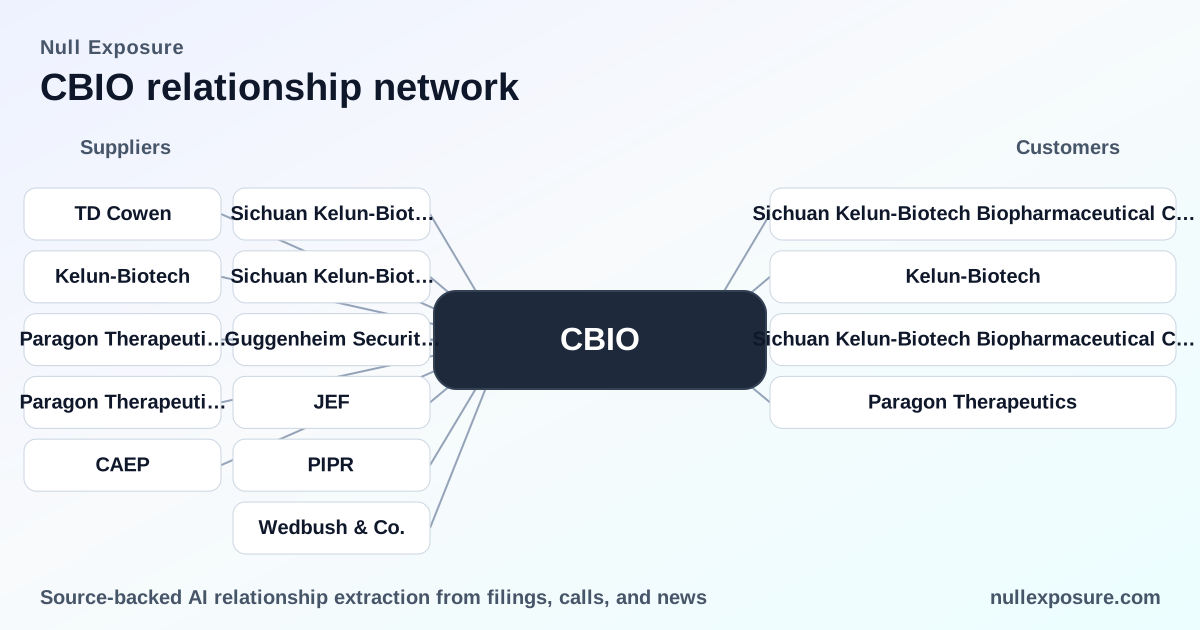
Below I cover every partner relationship surfaced in the public results and how they translate into near‑term economics and strategic positioning.
Sichuan Kelun‑Biotech — Greater China exclusivity and $20M upfront
Crescent granted Sichuan Kelun‑Biotech exclusive rights to research, develop and commercialize CR‑001 in Greater China, generating a $20.0 million upfront payment recorded as revenue and up to $30.0 million in milestone payments plus tiered low‑ to mid‑single‑digit royalties on net sales. This deal both accelerates CR‑001 development in Asia and provides Crescent with immediate non‑dilutive capital. (According to the company’s press releases and filings detailing the partnership and the upfront recognition, Dec 2025–Q1 2026.)
Source: GlobeNewswire announcement (Dec 4, 2025) and Crescent’s Q1 2026 financial release (Apr 29, 2026).
Kelun‑Biotech — execution updates and clinical milestones
Beyond the headline license economics, Kelun‑Biotech has moved CR‑001 into clinical activity under the collaboration, including IND clearances and first patient dosing in the ASCEND Phase 1/2 trial—progress that unlocks future milestones under the agreement. Those clinical readouts are the primary near‑term value drivers for additional payments and eventual royalty streams.
Source: GlobeNewswire and related press coverage summarizing IND clearances and ASCEND dosing (Jan–Feb 2026).
Paragon Therapeutics — collaboration on immuno‑oncology and ADC strategies
Crescent lists Paragon Therapeutics among leading partners with whom it is pursuing immuno‑oncology programs and antibody‑drug conjugate (ADC) combinations, indicating a cooperative approach of co‑development and externalized commercialization for complex oncology assets. This relationship signals Crescent’s strategy to combine internal R&D with partner expertise to broaden clinical scope and commercialization pathways.
Source: GlobeNewswire partnership announcement (Dec 4, 2025).
Apollomics — clinical supply agreement (manufacturing revenue)
Crescent’s public filings disclose a clinical supply agreement with Apollomics under which Crescent will manufacture and supply uproleselan product at agreed prices, demonstrating that manufacturing contracts provide a predictable, fee‑for‑service revenue leg alongside licensing. This is a direct statement in company regulatory materials rather than a press release.
Source: Company filings (regulatory disclosures, FY filings).
What the relationship map tells investors about risk and runway
The partner roster and contract types produce clear business‑model signals that should shape valuation and operational diligence:
- Contracting posture: Crescent structures deals to capture upfront cash and retain upside via milestones and royalties—this reduces near‑term dilution and makes revenue lumpy but sizable when deals close. The Kelun upfront is a textbook example.
- Concentration: Large license receipts create revenue concentration risk—single partner events (like the $20M Kelun upfront) can materially move reported revenue. Investors must treat covenant and milestone timing as binary risk drivers.
- Criticality: Partnerships are mission‑critical for commercialization and regional access; giving exclusive rights for Greater China accelerates market entry while shifting commercialization execution risk to Kelun.
- Maturity: Relationships span early clinical execution (ASCEND dosing) to documented commercial economics (upfronts and royalties), placing Crescent in a mid‑stage partnership maturity cohort—not yet a product‑sales company, but not a purely discovery stage biotech either.
Regulatory and counterparty context that affects customer dynamics
Company disclosures also flag several company‑level constraints that shape customer relationships and go‑to‑market mechanics:
- Government and healthcare payor exposure: Crescent acknowledges anti‑kickback, fraud and other healthcare laws affecting relationships with payors and providers, which underscores regulatory complexity when licensing to cross‑border partners or engaging with public healthcare systems.
- Global footprint: Disclosures identify global commercialization and payor interactions as core to the commercial pathway, reflecting multi‑jurisdictional risk and upside when partners hold regional rights.
- Role diversity: Public filings list Crescent as a manufacturer, seller and (in the commercial context) buyer of services, signaling a hybrid operating model that combines developer, contract manufacturer and licensing counterparty roles.
These constraints are company‑level signals; Apollomics is explicitly identified in filings as a counterparty under a clinical supply agreement, which is why manufacturing revenue emerges as a discrete line item in recent quarter reporting.
Investment implications and what to watch next
- Near‑term cash profile is driven by partner upfronts and milestones. Model lumpy licensing receipts separately from recurring manufacturing revenue.
- Clinical readouts from Kelun (ASCEND) will be binary catalysts for milestone payments and royalty potential; track IND/clinical milestones on Kelun’s timeline.
- Commercial concentration risk is real. One or two licensing events dominate recent revenue—investors should monitor partner performance and milestone timing carefully.
For a systematic view of Crescent’s counterparty exposures, licensing timelines and revenue triggers, explore our hub at https://nullexposure.com/ where the partnership map and filing annotations are maintained and updated.
Bold, partner‑led monetization is Crescent’s operational identity: the company turns clinical assets into cash via regional licensing and fee‑for‑service manufacturing while retaining asymmetric upside through milestones and royalties. Investors should underwrite both the upside from successful partner development and the timing/concentration risk that comes with an early‑stage, collaboration‑heavy model.