Chain Bridge Bancorp (CBNA): Customer Relationships and Strategic Implications
Chain Bridge Bancorp operates as the bank holding company for Chain Bridge Bank, N.A., providing deposit, lending, treasury, wealth and custody services to a nationwide client base from a single banking office in McLean, VA. The company monetizes through net interest margin on commercial and consumer lending, fee income from trust and custody services, and deposit-placement income for excess balances routed through wholesale liquidity networks. For investors evaluating customer relationships, the mix of politically oriented non-profits, institutional custody clients, and retail depositors creates both durable fee corridors and concentrated counterparty risks. Learn more about our coverage at https://nullexposure.com/.
How Chain Bridge actually makes money and who it serves
Chain Bridge is a service-focused regional bank that packages traditional banking products (deposit accounts, treasury services, commercial and residential lending) with trust, wealth management, and custody capabilities. Revenue drivers are split between interest income on loans and investment securities and fee-based services, notably custody/trust fees and deposit placement revenue when the bank places excess deposits through third-party networks.
- Fee and placement income is a second-order but material revenue stream: the company reports explicit deposit-placement income tied to third-party networks for excess liquidity, which can fluctuate quarter-to-quarter.
- Customer mix skews toward non-profits and political organizations alongside individuals and commercial entities, a positioning that shapes deposit stickiness, compliance burdens, and political/reputational sensitivity.
- A nationwide deposit footprint from a single office produces scale in fee capture but concentrates operational complexity around remote service delivery.
Company-level constraints that shape the customer profile
Investors should treat several filing-extracted constraints as structural characteristics of Chain Bridge's operating model rather than incidental facts.
- Contracting posture — short-term funding: Deposits are a primary funding source and are generally withdrawable on demand, which makes liquidity management central to capital and ALM strategy.
- Counterparty mix — non-profit and individual clients dominate: Filings explicitly list political committees, PACs, tax-exempt 527 organizations, trade associations and individual clients as primary customers, which elevates compliance, reputational and concentration considerations.
- Geographic reach — national but regionally concentrated lending: Chain Bridge serves clients in 49 states plus D.C. and Puerto Rico, yet lending exposure is materially concentrated in the Washington, D.C. metro area, combining national deposit diversity with regional credit concentration.
- Materiality and concentration: The bank discloses that four custody clients each exceeded 5% of assets under administration and collectively represented 35% of AUA, signaling meaningful client concentration in the custody segment.
- Service-provider role and business maturity: The company presents itself as a full-service provider—deposits, loans, trust, wealth and custody—reflecting mature service lines with diversified fee opportunities.
- Liquidity sizing tied to third-party placement programs: According to company disclosures as of December 31, 2024, $193.6 million of deposit balances were enrolled in the IntraFi Cash Service (ICS) program, and $63.3 million of excess deposits were placed at other participating banks as One-Way Sell deposits, indicating structural reliance on deposit placement mechanics for excess-liquidity management.
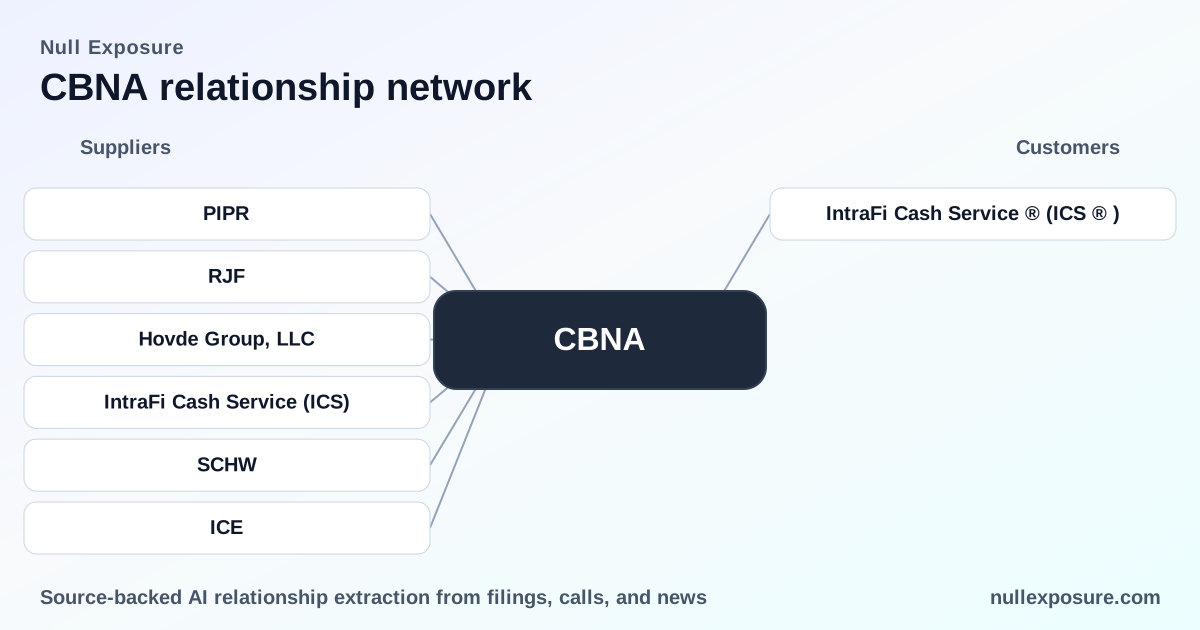
The single customer relationship in view: IntraFi Cash Service (ICS)
IntraFi Cash Service (ICS): Chain Bridge uses IntraFi’s ICS network to place excess deposits; deposit-placement services income is driven by One-Way Sell volumes and the rates paid by ICS for those deposits. Deposit-placement services income was $372,000 in Q4 2025, up from $174,000 in Q3 2025 and down from $582,000 in Q4 2024. (Source: StockTitan summary of Chain Bridge's FY2026 results, published March 2026.)
Additionally, Chain Bridge’s filings show $193.6 million enrolled in the ICS program as of December 31, 2024, with $63.3 million placed as One-Way Sell deposits, establishing ICS as a meaningful conduit for liquidity placement and a non-trivial contributor to fee income. (Source: Company filing disclosures as of December 31, 2024.)
Why the ICS relationship matters strategically
The ICS partnership is a functional lever for liquidity and a source of fee income. Two features make it important to investors:
- Revenue volatility: Deposit-placement income moves with volumes and marketplace rates; the sequential and year-over-year swings in Q4 2025 underscore the sensitivity of that revenue line.
- Balance-sheet management: The substantial enrollment level in ICS (nearly $194M) and One-Way Sell placements ($63.3M) highlight a structural use of third-party networks to manage excess deposits without expanding on‑balance sheet lending or securities positions.
Investment implications and a focused risk checklist
Chain Bridge’s customer profile and operating constraints create a compact set of investment levers and risks for credit and equity investors.
Key positives:
- Diversified service lines (traditional banking plus custody/wealth) generate fee channels beyond net interest margin.
- Solid profitability metrics — return on equity around 13.3% and a healthy operating margin — support valuation of a regionally focused bank (company financials, latest quarter 2026-03-31).
Key risks and monitors:
- Client concentration in custody: Four custody clients represent 35% of AUA; loss or downgrades of one large relationship would materially compress fee income.
- Liquidity sensitivity from short-term deposits: The bank’s funding base is largely withdrawable deposit balances, increasing reliance on placement programs like ICS for active liquidity management.
- Revenue swings from deposit-placement activity: The deposit-placement income series shows quarter-to-quarter volatility; track ICS-related volumes and market rates to model short-term fee variability.
- Reputational and compliance exposure: Heavy exposure to political committees and tax-exempt organizations adds compliance costs and potential reputational risk in politically charged cycles.
Actionable checklist for investors:
- Monitor ICS placement balances and One-Way Sell volumes each quarter and compare placement income trends against those balances.
- Watch the composition of the top custody clients and any disclosed attrition or onboarding that would alter the 35% AUA concentration.
- Evaluate liquidity buffers and access to wholesale funding given the short-term character of the deposit base.
- Assess regulatory and reputational disclosures tied to political-customer activity and related compliance expenditures.
Bottom line
Chain Bridge Bancorp is a compact, service-oriented regional bank whose deposit-placement partnerships (notably ICS) and custody client concentration are primary lenses through which to assess near-term revenue durability and liquidity risk. Operationally, the bank balances nationwide deposit sourcing with geographically concentrated lending and a client mix that emphasizes non-profits and political organizations — a combination that offers differentiated fee opportunity but also concentrated counterparty and reputational risk. For deeper diligence on relationship exposures and model implications, visit https://nullexposure.com/.