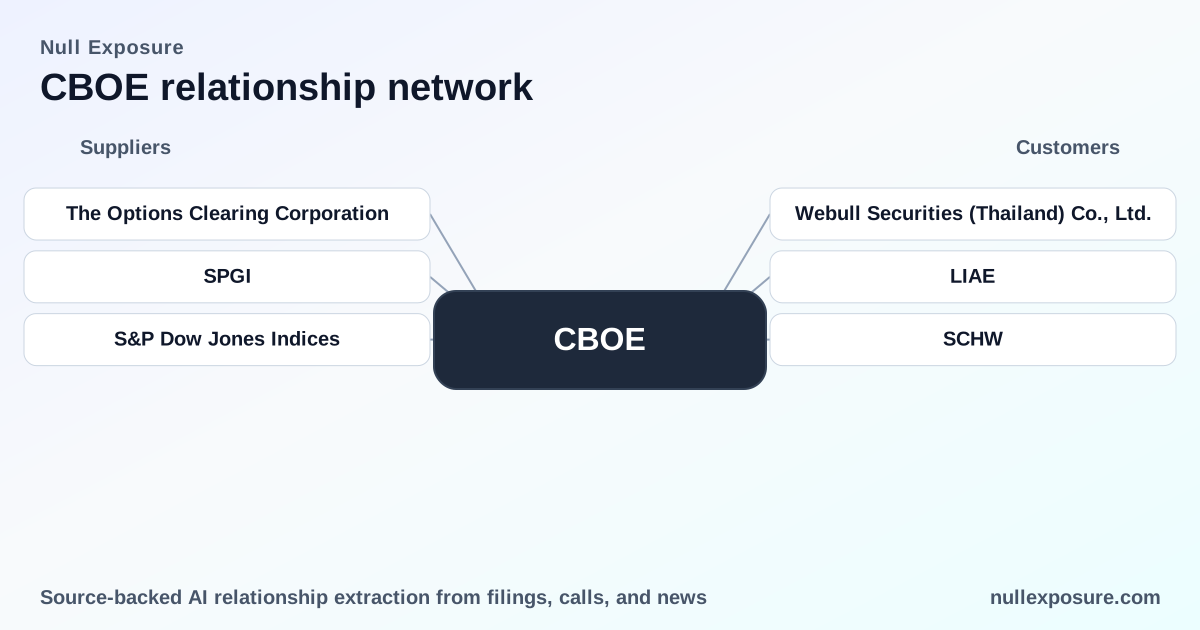
Cboe customer map: who pays and why it matters for investors
Cboe Global Markets operates exchanges, listings platforms, clearing and market data businesses and monetizes through transaction and clearing fees, index and market-data licensing, and listings/listing services. The company’s economics are fee‑dense and concentrated—a small set of market‑makers, banks and ETF sponsors account for a large share of trading volume and recurring licensing revenue, while its product set spans equities, options, futures, FX and ETP listings across North America, Europe and Asia Pacific.
If you want a concise commercial view of Cboe’s customer footprint and relationship signals, visit https://nullexposure.com/ for a structured inventory of counterparties and evidence.
How Cboe makes money and what investors should watch
Cboe’s core revenue drivers are straightforward: transaction and clearing fees on high‑volume derivatives and equities, recurring market‑data and index licensing, and listing fees from ETP sponsors. Public filings and disclosures show roughly 73% of revenue (less cost of revenues) is transaction/clearing‑based, and market‑data/index licensing is a high‑margin, recurring revenue stream. The company’s 2024 disclosures also note material customer concentration—the top ten customers historically represent a large share of revenue and one customer alone contributed ~10% in recent years—so client retention and volume stability are critical to margins and valuation.
Cboe’s footprint is global in distribution (North America, EMEA, APAC) yet the business is structurally exposed to cyclical trading volumes and to the competitive dynamics of venue choice and ETF listings.
Customer map: every named relationship in the coverage
Below I list each counterparty mentioned in the results set with a one‑line plain‑English summary and the source that reported the relationship.
- DeFi Technologies Inc. (DEFI) — Valour, a DeFi Technologies subsidiary, secured institutional purchases into Hedera ETPs that trade on European exchanges and Cboe‑listed tickers are referenced for the group’s listings. Reported by EQS News (May 2, 2026).
- VHAI‑WS‑B / Vocodia Holdings (VHAI) — Cboe’s Global VP of Corporate Listings confirmed Cboe worked on the Vocodia IPO and onboarding to Cboe listing infrastructure. Reported by Newsfile / Yahoo Finance (2026).
- T‑REX 2X SOL Daily Target ETF (SOLX) — T‑REX crypto‑related single‑stock/crypto ETPs are listed and trading on Cboe BZX. Reported by ETFGI (Dec 2025 / Mar 2026 coverage).
- Purpose Investments Inc. — Purpose lists and trades multiple ETFs on TSX and Cboe Canada, demonstrating Cboe’s Canadian ETP distribution relationships. Noted in The Globe and Mail (May 2026).
- VanEck Bitcoin Trust (HODL) — VanEck’s Bitcoin Trust trades on Cboe BZX with named authorized participants; Cboe serves as its primary U.S. exchange venue. Reported by Decrypt and Investing.com (2025–2026).
- WisdomTree Bitcoin Fund (BTCW) — WisdomTree filed to list BTCW on Cboe BZX with an expense ratio and temporary fee waiver; Cboe provides the listing venue. Reported by AI Journ and ForkLog (2024–2026 coverage).
- Tradr 2X Short CLSK Daily ETF (CLSZ) — Tradr launched leveraged single‑stock ETFs that list on Cboe, illustrating sponsorship of first‑to‑market strategies. Reported by ETFGI (Feb 2026).
- Roundhill MSFT WeeklyPay ETF (MSFW) — Roundhill’s leveraged single‑stock ETF (Microsoft exposure) lists on Cboe and uses Cboe liquidity for execution. Reported by 247WallSt (Apr 2026).
- DWS Group (Xtrackers) — DWS launched an Xtrackers Europe Market Leaders ETF that is listed on Cboe with published expense ratios. Reported by SimplyWall.St (May 2026).
- Deutsche Bank (DB) — Deutsche Bank executed share repurchases that can occur on multilateral trading systems including Cboe Europe venues, indicating Cboe’s role in European liquidity pools. Reported via TradingView / Reuters filings (2026).
- Tradr ETFs (LITX / LITX family) — Tradr launched multiple first‑to‑market funds that were listed on Cboe BZX, underscoring sponsor reliance on Cboe for novel ETF distribution. Reported by PR Newswire and Cboe notices (Jan–Mar 2026).
- Fidelity Solana Fund (FSOL) — Cboe BZX filed a 19b‑4 for the Fidelity Solana Fund, positioning Cboe as the listing exchange for prospective spot‑Solana product filings. Reported by The Block and CoinDesk (2025–2026).
- LifeX 2050 Inflation‑Protected Longevity Income ETF (LIAE) — LIAE is listed with a Cboe ticker (CBOE:LIAE), showing Cboe’s market for specialty thematic ETFs. Tracked on TradingView (2026).
- Canary Solana ETF (SOLC) — Canary Capital’s Solana ETF filed to trade on Cboe BZX under SOLC once approved, further evidence of Cboe’s role in crypto‑related ETP listings. Reported by CryptoRank (Mar 2026).
- Aether Holdings (ATHR) — Aether disclosed that its analytics platform ingests raw inputs from Cboe among other sources, demonstrating market‑data consumption by fintechs. Reported by Markets.FinancialContent / TradingView (2026).
- Webull Securities (Thailand) — Webull Thailand lists Cboe as a partner for derivatives/market data for Thai users, indicating regional distribution of Cboe data services. Reported by Markets.FinancialContent (Mar 2026).
- WDCX — WDCX was announced as trading on Cboe following ETF sponsor listings; Cboe provided listing notice (Cboe notices / TradingView 2026).
- Canary SUI ETF (SUIS) — Cboe BZX submitted a rule change to list and trade Canary’s SUI ETF, reflecting Cboe’s acceptance of new crypto ETPs. Reported by CryptoBriefing (Mar 2026).
- PONX and related Tradr launches — Multiple Tradr funds, described as first‑to‑market strategies, were listed on Cboe, showing sponsor concentration in Cboe’s product pipeline. Reported by Yahoo Finance / PR releases (2025–2026).
- Tuttle / MAGO — Tuttle’s MAGO ETF launched and is now trading on Cboe, underlining ongoing ETF sponsor onboarding. Reported by Yahoo Finance (2025–2026).
- Charles Schwab (SCHW) — Schwab, a leading retail options participant, publicly commented on collaboration with Cboe around new product innovation, signaling strategic partner alignment. Reported by Finviz (Mar 2026).
- SNXX (Tradr 2X Long SNDK Daily ETF) — SNXX was listed and announced via Cboe notices as a new issue on Cboe BZX. Reported by Cboe notices and TS2.Tech (Jan–Mar 2026).
- DGXX (DigiPower X) — DigiPower X announced an uplisting to Cboe Canada, showing Cboe’s Canadian listings channel usage. Reported via AccessNewswire (Feb 2026).
- SMZ (Tradr 2X Short SMR Daily ETF) and BEZ — New leveraged Tradr funds began trading on Cboe, showing the exchange handles complex leveraged exposures. Reported by Benzinga / PR releases (Mar 2026).
- TMX Group (deal coverage) — Cboe announced agreement to sell Cboe Australia and Cboe Canada to TMX Group, an item in Cboe’s corporate results discussion with strategic implications for regional operations. Reported by PR Newswire and multiple outlets (May 2026).
- IQMM — Trading data snapshots for IQMM show execution quotes on Cboe BZX, indicating the exchange routes for small‑cap or emerging tickers. Reported on Barchart (May 2026).
- First Trust Portfolios — First Trust sponsors ETFs that trade on Cboe BZX; product pages list Cboe as the exchange. Reported by MoneyDJ and fund listings (2026).
- SMQ (Tradr 1X Short Innovation 100 Monthly ETF) — Tradr announced SMQ listing on Cboe, continuing the pattern of boutique sponsors using Cboe for specialized products. Reported by PR Newswire (Mar 2025–2026).
- GSK — Share purchases/executions by BNP Paribas referenced Cboe Europe order books as possible execution venues, showing institutional flow routing to Cboe’s European platforms. Reported by TradingView/Reuters (Feb–Mar 2026).
- ONDL — ONDL listed on Cboe BZX on Dec. 30 according to Cboe listings data, another single‑stock/leveraged ETF example. Reported by TS2.Tech / Cboe listings (Dec 2025 / Mar 2026).
- FGRU — T‑REX long FIGR daily target ETF (FGRU) was listed on Cboe, another sponsor listing. Reported by Mexc News and ETF coverage (May 2026).
- WT (WisdomTree new funds: GDT, WTLS) — WisdomTree launched new funds that are trading on Cboe, demonstrating large ETF managers’ engagement with Cboe listing venues. Reported by Benzinga (Mar 2026).
(If you want a navigable, sourced table of every counterparty and associated documents, explore our product at https://nullexposure.com/.)
Key operating constraints and what they signal for investors
- Contracting posture: licensing + exchange services. Cboe earns recurring licensing fees for proprietary market data and indices in addition to transactional fees; licensing is a deliberate, high‑margin revenue stream (company filings).
- Concentration is material. Public disclosures state a limited number of customers comprise a material portion of revenues and one customer contributed ~10% in recent years; revenue is sensitive to a handful of high‑volume counterparties.
- Global footprint but regional sensitivity. Cboe operates across NA, EMEA and APAC; macro and regional market conditions directly affect volume and listings activity—geographic diversification exists but regional cycles matter.
- Dual role: licensor and services provider. Cboe functions both as an index/licensing provider and as an exchange/clearing service provider; that vertical mix supports recurring margins but increases operational complexity.
- Digital business wind‑down. Cboe has closed its Digital spot market and expects Digital to cease as a distinct segment, a signal of strategic reallocation away from certain crypto spot execution services (2024–2025 disclosures).
- Segment mix: transaction‑heavy. Around 73% of revenue (less cost of revenues) is transaction and clearing based, making earnings sensitive to volumes and volatility.
Bottom line for investors
Cboe’s customer list shows broad adoption by ETF sponsors, boutique product issuers and institutional flow providers, reinforcing its strategic position as a primary listing venue and market‑data licensor. The stock lever is volume and listing cadence plus the stability of a concentrated customer base; monitor sponsor onboarding, regulatory filings for new rule changes (19b‑4s), and any changes in the top‑customer revenue mix.
For structured counterparty evidence and downloadable source links, see our research hub at https://nullexposure.com/.