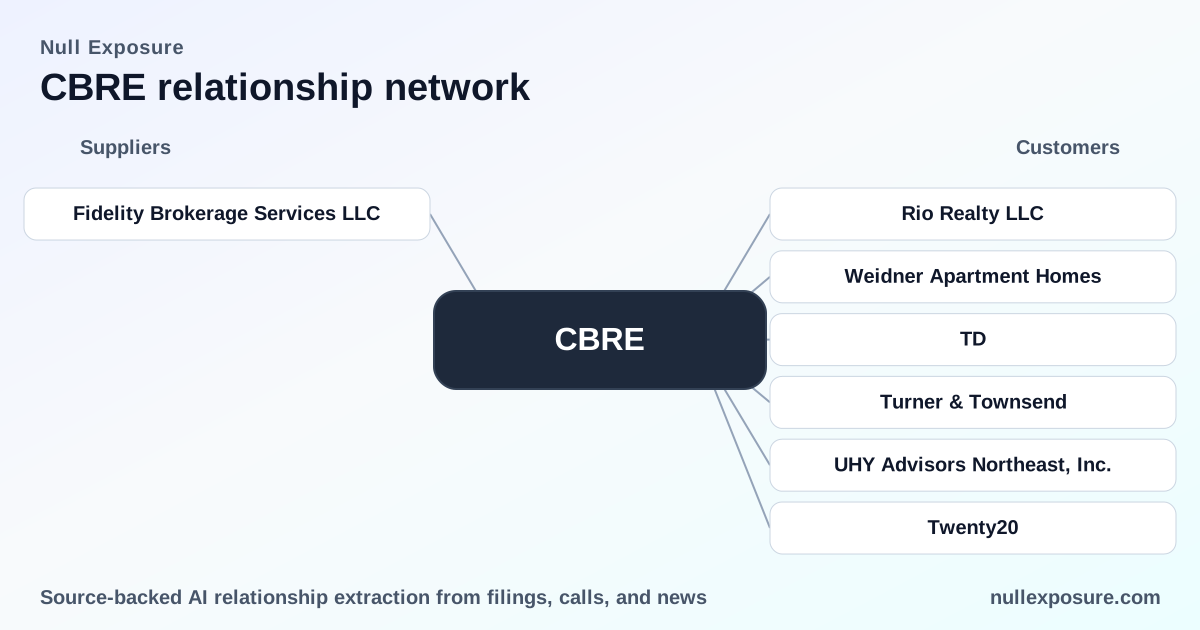
CBRE’s customer footprint: commercial relationships that drive recurring fees and transaction revenue
Thesis: CBRE Group is a fee-and-commission business built on scale — it monetizes through recurring, multi-year facilities and investment-management contracts plus transactional brokerage and capital-markets fees. With FY2025 revenue above $42 billion and a diversified global client base, CBRE’s cash flow profile blends predictable management fees from long-term outsourcing with lumpy but high-margin capital markets and leasing commissions. For investors, the key variable is how client mix and contract tenor sustain margins as interest rates and capital-market activity fluctuate. Explore client-level deals and the operating signals below to evaluate CBRE’s commercial durability and revenue quality.
Discover more at https://nullexposure.com/.
What the client relationships tell you about how CBRE operates
CBRE is executing a hybrid business model: long-term contracted services provide baseline cash generation while capital markets and leasing win episodic upside. The constraints in public disclosures produce a consistent company-level signal:
- Contracting posture: CBRE relies substantially on multi-year agreements and management-fee arrangements alongside transactional commissions; its disclosures reference long-term, fixed-price and multi-year contracts that underpin the BOE and facilities-management businesses.
- Client concentration and type: The firm serves large enterprises and institutional investors (pension funds, insurers, sovereign wealth), and also has a government-facing component after acquiring J&J — a signal of scale and client diversity rather than dependence on a single sector.
- Geographic footprint and maturity: CBRE operates in more than 100 countries with notable activity in North America and EMEA; global scale lets it cross-sell services (advisory, leasing, valuation, capital markets).
- Role and criticality: CBRE functions primarily as a service provider across brokerage, investment management, and outsourced facilities/property management — roles that are often operationally critical for large occupiers and institutional owners.
These constraints frame how to interpret individual deals below: long-term service wins are revenue-stable; capital-markets assignments are cyclical but can be earnings-accretive.
Deal-by-deal roll call: every relationship surfaced in recent coverage
Below I list every relationship captured in the sample results, with a one- to two-sentence plain-English summary and the cited source for each item.
- SLG (SL Green): CBRE brokers were listed as leasing and tenant-representation leads on newly developed 15 Laight Street, with Ryan Alexander among the CBRE team overseeing leasing. — GlobeNewswire, Apr 28, 2026.
- Safehold Inc. (SAFE): Safehold reported that its portfolio GLTV is based on annual asset appraisals from CBRE, and noted a quarter-over-quarter GLTV decline to 51% with rent coverage at 3.4x. — Investing.com earnings transcript, Q1 2026.
- Veris Residential (VRE): CBRE is marketing Veris’ Harborside 5 (983,041 sq ft) on the company’s behalf, acting as the seller’s agent in the offering. — re-nj.com, FY2022-style report (published 2026).
- Veris Residential (VRE) — Park Ridge sale: CBRE brokers announced the sale of a 240-unit luxury building in Park Ridge for $117 million and advised the seller through an institutional properties team. — re-nj.com, reported Mar 2026 (FY2025 reference).
- Regional Management Corp. (RM): A local report references a CBRE commercial representative (Charles Gouch) in connection with RM’s office expansion and headquarters move. — GreenvilleOnline, Aug 2016 (cited in later aggregation).
- Presidio Property Trust (SQFT): Leasing for Shea Center II is handled by Mitch Bradley of CBRE, per press releases on certifications and leasing activity. — FinancialContent/markets releases, FY2022 notices (reposted 2026).
- Hudson Pacific (HPP-P-C): CBRE was named a strategic partner and exclusive provider of certain real estate services for a Hudson Pacific DEI-focused impact fund initiative. — REIT.com, FY2022 announcement (reported 2026).
- Rio Realty LLC / Weidner Apartment Homes: CBRE’s debt & structured finance team secured acquisition financing for Rio Realty’s purchase of a 144-unit Sunset Ridge property; CBRE also represented Weidner as the seller. — UrbanMilwaukee press release, Mar 2026.
- QVC Group / HSN site: CBRE Group is marketing QVC’s 65-acre St. Petersburg HSN campus for redevelopment as apartments/warehouses after the company consolidated operations. — Vista.today / Philadelphia Business Journal coverage, Apr 2025 (reported 2026).
- Seldon Realty Group (SRG) — Midtown Mall: A CBRE senior vice president represented a seller in the Midtown Mall transaction and publicly described the asset as highly compelling. — AKBizMag, FY2022-style coverage (reported 2026).
- Soloviev Group: CBRE team members were credited as representing Soloviev Group in a record-setting NYC lease transaction. — Bisnow New York, May 2026.
- Vornado Realty Trust (VNO): Vornado used an in-house team alongside a CBRE team led by Bill Cumbelich and Angus Scott on a San Francisco property deal. — CityBiz, May 2026.
- TD Securities: In the SL Green leasing announcement, CBRE agents represented the tenant which included TD Securities in that slate of tenant representations. — GlobeNewswire, Mar 2026.
- Turner & Townsend: CBRE agents (Mary Ann Tighe et al.) were listed as tenant representatives on the SL Green leasing release. — GlobeNewswire, Mar 2026.
- UHY Advisors Northeast, Inc.: CBRE representatives were noted as tenant-side advisors in the SL Green leasing announcement. — GlobeNewswire, Mar 2026.
- ProKidney (PROK): A CBRE commercial listing put a Greensboro property owned by ProKidney up for sale. — WFMY News2, FY2024 report (cited 2026).
- Piedmont (PDM): Piedmont’s transaction was advised externally by Michael Phipps & Colin Morrison of CBRE, per corporate filings and press coverage. — Yahoo Finance / business press, FY2024 reporting (published 2026).
- Kilroy Realty (KRC): Stephen Somer and Brooke Silver of CBRE brokered Kilroy’s purchase of a Beverly Hills office campus. — RebusinessOnline, FY2025 coverage (Mar 2026).
- CubeSmart (CUBE): A $250M self-storage venture positions CubeSmart to use its operating platform while CBRE Investment Management provides capital and oversight. — SimplyWallSt summary, FY2026 reporting.
- Ares Commercial Real Estate (ACRE): CBRE’s National Partners team led by Brian Fiumara marketed and procured buyer interest for a 20-property industrial portfolio. — WRENews, May 2026.
- Seaport Entertainment / Meow Wolf (SEG-R): CBRE represented both sides on a 20-year lease at Pier 17, with distinct CBRE teams for Seaport Entertainment and Meow Wolf. — ConnectCRE, FY2025 coverage (Mar 2026).
- Meta (META): CBRE described building recruiting/training capabilities across U.S. cities to place technical staff in support of Meta’s data-center initiative, signaling a workforce/real-estate support role. — Investing.com transcript of CBRE Q1 2026 earnings call.
- Sky Harbour (SKYH): Sky Harbour tracks campus performance against projections that were prepared by CBRE as consultants at bond offering time. — Investing.com transcript, FY2025 Q2 commentary (reported 2026).
- Constellation Brands / Beer distributor (STZ-B): CBRE arranged a lease for a 469,830 sq ft industrial building in North Jacksonville connected to Constellation Brands distribution activity. — Jax Daily Record, Feb 2022 coverage (rereported 2026).
- Fifth Third Bank (FITBI): Bank representatives presented organizational changes at a CBRE-hosted event, indicating CBRE’s role as facilitator for corporate-occupier strategy sessions. — MPAMag, FY2022-style post (2026 citation).
- Twenty20 (multifamily sale): CBRE arranged the sale of Twenty20, a 355-unit high-rise in East Cambridge, per local brokerage coverage. — NEREJ, Mar 2026.
- Safehold Inc. (duplicate): Multiple earnings transcripts reiterate that Safehold’s GLTV calculations rely on CBRE appraisals, with reports showing GLTV stable at 52% in some quarters. — InsiderMonkey / The Globe and Mail / other Q4/Q1 2026 transcripts.
- Veris Residential — Harborside 1/2/3 sale: CBRE brokers Jeffrey Dunne, Bill Shanahan and Roland Merchant were credited with arranging a $420M sale of the Harborside complex. — NJB Magazine / re-nj and related press, FY2023 reporting (2026 aggregation).
- Veris Residential — financing and refinancing: CBRE personnel (James Millon et al.) negotiated project financing for Haus25 and other Jersey City projects opened in 2023. — JerseyDigs, FY2023 coverage (2026 reporting).
(Each of the entries above corresponds to a discrete result item in the dataset and is cited to the public news/press outlet where the deal coverage first appeared.)
Investment implications: how these client ties shape the outlook
- Recurring revenue anchor: Multiple items confirm CBRE’s role as a long-term service provider to large enterprises and institutional owners; this underpins baseline fee income and reduces volatility relative to pure brokerage firms.
- Capital markets optionality: The firm’s repeated presence on major asset sales (Veris, Kilroy, CubeSmart JV) shows that transaction volume swings will still dominate short-term EPS variance, but successful mandates are high-margin.
- Appraisals and advisory influence: Use of CBRE appraisals by clients like Safehold signals the firm’s valuation and advisory role is deeply embedded in certain client processes, increasing stickiness.
- Geographic and client diversification: Coverage spans North America and EMEA and multiple client types (REITs, corporations, funds), supporting revenue resilience against regional slowdowns.
For a deeper look at the underlying data and to monitor new relationship signals as they surface, visit https://nullexposure.com/.
Bold takeaway: CBRE’s revenue mix — anchored by multi-year management fees and amplified by episodic capital-markets mandates — delivers a predictable core with upside potential tied to deal flow and market velocity.