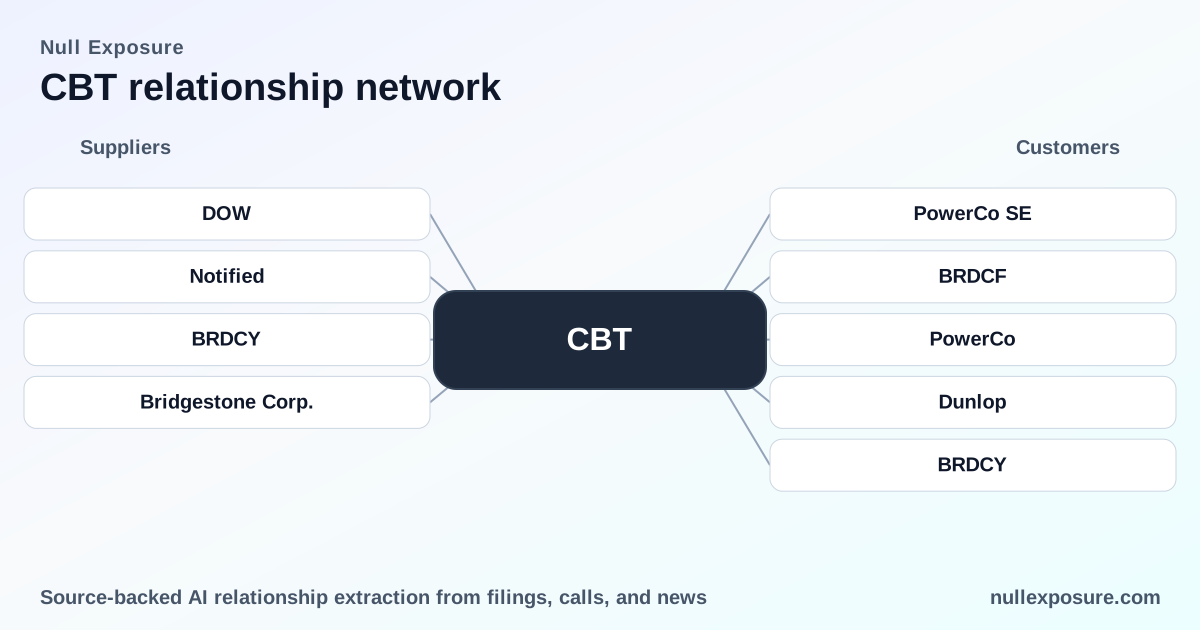
Cabot Corporation (CBT): Customer Relationships Driving a Strategic Pivot
Cabot Corporation operates as a global specialty chemicals and performance materials supplier, monetizing through the sale of carbon blacks, specialty compounds, battery additives and fee-based toll conversion services to tire manufacturers, battery OEMs, and other industrial customers. Revenue derives from product sales, multi-year supply contracts with strategic OEMs, and selective asset acquisitions that secure regional capacity and long-term off-take arrangements. For investors, the company’s commercial strategy is a combination of volume-driven reinforcement materials and higher-margin, growth-oriented battery materials that lift overall margin profile.
Learn more about our coverage and methodology at https://nullexposure.com/.
What investors need to know: a concise commercial thesis
Cabot is executing a targeted shift from legacy reinforcement materials toward battery materials and circular carbon solutions. The company monetizes by locking multi-year supply agreements with high-volume OEMs and by acquiring capacity to internalize production and secure customer continuity. This model creates both revenue stability from traditional tire customers and asymmetric upside from battery materials, where Cabot captures higher value per ton and benefits from electrification trends.
Recent customer relationships — the evidence set
Below I list each relationship mention from the public record, with a one- or two-sentence plain-English summary and a source citation. Each entry corresponds to a discrete report or press item in the results set.
-
Cabot completed the acquisition of Mexico Carbon Manufacturing S.A. de C.V. from Bridgestone, reinforcing an ongoing supplier relationship with Bridgestone and expanding Cabot’s Mexican manufacturing footprint. (GlobeNewswire, Feb 2, 2026 — https://www.globenewswire.com/news-release/2026/02/02/3230310/0/en/Cabot-Corporation-Completes-Acquisition-of-Mexico-Carbon-Manufacturing-S-A-de-C-V-from-Bridgestone-Corporation.html)
-
Cabot announced a multi-year supply agreement with PowerCo SE to deliver conductive carbons and dispersions for lithium-ion battery applications, positioning Cabot as a strategic battery-materials supplier to Volkswagen’s battery affiliate. (TradingView news, Q1 FY2026 — https://www.tradingview.com/news/tradingview:1e040f0f4d09a:0-cabot-corporation-reports-first-quarter-fiscal-year-2026-results/)
-
Cabot publicly confirmed a multi-year supply agreement with PowerCo SE, highlighting the company’s growth trajectory in the EV battery supply chain. (GlobeNewswire press release, Jan 2026 — https://www.globenewswire.com/news-release/2026/01/07/3214587/0/en/Cabot-Corporation-Signs-Multi-Year-Supply-Agreement-with-PowerCo-SE-a-Battery-Manufacturing-Subsidiary-of-Volkswagen-Group.html)
-
A GlobeNewswire report noted that Cabot’s acquisition strengthens a long-standing relationship wherein Cabot has supplied Bridgestone with reinforcing carbon products. (GlobeNewswire, Feb 2, 2026 — same link as above)
-
Mexico-focused coverage of the Bridgestone plant sale to Cabot states the deal was valued at roughly US$70 million on a debt-free, cash-free basis and that Cabot will maintain long-term product supply to Bridgestone from the acquired MXCB facility. (Mexico Now, May 2026 — https://mexico-now.com/bridgestone-completes-sale-of-altamira-plant-to-cabot-corp/)
-
A QuiverQuant summary repeated that Cabot’s acquisition of Mexico Carbon Manufacturing reinforces the long-term supply relationship with Bridgestone. (QuiverQuant news, Mar 2026 — https://www.quiverquant.com/news/Cabot+Corporation+Completes+Acquisition+of+Mexico+Carbon+Manufacturing+S.A.+de+C.V.+from+Bridgestone+Corporation)
-
Market reaction coverage noted the same Bridgestone-cited link between the acquisition and historic supplier ties, reinforcing the strategic nature of the deal. (TS2.Tech coverage of Q1 earnings, Mar 2026 — https://ts2.tech/en/cabot-cbt-stock-jumps-12-after-earnings-battery-deal-headlines-and-tire-worries-linger/)
-
QuiverQuant reiterated the acquisition’s role in strengthening commercial ties with Bridgestone, highlighting continuity of supply. (QuiverQuant, Mar 2026 — same QuiverQuant link)
-
Battery-News reported that Cabot will supply battery materials to PowerCo, confirming the company’s entry into Volkswagen’s battery supply chain. (Battery-News, Jan 2026 — https://battery-news.de/en/2026/01/09/cabot-to-supply-battery-materials-to-powerco/)
-
The European Rubber Journal reported an MoU between Dunlop (Sumitomo Rubber Industries) and Cabot to commercialize Cabot’s resource-recycling reinforcing carbon for tire applications. (European Rubber Journal, 2026 — https://www.european-rubber-journal.com/article/2098632/dunlop-cabot-in-link-up-for-recycled-carbon-black-use-in-tires)
-
StockTitan coverage summarized the PowerCo SE multi-year supply agreement for advanced conductive carbons and dispersions for lithium-ion EV battery electrodes. (StockTitan, Q1 FY2026 — https://www.stocktitan.net/news/CBT/cabot-corporation-signs-multi-year-supply-agreement-with-power-co-se-wf58mlgqwa2r.html)
-
An earnings-call transcript captured management highlighting the multiyear agreement with PowerCo as a strategic milestone for Cabot’s battery materials product line. (InsiderMonkey transcript of Q1 FY2026 earnings call — https://www.insidermonkey.com/blog/cabot-corporation-nysecbt-q1-2026-earnings-call-transcript-1689394/)
-
The earnings transcript referenced a long-term supply agreement providing materials back to Bridgestone for tire production in Mexico and the Americas. (InsiderMonkey earnings-call transcript — same link)
-
Electrive noted that Volkswagen’s PowerCo signed a multi-year supply deal with Cabot for battery materials. (Electrive, Jan 2026 — https://www.electrive.com/2026/01/08/powerco-sources-battery-materials-from-cabot/)
-
BatteriesNews repeated the GlobeNewswire announcement that Cabot signed a multi-year supply agreement with PowerCo SE for EV battery sector materials. (BatteriesNews, Jan 2026 — https://batteriesnews.com/cabot-corporation-signs-multi-year-supply-agreement-with-powerco-se-a-battery-manufacturing-subsidiary-of-volkswagen-group/)
-
QuiverQuant summarized Cabot’s Q1 FY2026 results and reiterated the strategic supply agreement with PowerCo SE. (QuiverQuant Q1 results summary, Mar 2026 — https://www.quiverquant.com/news/Cabot+Corporation+Reports+First+Quarter+Fiscal+Year+2026+Results+with+13%25+Decrease+in+Adjusted+EPS+and+Strategic+Supply+Agreement+with+PowerCo+SE)
-
RubberNews documented a collaboration between Cabot and Dunlop to test circular reinforced carbons for mass tire production. (RubberNews, 2026 — https://www.rubbernews.com/suppliers/rn-cabot-dunlop-partner-pyrolysis-reinforced-carbons-tires/)
-
Aktienschcheck coverage emphasized Cabot’s strategic pivot and cited the PowerCo supply agreement as evidence supporting investor optimism. (Aktiencheck, Jan 2026 — https://www.aktiencheck.de/news/Artikel-Cabot_s_Strategic_Pivot_Fuels_Cautious_Optimism_Among_Investors-19423605)
-
Investing.com quoted analysts referencing Jefferies’ raised price target tied to Cabot’s PowerCo supply agreement, linking deal flow to valuation upside. (Investing.com analyst report, May 2026 — https://m.investing.com/news/analyst-ratings/mizuho-downgrades-cabot-stock-to-neutral-on-weak-carbon-black-demand-93CH-4486251?ampMode=1)
-
Finviz summarized the MXCB facility buyout and emphasized the ~$70 million consideration and reinforced commercial ties with Bridgestone. (Finviz news, Mar 2026 — https://finviz.com/news/301522/cabot-expands-mexico-footprint-with-mxcb-facility-buyout)
-
Finviz repeated the Bridgestone tie and acquisition valuation in subsequent coverage. (Finviz, same Mar 2026 link)
(Entries above reflect every distinct press and news mention in the provided results; where multiple items repeat the same underlying announcement, each report is cited separately to preserve the provenance of the relationship signal.)
Operational constraints and what they imply for revenue durability
Cabot’s public disclosures create several company-level signals about how customer arrangements are structured:
-
Contracting posture: short-term orientation is typical. Cabot states many supply arrangements have a typical duration of one year, which implies recurring negotiation risk and the need to continually secure renewals or convert to multi-year agreements.
-
Geographic footprint is global with regional concentration. The company reports significant activity in Asia Pacific (China represents a large share of sales and fixed assets) and material presence in EMEA; this supports a geographically diversified customer base but also exposes Cabot to regional demand cycles.
-
Concentration is mixed: no single consolidated customer >10%, but product-line concentration exists. Consolidated revenue has no >10% single-customer dependence, yet certain product lines are concentrated: battery materials and fumed metal oxides show material customer concentration within those lines, and reinforcement materials have several large tire customers that are material to the segment.
-
Role spectrum is broad: seller, distributor channels, buyer dynamics, and toll conversion activity. Cabot sells directly and through distributors, acts as a converter on fee-based toll arrangements for some customers, and faces buyer-driven volume variability—this hybrid role increases commercial flexibility but requires strong customer service and logistics capability.
-
Maturity and criticality: Battery materials are higher-growth and higher-criticality for strategic OEMs; reinforcement materials remain mature but indispensable to tire customers.
Investor implications and risk-reward framing
-
Upside: Multi-year battery agreements (PowerCo) and capacity acquisitions (MXCB) strategically reposition Cabot into faster-growing, higher-margin segments; analysts have already tied these commercial wins to higher price targets.
-
Risks: The prevalence of one-year supply arrangements and product-line customer concentration mean that revenue visibility depends on converting short-term contracts into longer-term partnerships and on managing regional demand variance in APAC and EMEA.
-
Operational execution is key: Integration of the Mexican facility, scale-up of battery materials production, and commercialization of circular carbon products with partners like Dunlop determine whether Cabot realizes durable margin expansion.
If you want a deeper dossier on these customer ties and how they affect valuation scenarios, visit https://nullexposure.com/ for more investor-focused relationship analytics.
Bottom line
Cabot’s customer activity in early FY2026 demonstrates a deliberate, commercially driven pivot: securing OEM battery supply agreements while consolidating tire-related supply through asset ownership and circular-material partnerships. For investors, the company’s path to valuation upside runs through converting short-term supply exposure into durable, high-value relationships in battery materials while managing legacy cyclicality in reinforcement materials.