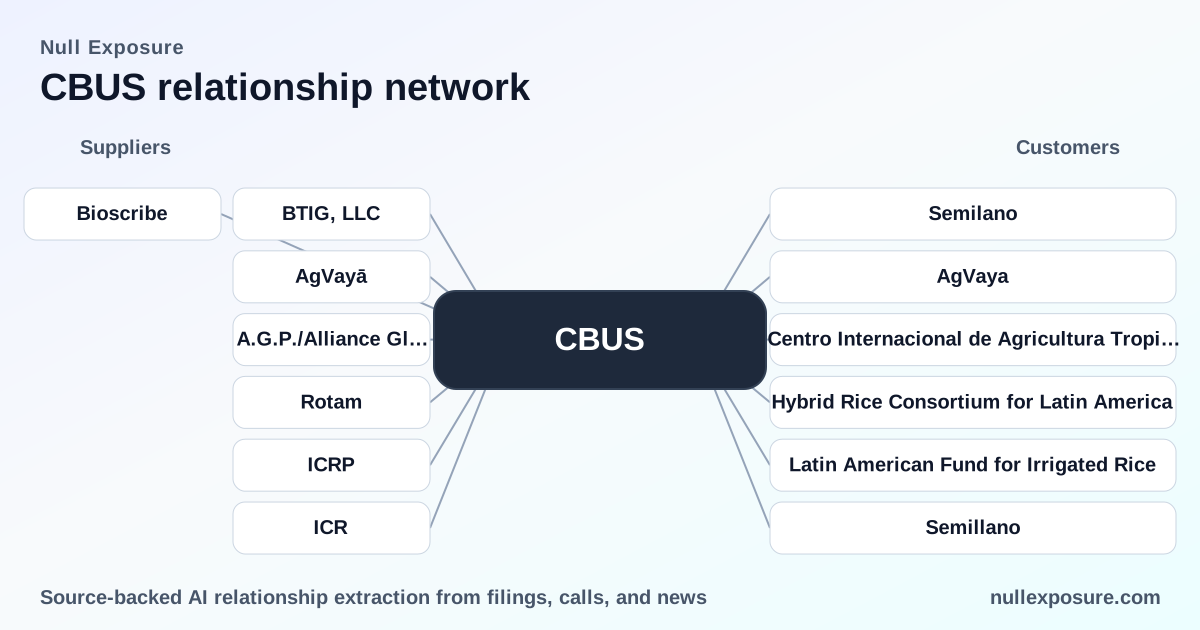
Cibus Global (CBUS): Customer Relationships That Drive Trait Commercialization
Cibus Global develops plant traits for the seed industry and monetizes primarily by providing R&D and trait-development services to seed companies and by entering future commercialization or license agreements that generate royalty or license fees when seed containing a Cibus-developed trait reaches market. Its operating revenue today is service-driven while the long-term payback is royalty/licensing-based, creating a two-stage monetization pathway: near-term services revenue and long-term upside from licensed trait sales. For investors this dual model means tracking both the roster of seed customers and the pipeline of commercialization agreements that will convert R&D investments into recurring royalty streams. Visit https://nullexposure.com/ for a concise view of how these relationship signals are collected.
Key takeaways up front: Cibus runs a services-first, partner-dependent commercial model; its customer mix is concentrated in North America and Latin America; and its commercialization thesis depends on converting material transfer and R&D collaborations into licensing arrangements with large seed companies.
What the public record shows about who Cibus is working with now
Below I catalogue every customer-relationship mention in the public results and give a plain-English summary with a concise source reference for each entry.
Semilano / Semillano — Colombian rice seed company
Cibus reported signing an agreement with Semilano, a Colombian-based rice seed company, positioning it as the company's fifth customer in the Americas — signaling active expansion in Latin American rice markets. (Cibus earnings call, 2025 Q2 and 2025 Q3).
AgVaya — strategic growth advisory for India access
Cibus began collaborating with AgVaya to develop a strategy for establishing access to seed companies in India, reflecting a deliberate market-entry advisory engagement rather than a transactional seed-license today. (Cibus earnings call, 2025 Q3).
Centro Internacional de Agricultura Tropical (CIAT) — regional partnership for rice
Cibus is expanding its Latin American customer base through a partnership with CIAT, which operates with the Latin American Fund for Irrigated Rice (FLAR); this relationship supports regional programmatic access to rice-breeding networks. (Cibus earnings call, 2025 Q3).
Hybrid Rice Consortium for Latin America (HIAAL) — collaborative consortium participation
Cibus participates in the Hybrid Rice Consortium for Latin America, indicating involvement in multi-party research and deployment efforts that facilitate broader adoption pathways for hybrid rice traits. (Cibus earnings call, 2025 Q3).
Latin American Fund for Irrigated Rice (FLAR) — fund-level engagement via CIAT
Through CIAT, Cibus has an engagement tied to FLAR, which provides program-level access to irrigated rice initiatives across Latin America and supports pathways to scale trait deployment. (Cibus earnings call, 2025 Q3).
Bayer — major seed company agreement
Cibus has formed agreements with major seed companies including Bayer for trait development, signaling alignment with global seed OEMs that can fast-track commercialization and distribution if traits are licensed. (News report summarizing FY2024 business developments, GuruFocus, FY2024).
Nutrien Ltd (Loveland Products subsidiary) — material transfer and trait development relationship
Cibus disclosed agreements with Nutrien Ltd’s subsidiary for trait development and material transfers, representing a relationship with one of the large agricultural input firms that can influence addressable acres for Cibus traits. (News report summarizing FY2024 business developments, GuruFocus, FY2024).
How these relationships map to the business model and investor risks
Cibus’ relationship footprint points to a services-first operating posture: R&D contracts and material transfer agreements are the on-ramp to future licensing revenues. The company’s own disclosures state revenue is recognized from research collaboration agreements, sales of products, and licenses — underscoring a hybrid cashflow profile where services fund development and licenses deliver scalability.
- Contracting posture: Cibus operates primarily under material transfer and R&D collaboration agreements today with an explicit plan to convert those engagements into commercialization or license agreements that yield royalties. This is a deliberate two-stage commercial play.
- Concentration: Public filings indicate a concentration of strategic partners in North and Latin America, with a small set of large seed companies representing a meaningful share of addressable acres; this raises both upside from focused, deep partnerships and counterparty concentration risk.
- Criticality: For customers, Cibus functions as a specialized service provider that augments breeding programs rather than competing with them; this positions Cibus as a critical, non-competitive partner for seed companies seeking trait innovation.
- Maturity: Relationships today skew toward collaborative R&D and consortium participation rather than large-scale commercialization contracts, indicating early-to-mid commercial maturity: technical validations and pilot deployments precede royalty-generating licenses.
For a deeper signal-read and ongoing coverage of customer relationship developments, check detailed relationship tracking at https://nullexposure.com/.
What investors should watch next
- Conversion cadence from R&D to licensing. The valuation upside depends heavily on the rate and terms at which Cibus converts existing material transfer agreements into royalty-bearing commercialization agreements.
- Counterparty depth and geography. Expansion beyond a small set of North/LATAM partners into large Asian seed markets (explicitly targeted via AgVaya advisory work) will materially change addressable acres and licensing leverage.
- Partnerships with global OEMs. Ongoing relationships with Bayer and Nutrien-scale partners are the clearest path to rapid acreage adoption if commercial terms are executed.
- Balance between services revenue and long-term royalties. Near-term fundamentals are services-driven; investors should monitor margin progression as licensing replaces or supplements services income.
Final read: positioning and risk profile
Cibus presents an attractive intellectual-property and service platform with a clear commercialization engine: develop traits under contract, then monetize through licensing and royalties. The company’s customer list reflects a focused go-to-market strategy in rice across North and Latin America, supported by consortium and advisory relationships that target geographic expansion. The primary investor risk is execution — converting collaborative pilot programs into broad, royalty-generating commercial agreements with large seed partners — and concentration tied to a limited set of large enterprise counterparties. These dynamics are already visible in the revenue recognition approach and the publicly disclosed material transfer agreements.
For an ongoing monitor of Cibus customer signals, relationship evolution, and commercialization milestones, visit https://nullexposure.com/.