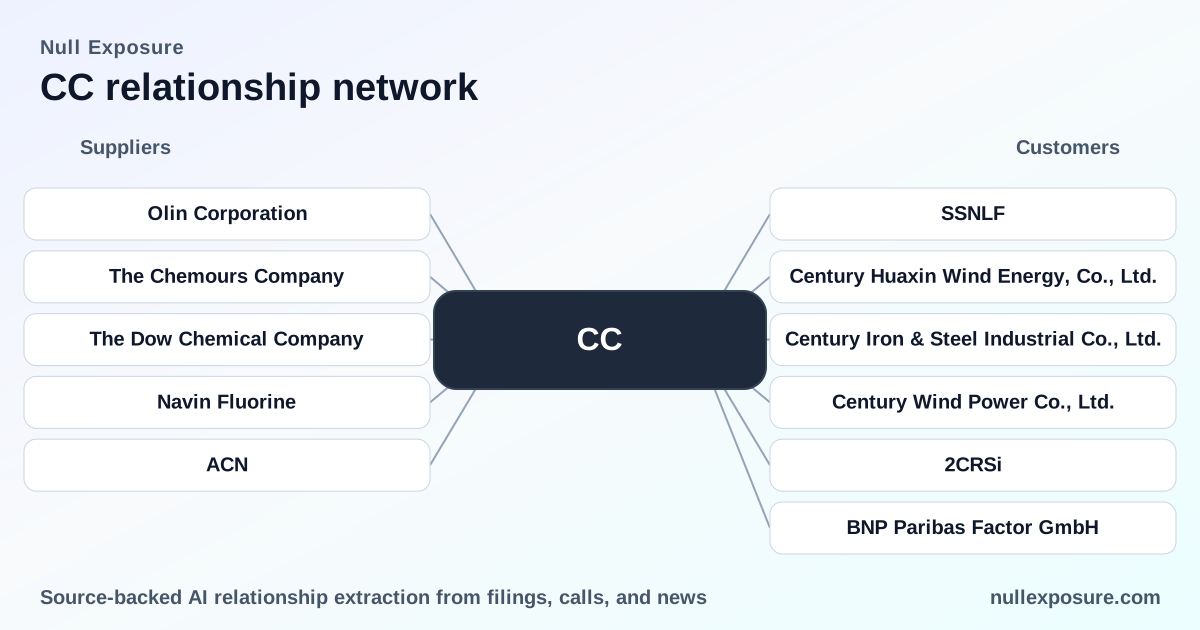
Chemours (CC) — Customer Relationships that Shape Revenue and Risk
Thesis: Chemours monetizes a global portfolio of performance chemicals—refrigerants, titanium dioxide pigment, and industrial fluoropolymers—by selling product under a mix of spot purchases and multi‑year contracts, supplemented by trademark licensing and channel distribution. Revenue depends on broad, geographically diversified industrial demand rather than a handful of strategic customers, while targeted partnerships (data‑center cooling, rare‑earth feedstock, and HVAC OEMs) provide high‑margin growth pathways. For a structured view of customer exposures, see our platform at https://nullexposure.com/.
What the customer map tells investors about business durability
Chemours operates as a seller first: product sales represent the vast majority of net sales, executed through purchase orders, master services agreements, and reseller/distributor channels. Its commercial posture combines short payment cycles (typically <90 days) and a hybrid contract mix—spot pricing for commodity flows and multi‑year contracts where performance or supply certainty matters. The company also recognizes trademark licensing revenue, which introduces a low‑capital, recurring margin stream. These operating traits produce a business that is globally diversified (NA, APAC, EMEA, LATAM) and not materially dependent on any single customer, reducing single‑counterparty revenue concentration risk while keeping working capital demands steady.
- Contracting posture: mix of spot and long‑term, with MSAs and POs governing performance; payment terms typically under 90 days.
- Concentration: sales are dispersed across ~2,500 customers in ~110 countries; one customer represented ~7% of receivables at year‑end (company disclosure).
- Criticality & maturity: many commercial relationships are long‑standing and cross multiple product segments, supporting predictable demand in industrial end‑markets.
- Channel structure: direct sales supplemented by resellers and distributors; licensing of trademarks is an ancillary stream.
Explore relationship-level detail and sources on our platform: https://nullexposure.com/.
Relationship roll call — each customer, in plain language
Below are the customer and partner references surfaced in recent coverage and filings. Each item is a concise investor‑oriented summary with its cited source.
-
Samsung Electronics — A CSRwire press release and subsequent reporting note that Samsung qualified Chemours’ Opteon two‑phase immersion cooling fluid (August 15, 2025) as part of data‑center cooling validation, signaling product acceptance in hyperscale/enterprise equipment. (CSRwire press release, Aug 15, 2025; Q4 2025 earnings call coverage reported Mar 9, 2026.)
-
SSNLF — Reported in an earnings‑call transcript, Chemours’ two‑phase liquid cooling solution gained qualification with Samsung and the company announced a manufacturing arrangement with Navin Fluorine targeting initial commercial production in 2026, underlining commercialization progress for Opteon immersion products. (The Globe and Mail / Motley Fool earnings‑call transcript, Mar 9, 2026.)
-
Samsung Electronics (duplicate mention) — The Q4 2025 call reiterates the qualification milestone and the move toward volume manufacturing through partners, which supports incremental revenue upside from data‑center and AI infrastructure demand. (The Globe and Mail / Motley Fool, Mar 9, 2026.)
-
Century Iron & Steel Industrial Co., Ltd. — Chemours signed definitive agreements to sell remaining land at its former TiO2 site in Kuan Yin, Taiwan to a consortium that includes Century Iron & Steel, indicating a non‑core asset disposition and local commercial transfer of property tied to legacy manufacturing footprints. (Quantisnow insight, Mar 9, 2026.)
-
Energy Fuels (UUUU) — Energy Fuels sources monazite sands from Chemours’ titanium and zirconium operations as an offtake/feedstock input; public reports state the current offtake supplies ~500 tonnes per year, providing a steady near‑term feedstock for rare‑earth processing. (MetalTechNews, Apr 1, 2026; CRUX Investor, May 2026.)
-
Century Wind Power Co., Ltd. — Part of the same Kuan Yin transaction consortium, Century Wind Power is acquiring land that once hosted Chemours’ TiO2 operations, reflecting regional asset reallocation rather than an ongoing supply relationship. (Quantisnow insight, Mar 9, 2026.)
-
Century Huaxin Wind Energy, Co., Ltd. — Also in the Kuan Yin ownership group purchasing former Chemours property, suggesting localized monetization of non‑operating real estate tied to prior production sites. (Quantisnow insight, Mar 9, 2026.)
-
Bohn de Mexico — Chemours and Bohn de Mexico announced an alliance where Bohn will adopt Opteon refrigerants (XL40, XL20, XL10) for its BOHN Ecoflex condensing units, representing OEM adoption and channel penetration in commercial refrigeration with low‑GWP refrigerants. (CSRwire press release, May 2026.)
-
2CRSi — Chemours and 2CRSi entered a Joint Development Agreement after the qualification of Opteon two‑phase immersion cooling fluid in 2CRSi servers, positioning Chemours for systems‑level sales into HPC and AI server OEMs. (Quantisnow insight, Mar 9, 2026.)
-
BNP Paribas Factor GmbH — Chemours executed a Receivables Purchase Agreement with BNP Paribas Factor to sell certain receivables, enhancing liquidity and reflecting active working‑capital management through third‑party factoring. (SEC 10‑K summary reported via TradingView, Mar 2026.)
-
2CRSi (second mention) — Commentary in investor media connected the 2CRSi JDA to Chemours’ broader strategic push into data‑center cooling at a time when the company was refinancing debt, highlighting the pairing of commercial catalysts with capital structure actions. (SimplyWallSt coverage, May 2, 2026.)
Investment implications: growth pathways and risk vectors
Chemours’ customer relationships expose two clear strategic levers for investors. First, adjacent growth from Opteon refrigerants and immersion cooling partnerships (Samsung, 2CRSi, Bohn) introduces higher‑value, technically differentiated revenue that scales beyond commodity cycles. Second, industrial byproduct monetization (monazite supply to Energy Fuels) demonstrates the company’s ability to convert upstream operations into third‑party feedstock sales.
Conversely, the company’s mix of spot and contractual sales implies earnings cyclicality tied to end‑market demand, and asset dispositions (Kuan Yin land sales) underscore ongoing portfolio optimization. Working capital and receivables financing (BNP Paribas Factor) are active levers for liquidity management and should be monitored alongside debt refinancing activity.
Bottom line for operators and researchers
- Chemours is a diversified seller with mature commercial relationships and a clear pathway to capture higher‑margin, tech‑adjacent demand through Opteon products.
- Concentration risk is limited at the customer level, but macro end‑market cycles and raw‑material/operational exposures continue to drive variability in revenue and margins.
- Monitor commercialization milestones (manufacturing ramp dates, OEM adoption) and receivables financing as leading indicators of revenue realization and cash‑flow health.
For a practical slice of this relationship intelligence and comparable company exposures, visit our research hub: https://nullexposure.com/.