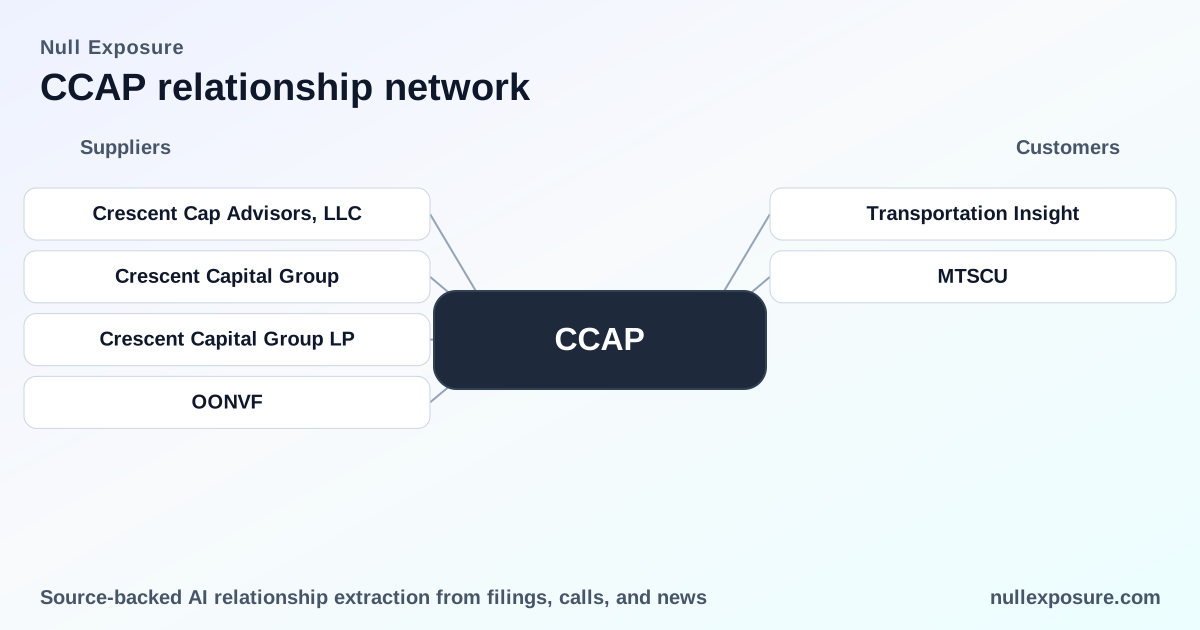
Crescent Capital BDC (CCAP) — Credit Relationships, Recent Hits, and What Investors Should Price In
Crescent Capital BDC (CCAP) operates as a middle‑market credit investor: it originates and purchases senior secured and unitranche loans, manages collateral through affiliated SPVs, and distributes yield to shareholders via a high dividend policy. The company monetizes through net interest and fee income on long‑dated private credit exposure, amplified by leverage from note issuances and SPV financing. For a compact data-led view of CCAP’s commercial ties and exposures, see https://nullexposure.com/.
Price action and the credit story in one line
CCAP’s Q4/FY2026 disclosures shifted the narrative from steady yield collection to active workout and resolution of stressed credits — two material nonaccruals drove the quarter’s unrealized losses, while at least one legacy nonaccrual was realized at a gain.
What the Q4/FY2026 commentary actually revealed about credit quality
Crescent called out two investments placed on nonaccrual in the quarter — Generate and Transportation Insight — as the largest drivers of unrealized losses. That single disclosure signals elevated near‑term credit volatility in the portfolio and a pivot toward resolution processes (workouts, restructurings, or write‑downs) that will materially affect mark‑to‑market outcomes and distributable earnings in the coming quarters. At the same time, management disclosed a successful realization of a previously nonaccrual exposure (MTS/MTSCU) at a recovery above cost, which demonstrates that recovery pathways can be value accretive when executed. These points come directly from the company’s Q4 2025 / FY2026 earnings transcripts (published in March and May 2026 on InsiderMonkey and The Globe and Mail).
Relationship snapshots investors should track now
Below are concise, plain‑English summaries for every counterparty mentioned in CCAP’s FY2026 public remarks and press coverage.
Transportation Insight
Crescent placed Transportation Insight on nonaccrual during FY2026 and identified it as one of the two largest drivers of the quarter’s unrealized losses. This indicates significant credit stress and an ongoing workout or valuation reset for that exposure (Source: Crescent’s Q4 2025 earnings call transcript as reported on InsiderMonkey, March 9, 2026, and the Globe and Mail earnings transcript, May 2, 2026).
Generate
Generate was the other investment placed on nonaccrual in FY2026 and was explicitly cited alongside Transportation Insight as a principal contributor to unrealized losses for the quarter — a direct signal of marked impairment in that position (Source: Q4 2025 earnings transcript, Globe and Mail, May 2, 2026).
MTS
Crescent disclosed that an investment in MTS, which had been on nonaccrual several years earlier, was realized during Q4 at a price above the company’s cost basis. That recovery reduced realized loss pressure and demonstrates an ability to extract value from legacy stressed positions (Source: Q4 2025 earnings call transcript, InsiderMonkey, March 9, 2026; Globe and Mail press release).
MTSCU
MTSCU is referenced as the ticker/formal designation for the MTS exposure in Crescent’s disclosures; the company confirmed closing a transaction on that position during the fourth quarter, resulting in a gain relative to cost (Source: Q4 2025 earnings transcript, Globe and Mail, May 2, 2026).
Operating constraints and what they imply for CCAP’s model
The public evidence around CCAP’s portfolio and capital structure outlines a set of structural constraints that shape performance and risk.
-
Long‑dated capital and debt posture. Filings document long‑term unsecured note maturities (Series 2024A Unsecured Notes due 2030) and other instruments stretching into 2027–2030, which supports a buy‑and‑hold private credit strategy and reduces short‑term liquidity pressure but locks in leverage duration. This is a company‑level signal derived from CCAP’s financing disclosures.
-
Geographic concentration with global pockets. The consolidated schedule of investments emphasizes heavy U.S. exposure (primary market for the portfolio) while also showing single‑name investments in APAC (Australia) and EMEA (UK), signaling a predominantly North American book with selective offshore allocations.
-
Manager / seller roles built into the capital structure. Corporate documents reference a Crescent Capital BDC Funding SPV and scenarios where CCAP acts as collateral manager and seller in SPV facilities, which points to vertical integration between portfolio management and funding conduits — a structural lever for both value capture and governance complexity.
-
Active credit posture and sector tilts. Schedules list active debt investments across sectors with software and services highlighted, suggesting sector concentration that will influence loss severity and recovery profiles during technology‑sensitive economic cycles.
Taken together, these constraints imply CCAP runs a leveraged, long‑duration private credit book that is U.S.‑centric but not exclusively domestic, with operational complexity from SPV funding and selective sector concentrations.
Investment implications — risk and upside
- Credit volatility is the near‑term headline. Two current nonaccruals (Generate and Transportation Insight) materially drove unrealized losses in FY2026; investors should price in earnings and NAV mark volatility over the next several quarters as those work through resolution.
- Recovery outcomes matter more than ever. The realized recovery on MTS demonstrates Crescent’s ability to execute exits that can be accretive; recoveries can offset impaired marks when transactions close at or above cost.
- Structural durability supports yield continuity. The company’s long‑dated notes and funding arrangements underpin its ability to continue a high dividend policy, but they also increase exposure to credit cycles over the life of assets. Yield is a function of realized coupon income plus realized loss/gain outcomes.
- Concentration risk is real. Sector and regional concentrations (software tilt and U.S. dominance) make CCAP sensitive to sector‑specific downturns and regional economic cycles.
For investors and operators wanting a succinct monitor, track: new nonaccrual listings, realized recovery transactions and their economics, covenant activity in SPV facilities, and the pace of portfolio rotations away from stressed names.
If you want a structured view of these counterparty events and how they affect CCAP’s balance sheet and NAV, start here: https://nullexposure.com/.
Final read
CCAP’s FY2026 disclosures present a mixed credit picture: material contemporaneous impairments alongside evidence that recoveries remain possible and occasionally accretive. The company’s long‑term funding profile, U.S. concentration, and SPV funding architecture create both resilience and point risks — resilience via matched funding duration and yield capture, and risk via concentrated sector exposure and the operational complexity of managing nonaccrual resolutions. Investors should position for higher NAV and earnings dispersion over the next several quarters, with upside tied directly to how the Generate and Transportation Insight situations resolve and how many legacy stressed credits convert into recoveries like MTS.
Sources: Crescent’s Q4 2025 / FY2026 earnings call and related transcripts as reported on InsiderMonkey (March 9, 2026) and the Globe and Mail (May 2, 2026).