Coastal Financial (CCB): Bank-on-a-BaaS Story with a Regional Deposit Engine
Coastal Financial Corporation operates as a regional community bank that monetizes through traditional interest income on loans and an expanding Banking-as-a-Service (CCBX) fee program that supplies deposit funding and fee revenue from fintech partners. CCB leverages a stable Puget Sound retail and SME deposit base while selling oversight, governance and payment rails to fintechs — a dual model that amplifies margin upside but concentrates execution risk around partner onboarding and deposit aggregation. Explore coverage at Null Exposure.
The business behind the headlines: how Coastal makes money and how that shapes risk
Coastal is a classic community bank with a fintech overlay. The core profit engine is net interest income from loans funded primarily by commercial and retail deposits, while CCBX (BaaS) contributes fee income and incremental deposits that improve funding mix and return on equity. Contracting posture is provider-led: Coastal acts as the regulated banking counterparty for third‑party fintech brands and, increasingly, as brand owner where it sees strategic value.
- Concentration and geography: Coastal’s retail and small-business focus is anchored in the Puget Sound region with digital channels extending reach; this regional footprint reduces diversification but supports predictable deposit flows.
- Counterparty mix and criticality: Evidence indicates counterparties are consumers, small businesses and mid‑market fintechs — relationships that are critical to partner go‑to‑market plans and to CCB’s deposit growth via branded programs.
- Maturity and posture: Coastal combines a mature community bank balance sheet with a developing fintech services arm; the company explicitly generates revenue from interest on loans and BaaS fee income, shifting some strategic risk from lending to platform relationships.
Client relationships that drive CCB’s BaaS and deposit franchise
Dave — a new partner bank role
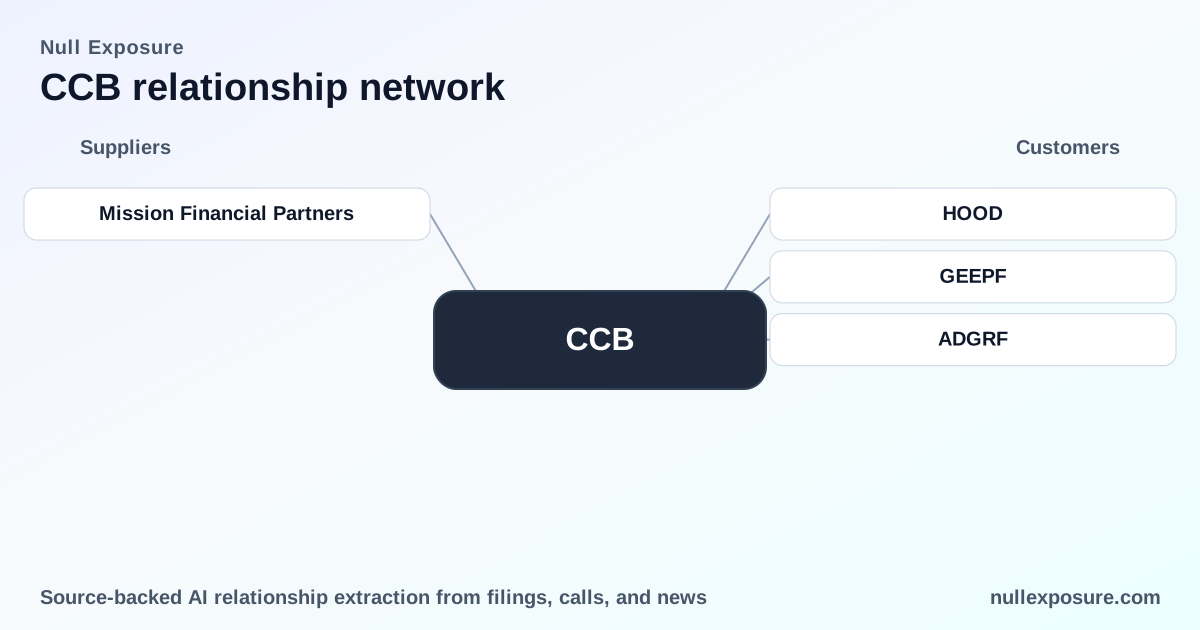
Coastal recently signed on as the partner bank for fintech Dave in a strategic pivot away from Evolve Bank & Trust, positioning Coastal as the regulated deposit and governance provider for Dave’s programs. Banking Dive reported the deal and contextualized it as part of Coastal’s broader fintech positioning (Banking Dive, May 2, 2026).
Robinhood — deposit program contribution to growth
Robinhood’s deposit program launched during Q4 2025 and meaningfully contributed to CCBX deposit growth for the quarter ended December 31, 2025, highlighting how fintech deposit vehicles translate directly into funding for Coastal’s lending book (Coastal Q4 2025 results, GlobeNewswire and Sahm Capital, Jan 29, 2026).
GreenFi — acquisition plus ongoing bank partnership
Coastal acquired the GreenFi brand and will continue to serve as the banking partner for GreenFi’s consumer financial services program, taking on governance, oversight and long-term brand stewardship as part of the acquisition strategy (Coastal press release, GlobeNewswire Jan 9, 2026; Banking Dive coverage, May 2, 2026).
Albert — deliberate exit from partnership
During the quarter ended December 31, 2025, Coastal exited its partnership with Albert as part of a broader rebalancing of third-party relationships; management signaled continued selective exits where appropriate (Coastal Q4 2025 results, GlobeNewswire and Sahm Capital, Jan 29, 2026).
What these relationships mean for investors: key takeaways
- BaaS is material and growing. Robinhood’s deposit program and new fintech deals (Dave, GreenFi) illustrate that CCB’s BaaS business is now a recognized contributor to deposit growth and fee income.
- Partner turnover is real but manageable. The Albert exit demonstrates active portfolio management; selective exits reduce tail risk but also create short-term revenue volatility.
- Operational and governance responsibilities increase with scale. As Coastal assumes oversight roles (notably with GreenFi), the bank’s compliance and operational load increases — a factor that affects expense dynamics and regulatory scrutiny.
- Regional deposit base remains the ballast. The Puget Sound retail and SME franchise underpins liquidity and funds core lending activity even as fintech relationships deliver incremental funding.
Risk and concentration checklist for operators and investors
- Fintech concentration: Several deposit wins are tied to a small number of partners — monitor partner concentration metrics and deposit stickiness.
- Regulatory and oversight risk: Acting as partner bank and brand steward increases compliance exposure and governance costs.
- Revenue volatility from onboarding/exiting partners: Fee income can be lumpy as relationships are added or terminated.
- Geographic concentration: Heavy exposure to the Pacific Northwest presents macro/regional risk to deposit and loan performance.
Signals from corporate text: operating constraints that shape decision-making
The company disclosures provide clear operational signals: Coastal’s client base skews toward individuals, small businesses and mid‑market customers across the Puget Sound region and through digital channels, reflecting a hybrid branch-plus-digital distribution model. Management highlights that community bank revenue is generated primarily from interest on loans and CCBX fee income, and that commercial and retail deposits are the primary funding source for loans — a structural statement that ties the success of the fintech program directly to loan funding economics. These are company‑level constraints that inform contracting posture (provider of regulated banking services), concentration (regional focus), and criticality (banking partner status for fintechs).
What to watch next (practical investor signals)
- Quarterly CCBX fee income and deposit growth trends to assess how fintech relationships scale.
- Partner churn or new announcements (additional Dave, Robinhood expansions or other brand integrations).
- Regulatory commentary and any governance-related disclosures following brand acquisitions such as GreenFi.
- Loan growth and funding mix shifts as fintech deposits change the cost of funds.
Coastal’s strategy is clear: blend a conservatively managed community bank balance sheet with an aggressive fintech partnership program to capture higher-yielding, fee-bearing deposits. Execution risk is concentrated in partner management and regulatory oversight, but the business model provides a credible runway for margin and ROE expansion if CCB sustains deposit gains and controls governance costs.