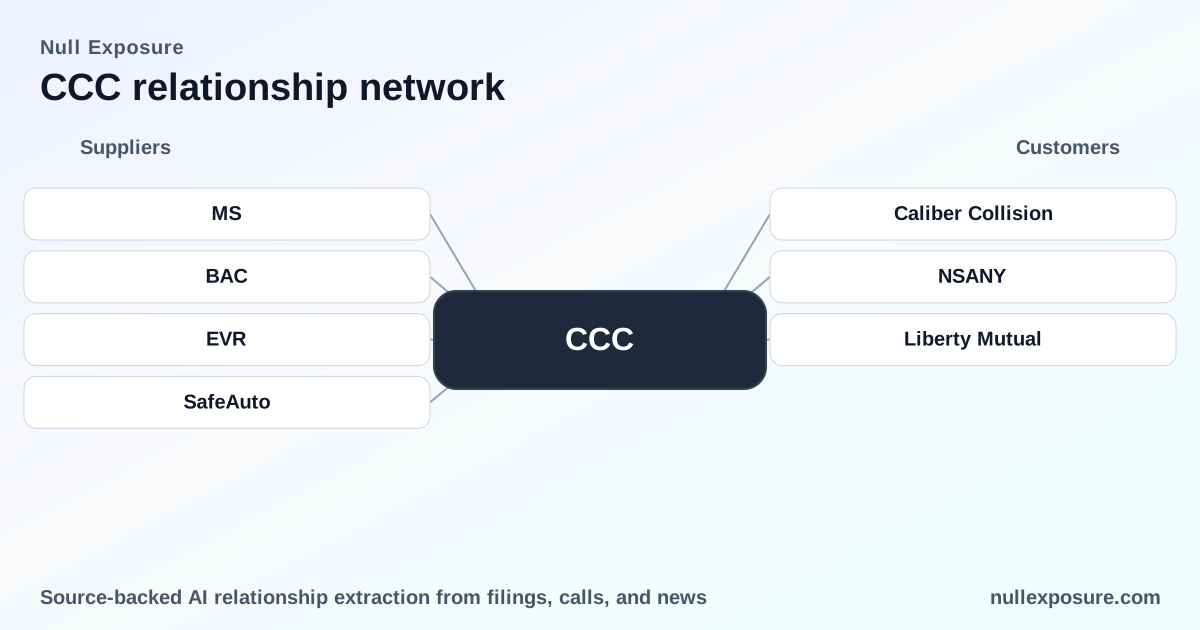
CCC Intelligent Solutions: customer map and what it means for investors
CCC Intelligent Solutions operates a cloud-native SaaS platform that digitizes claims management, repair estimation, OEM certification and consumer financing for the auto and P&C insurance ecosystem. The company monetizes primarily through software subscriptions (3–5 year average contracts) and transactional services, supplemented by professional services and financing partnerships—an arrangement that creates recurring revenue and high customer stickiness. For a deeper look at the company’s customer exposure and implications for revenue durability, visit https://nullexposure.com/.
How CCC’s product-to-cash model drives predictable revenue
CCC sells a mix of subscription licenses and usage-based services into insurers, collision repair shops, OEMs and lenders. Subscription revenue accounted for the vast majority of recent revenue, which gives the business predictable recurring cash flows and levered operating margins as usage grows. The company’s platform also benefits from network effects: integrations between carriers, shops and OEMs increase switching friction and expand addressable wallet share over time.
- Contracting posture: CCC contracts are predominantly long-term subscription agreements, with typical durations of three to five years, and usage or per-transaction fees layered on top for certain services. This structure underpins recurring revenue recognition and longer revenue visibility.
- Revenue mix and criticality: Software subscription revenue is a core, critical driver of top-line performance and profitability, representing the lion’s share of reported revenue.
- Customer concentration and maturity: No single customer exceeded 10% of revenue in recent years, pointing to low concentration risk, while many carrier relationships span a decade or more—evidence of mature, embedded customer engagements.
- Geography and counterparty mix: The business is U.S.-centric with selective APAC exposure; counterparty footprint spans large national insurers to thousands of small repair shops.
- Commercial role: CCC functions primarily as a service provider and seller of SaaS solutions, with active and mature deployments across insurance and repair customers.
If you want a concise corporate customer risk report tailored to investment teams, see https://nullexposure.com/ for more.
Customer roll-up: the recent wins, renewals and strategic partners
Below are the source-level relationship notes drawn from public reporting and press coverage. Each short entry covers one reported relationship item and the original source.
-
All / ALL — In an earnings transcript excerpt, CCC disclosed a multi-year agreement with Allstate for their third-party casualty business, reflecting carrier-level adoption of CCC’s casualty workflow. (Benzinga transcript of CCC Q1 2026 earnings call, April–May 2026: https://www.benzinga.com/insights/news/26/04/52170130/ccc-intelligent-solutions-reports-q1-2026-results-full-earnings-call-transcript)
-
Caliber Collision — Caliber, the largest U.S. collision repair provider, renewed and extended its technology partnership with CCC, confirming shop network retention and distribution strength for CCC’s repair workflow and commerce tools. (CollisionWeek report, April 24, 2025: https://collisionweek.com/2025/04/24/caliber-collision-renews-technology-partnership-ccc/)
-
Liberty Mutual — CCC reported that Liberty Mutual selected CCC and has begun deploying a significant portion of its casualty business on the platform, indicating a large-carrier implementation and mid-2026 run-rate expectations. (Investing.com transcript of CCC Q1 2026 earnings call, May 2026: https://m.investing.com/news/transcripts/earnings-call-transcript-ccc-intelligent-solutions-q1-2026-beats-forecasts-93CH-4654050?ampMode=1)
-
Nissan — In January 2026 CCC added Nissan as the first automaker to join the CCC OEM Link Network, enabling OEM repair certification and improved visibility into certified repair processes. This is a strategic OEM integration that increases OEM-to-shop workflow lock-in. (SimplyWall.St coverage referencing January 2026 announcement: https://simplywall.st/stocks/us/software/nasdaq-ccc/ccc-intelligent-solutions-holdings/news/will-cccs-sunbit-financing-integration-shape-a-stickier-saas)
-
Allstate — Reiterating the earlier note, CCC confirmed a multi-year Allstate agreement for third‑party casualty, emphasizing the carrier-level expansion of CCC’s casualty module within major insurer workflows. (Benzinga earnings call transcript, April–May 2026: https://m.investing.com/news/transcripts/earnings-call-transcript-ccc-intelligent-solutions-q1-2026-beats-forecasts-93CH-4654050?ampMode=1)
-
Nissan (StockTitan recap) — A corporate press recap notes that Nissan joined CCC’s OEM Link Network, specifically as part of the OEM repair certification launch on January 8, 2026—an event that CCC flagged as positive for platform credibility. (StockTitan news recap, January 2026: https://www.stocktitan.net/news/CCC/ccc-intelligent-solutions-holdings-inc-announces-fourth-quarter-and-2xq9c58jn7sy.html)
-
NSANY — The same OEM development is documented under the NSANY ticker reference: Nissan's OEM Link participation is positioned as advancing certified repair workflows on CCC’s platform. (StockTitan, January 2026: https://www.stocktitan.net/news/CCC/ccc-intelligent-solutions-holdings-inc-announces-fourth-quarter-and-2xq9c58jn7sy.html)
-
Nissan (FinancialContent press release) — Corporate PR also described Nissan as the first automaker in the OEM Link Network, highlighting commitments to streamline certification and support repair quality metrics. (FinancialContent press releases page, FY2026: https://www.financialcontent.com/quote/NQ:CCC/pressReleases)
-
CollisionRight — CCC noted that CollisionRight, operating roughly 130 centers, is an early adopter of the new consumer financing feature within CCC One, reflecting expansion of onsite merchant finance capabilities to capture incremental repair demand. (GlobeNewswire/TMT via ManilaTimes, April 2026: https://www.manilatimes.net/2026/04/15/tmt-newswire/globenewswire/ccc-introduces-consumer-financing-in-ccc-one-to-help-collision-repair-shops-capture-more-work/2320943)
-
Nissan (SimplyWall.St AMP) — Multiple media write-ups reiterate the strategic relevance of Nissan joining OEM Link in January 2026 as part of CCC’s OEM network rollout. (SimplyWall.St AMP, FY2026: https://simplywall.st/stocks/us/software/nasdaq-ccc/ccc-intelligent-solutions-holdings/news/will-cccs-sunbit-financing-integration-shape-a-stickier-saas/amp)
-
Nissan (Bitget wiki) — Industry summaries note that CCC has forged partnerships with OEMs like Nissan to push repair certifications and diagnostics into the claims workflow, strengthening vertical integration. (Bitget company overview page, FY2026: https://www.bitget.com/en-CA/wiki/ccc-stock)
-
Liberty Mutual (Benzinga recap) — Benzinga also captured CCC’s disclosure that Liberty Mutual began deploying a substantial portion of its casualty business to CCC, reinforcing the carrier’s transition onto CCC’s casualty modules. (Benzinga earnings call transcript, April–May 2026: https://www.benzinga.com/insights/news/26/04/52170130/ccc-intelligent-solutions-reports-q1-2026-results-full-earnings-call-transcript)
-
Liberty Mutual (Tikr analysis) — Financial commentary adds that the Liberty Mutual transition is expected to reach full run-rate by mid-2026, a timeline investors can use to model near-term subscription revenue increases. (Tikr blog on CCC trading levels, FY2026: https://www.tikr.com/blog/trading-at-52-week-lows-can-ccc-intelligent-solutions-nasdaq-stock-rebound-in-2026)
Investment implications and downside considerations
- Positive: Long-term subscription contracts and multi-year carrier deployments imply high revenue visibility and recurring cash flow, supporting margin expansion if retention stays high.
- Negative: Although no single customer exceeds 10% of revenue, CCC’s business is structurally dependent on subscription revenue; any material loss of multiple large carriers or OEM integrations would be consequential.
- Timing risk: Large-carrier deployments (e.g., Liberty Mutual, Allstate) introduce implementation and ramp risks that affect near-term margin and revenue recognition profiles.
- Strategic optionality: OEM integrations and shop financing (Nissan, CollisionRight) create cross-sell pathways that can expand share of wallet and increase customer stickiness.
Bottom line
CCC’s go-to-market is anchored on sticky, long-term SaaS contracts with usage-based overlays, a diversified customer base across carriers, shops and OEMs, and evolving products that expand commerce and financing within repair workflows. For a practical client-facing customer risk brief and monitoring tools tailored to investment committees, see https://nullexposure.com/.
Key takeaway: investors should value CCC not merely as a software vendor but as a networked service provider whose revenue durability depends on multi-year carrier rollouts, OEM partnerships and continued retention across thousands of repair shops.