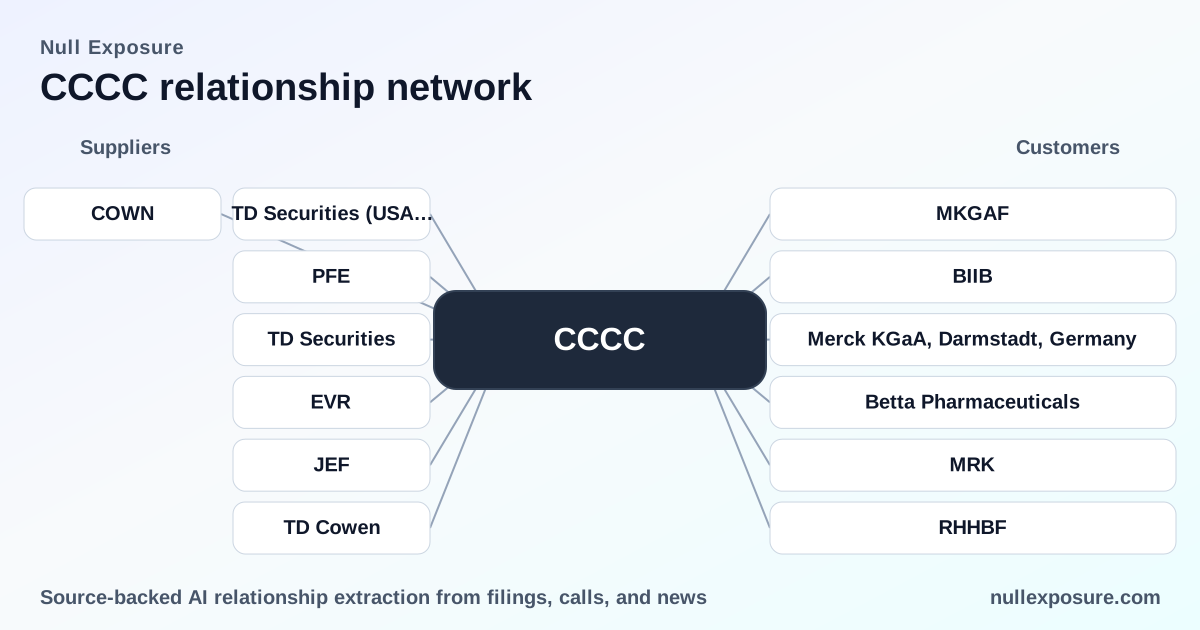
C4 Therapeutics (CCCC) — Customer Relationship Map and Investment Implications
C4 Therapeutics develops targeted protein degraders and monetizes primarily through collaborative deals with large pharmaceutical partners: upfront payments, research milestones, licensing fees and potential future royalties on partnered programs, supplemented by internal pipeline value creation. Its revenue profile is milestone-driven and episodic rather than product-sales recurring, which makes short-term cash flow volatile but enables outsized upside if partnered programs progress. For an investor-ready relationship map and to track updates, see https://nullexposure.com/.
Quick read: what matters for investors
- Revenue is partnership-dependent. C4’s near-term topline is driven by upfronts and milestone receipts from alliances rather than commercial products.
- Counterparty mix is heavyweight and concentrated — Roche, Biogen and Merck KGaA are strategic anchors that validate C4’s platform and supply lump-sum funding and milestones.
- Milestones de-risk value stepwise. Payments like the recent $2 million Biogen milestone and Roche upfronts are clear cash inflection points that fund R&D and extend the runway.
- Investment profile: outcome-driven binary upside with limited near-term revenue diversification.
How C4 structures deals and what that implies for operations
C4 operates with a collaboration-first commercial posture: it licenses discovery output and design work to large pharma partners and is compensated through a combination of upfront payments, per-program options, milestone payments and downstream royalties. This structure produces specific operating characteristics investors must internalize:
- Contracting posture: partner-led, non-commercial — C4 focuses on discovery and early translational work and transfers development or commercialization risk to larger partners through option/licensing frameworks.
- Revenue concentration: high, because a few large collaborations generate most near-term revenue; this amplifies sensitivity to partner decisions and milestone timing.
- Criticality: strategic validation — relationships with Roche, Biogen and Merck-class partners are reputationally and financially critical to capital markets sentiment.
- Maturity: early-stage to mid-stage — agreements are skewed toward discovery and preclinical/early clinical milestones rather than marketed-product royalties today.
These signals are company-level characteristics drawn from the partnership architecture and reported payments; they are not assigned to any single counterparty unless explicitly stated in a source.
Partner-by-partner readout: every relationship reported
Below is a concise, source-backed summary for each partner referenced in public reporting and press coverage. Each entry is 1–2 sentences and cites the reporting channel.
Merck KGaA (MKGAF / Merck KGaA, Darmstadt, Germany)
C4 lists a discovery collaboration with Merck KGaA that contributes research milestones and prioritizes workstreams, with the company noting KRAS project prioritization during Q4 2025 that impacted revenue recognition. This relationship is described in company reporting and investor summaries in March 2026 and in Stocktitan coverage (March 2026) and InvestingNews (March 2026).
Sources: Stocktitan report on strategic milestones (March 9, 2026); InvestingNews company results summary (March 2026).
Biogen (BIIB)
C4 earned milestone payments from Biogen tied to BTK and IRAK4 degrader programs — notably a $2 million milestone in January 2026 for BIIB145 and earlier milestones tied to phase 1 patient-dosing for BIIB142 — demonstrating active clinical-stage handoffs to Biogen. C4 disclosed these payments in its Q4/2025 investor release and subsequent press picks in late Q1 2026.
Sources: C4 press release via GlobeNewswire (Feb 26, 2026); InvestingNews and GlobeNewswire coverage of Q3/Q4 2025 milestones (Nov 2025 — Mar 2026).
Roche (RHHBY / RHHBF / Roche Holdings AG)
C4 expanded its long-term collaboration with Roche into a degrader-antibody conjugate (DAC) modality, receiving a $20 million upfront for two programs and the potential for over $1 billion in milestone payments plus royalties should options be exercised. This transaction is presented as a material validation and funding event in April–May 2026 filings and PR channels.
Sources: C4 press release reported on GlobeNewswire (Apr 9, 2026); InvestingNews coverage of the Roche collaboration (May 2, 2026); Sahm Capital commentary (Apr 9, 2026).
Betta Pharmaceuticals
C4 entered an exclusive licensing agreement with Betta Pharmaceuticals for development and commercialization in Greater China of CFT8919, an oral BiDAC degrader targeting EGFR L858R for NSCLC, which transfers regional rights while delivering licensing proceeds to C4. The agreement was disclosed alongside financing and investor event updates in late 2025/early 2026.
Sources: InvestingNews reporting on the licensing deal and offering materials (2025–2026).
Merck (MRK)
C4’s disclosures reference revenue impacts from recognized deferred revenue and milestone timing tied to collaborations with Merck (MRK) in the corporate quarterly commentary, noting the prior-year timing differences that influenced reported revenue in Q3 2025. This highlights that recognized revenue from large pharma partners can swing materially quarter-to-quarter.
Sources: C4 Q3 2025 financial results via GlobeNewswire (Nov 6, 2025) noting MRK-related revenue recognition effects.
What the relationships collectively tell investors
- Funding cadence is milestone-driven. The Roche upfront and Biogen milestones are immediate cash events; future option exercises and milestone triggers will dictate near-term funding sufficiency.
- Partner quality is high. Roche, Biogen and Merck-class partners are top-tier strategic collaborators that increase C4’s platform credibility and downstream optionality.
- Revenue predictability is low but stepwise. Cash inflows occur as discrete events rather than steady streams; each milestone or option exercise materially changes runway assumptions.
- Geographic and commercialization risk is managed via licensing. The Betta Pharmaceuticals Greater China license transfers regional execution risk while providing non-dilutive funding.
Key investment implications and risk checklist
- Upside: Collaboration payments and continued milestone capture create defined de-risking events that should be monitored as primary catalysts.
- Downside: High revenue concentration and milestone timing risk lead to quarter-to-quarter volatility and reliance on partner development decisions.
- Operational necessity: Continued success requires maintaining scientific leadership in degraders and executing discovery output that partners value enough to exercise options and pay milestones.
If you want a consolidated, interactive partner map and alerting for milestone events, visit https://nullexposure.com/ for the full relationship dashboard.
Bottom line
C4 Therapeutics runs a classic biotech partnership model: platform-led discovery monetized through high-quality collaborations, producing intermittent but meaningful cash inflows and validation signals. Investors should track partner option exercises, milestone receipts and the Roche/Biogen/Merck program progression as primary value drivers — the company’s market value will re-rate around execution of those discrete events.