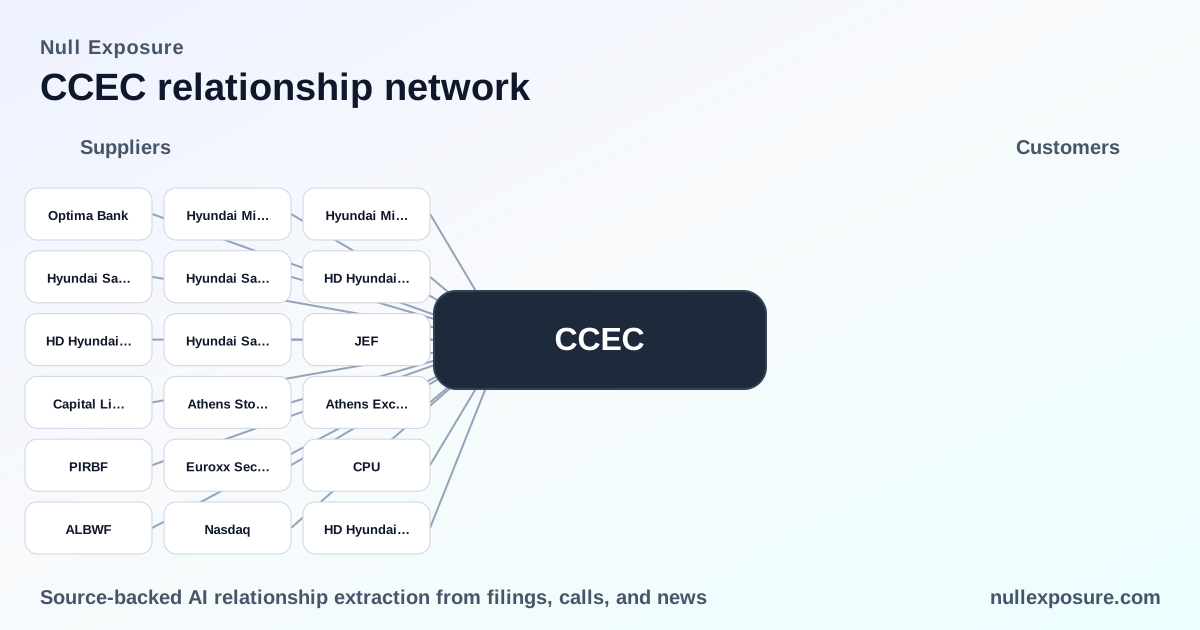
Capital Clean Energy Carriers (CCEC): JV-led charters shift revenue mix toward long-term, asset-light cashflow
Capital Clean Energy Carriers monetizes newbuild and retrofitted shipping assets by structuring majority-owned joint ventures and long-dated time charters that convert asset value into contracted revenue streams. The company takes equity positions in vessel-owning vehicles, sells minority stakes to partners and secures multi-year charters—translating an asset base into predictable cashflows while preserving a degree of capital efficiency. The April–May 2026 LNG joint-venture and its 10‑year charter commitment are a concrete example of that playbook: a $230 million vessel acquisition and up to $485.6 million of contracted topline drive both near-term monetization and extended revenue visibility. For a concise provider view, see https://nullexposure.com/.
A clear commercial pattern: JV control, long charters, and monetization
CCEC executes a repeatable pattern: it retains majority control of vessel-owning entities while partnering for capital and charter coverage. In the latest transaction CCEC takes a 51% stake in a Marshall Islands holding company, uses a wholly owned subsidiary to acquire the vessel, and simultaneously secures a decade-long charter for the asset. That structure achieves three objectives:
- Control without full capital exposure — a 51% ownership keeps decision-making power while bringing in partner capital.
- Long-tenor revenue visibility — the 10-year charter (with two three-year extension options) converts a single vessel into a multi-year revenue stream.
- Upside from options and asset rotation — extension options and potential resale of stakes permit future monetization events.
Company financials (TTM through FY2025) show revenue of approximately $392.7 million, so the JV’s potential contracted revenue of up to $485.6 million is material relative to the operating base and will meaningfully alter cashflow profiles over the next decade.
What the transaction reveals about contracting posture, concentration, criticality and maturity
No external constraints were flagged for customer relationships in the reviewed dataset; present company-level signals provide the operational context described here.
- Contracting posture: long-term, charter-centric. CCEC prefers time charters that front-load revenue certainty and reduce spot exposure.
- Concentration: high single-asset significance. One JV and its charter pipeline can represent a substantial share of near-term revenue given CCEC’s recent TTM scale.
- Criticality: charter counterparties are revenue-critical. Performance and payment under a single 10-year charter materially affect consolidated cash flow and asset utilization.
- Maturity: transaction-level maturity is medium to long — charter tenors extend into the 2030s and, with options exercised, potentially to 2043, delivering extended visibility into vessel economics.
These company-level characteristics shape how investors should value CCEC’s revenue predictability and governance tradeoffs, particularly given insider ownership exceeding 80% and low institutional ownership in public markets.
Relationship breakdown: the counterparties you need to know
BM Capital LLC
CCEC effected the vessel acquisition and JV through BM Capital HoldCo LLC and its wholly owned subsidiary BM Capital LLC; the vessel will be acquired for $230 million. According to a GlobeNewswire release on April 15, 2026, BM Capital LLC — as the operating acquisition vehicle for the joint venture — will take title to the vessel for that purchase price, with the JV structured to reflect CCEC’s 51% interest. (Source: GlobeNewswire, April 15, 2026.)
BGN INT DMCC
The joint venture has secured a 10‑year time charter to BGN INT DMCC, with two three-year extension options that, if exercised, extend contract coverage to 2043 and create aggregate contract revenues of up to approximately $485.6 million. This charter is the principal demand-side commitment underpinning the JV’s projected cashflows. (Source: GlobeNewswire, April 15, 2026; Shipping Telegraph, May 2026.)
BGN (BGNX) — the chartering counterparty
Industry press reports note that BGN (trading as BGNX in some markets) has signed its first LNG charter with Capital Clean Energy Carriers, marking the counterpart as an active charterer in the JV deal and signaling BGN’s entrance into LNG shipping through this arrangement. The TradeWinds coverage flagged the charter as BGN’s initial movement into LNG via a contract with CCEC. (Source: TradeWinds, May 2026.)
How each relationship translates into value and risk for investors
- BM Capital LLC (JV vehicle): delivers asset ownership and balance-sheet leverage; it is the capital arm that centralizes acquisition risk and enables CCEC to monetize through partial sale or carve-out. The $230 million acquisition price provides a clear, near-term cash outlay and baseline for asset returns. (Source: GlobeNewswire, April 15, 2026.)
- BGN INT DMCC (charter): provides multi-decade contracted revenues that reduce earnings volatility and increase visibility on utilization; the contract size is large relative to CCEC’s recent TTM revenue, so counterparty performance is material to consolidated projections. (Source: GlobeNewswire, April 15, 2026.)
- BGN/BGNX (commercial partner): by taking the charter CCEC secures market access and demand validation; successful execution creates follow-on commercial optionality across clean-energy shipping corridors. (Source: TradeWinds, May 2026.)
Risks, governance notes, and upside scenarios
- Concentration risk: a single long-tenor charter and a single-asset JV can disproportionately affect revenue when the vessel represents a large share of operating scale; investors must model downside scenarios where options are not exercised or counterparty performance deteriorates.
- Counterparty execution risk: long charters provide revenue certainty only if counterparties honor terms and operational integrations proceed smoothly.
- Governance and control: insider ownership above 80% concentrates voting control and could limit minority investor influence; this is a structural governance characteristic that affects valuation multiples and takeover dynamics. (Source: CCEC company profile, FY2025.)
- Upside: the JV route preserves balance-sheet capital while locking in long cashflows, enabling CCEC to scale faster and rotate assets into new JV deals or sales that can fund growth.
Investor takeaway
CCEC’s JV and charter approach converts capital-intensive vessels into long-term contracted revenue while sharing capital risk with partners. The April 2026 transaction — a $230 million acquisition combined with up to $485.6 million of time-charter revenues — materially improves near-term visibility but concentrates revenue on a limited set of counterparties and assets. Investors should value the company using scenarios that stress charter performance and extension option exercises while giving credit for the embedded, long-dated cashflows where counterparty credit is strong.
For additional analysis and deal-level sourcing, visit https://nullexposure.com/.