Cheche Group (CCG): Strategic OEM Partnerships Drive Embedded Insurance Growth
Cheche Group builds and monetizes an embedded insurance and financial-services platform by integrating with automakers and insurers to deliver AI-driven pricing, underwriting, and digital distribution for new-energy vehicles (NEVs) and related consumer credit products. Revenue comes from platform fees, insurance service arrangements and product distribution embedded inside OEM channels, while the company invests heavily in partnerships to scale distribution across China and select international markets. For investors, Cheche is a platform play: growth is partner-driven, unit economics depend on underwriting economics and partner retention, and value realization requires conversion of distribution into profitable insurance volumes and recurring SaaS-style revenue.
For a concise investor briefing and relational diligence, see the company hub at NullExposure.
What Cheche sells, and why OEMs partner with it
Cheche supplies a one-stop digital insurance solution: an embedded SaaS platform connected into automaker apps and dealer flows, combined with AI-powered risk models that incorporate driving behavior and claims data. The company’s commercial strategy is to win distribution agreements with leading OEMs and to outsource underwriting to insurance partners while capturing platform and distribution economics. Public statements and press coverage describe Cheche as the technology and platform supplier in these alliances, with insurance carriers underwriting policies and OEMs providing the customer interface.
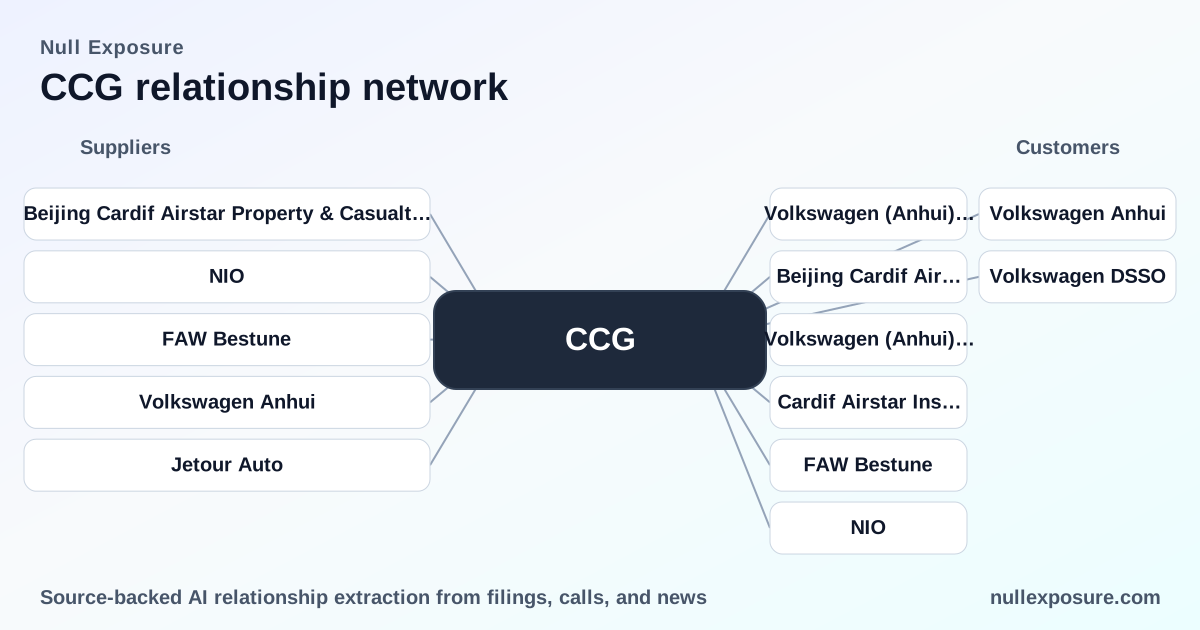
Customer roster: who Cheche is working with (concise relationship summaries)
Below are every partner relationship reported in public sources for FY2025–FY2026. Each entry is a plain-English summary with the cited publication and period.
Volkswagen (Anhui) / Volkswagen DSSO
Cheche signed a strategic cooperation with Volkswagen (Anhui) Digital Sales and Services Co. to build a digital insurance service system for Volkswagen owners in China focused on electric vehicles; Cheche supplies the embedded SaaS and intelligent pricing model while Cardif Airstar provides product design and underwriting, and policies are accessible through the automaker’s app. This cooperation was announced in late January 2026 and reported across industry outlets in March–May 2026 (Marketscreener, TipRanks, Yahoo Finance; FY2026 / Mar–May 2026).
Cardif Airstar Insurance (Beijing Cardif Airstar Property & Casualty Insurance Co. Ltd.)
Under the Volkswagen cooperation, Cardif Airstar will design and underwrite insurance products while Cheche provides the digital platform and intelligent pricing, positioning Cardif as the underwriting partner in that alliance. This arrangement was described in Cheche announcements and covered by Marketscreener and TipRanks in early 2026 (Marketscreener; FY2026 / Mar 2026).
Guangzhou Automobile Group
Cheche has launched business operations in collaboration with Guangzhou Automobile Group as part of its OEM go‑to‑market expansion, using the automaker’s channels to distribute insurance and platform services in China and overseas markets cited by management. MarketBeat reported this as part of the company’s FY2026 earnings commentary (MarketBeat; FY2026 / Apr 2026).
BYD
Cheche lists BYD among the automaker partners where it has launched operations, indicating platform integrations with one of China’s largest NEV manufacturers and access to large OEM customer bases. Management referenced BYD on the FY2026 earnings call and this was summarized in MarketBeat coverage (MarketBeat; FY2026 / Apr 2026).
Chery
Cheche has established business operations in partnership with Chery, leveraging the automaker’s sales and service channels for embedded insurance distribution as stated on the FY2026 earnings discussion (MarketBeat; FY2026 / Apr 2026).
Great Wall Motor
Cheche reports launched operations with Great Wall Motor, which adds another significant domestic OEM distribution channel for the company’s insurance and platform services (MarketBeat; FY2026 / Apr 2026).
NIO
Cheche and NIO have deepened a partnership focused on enhancing insurance services for NEVs, positioning Cheche as a provider of digital insurance tooling integrated into NIO’s vehicle ecosystem (StockTitan / company press summaries; FY2025–FY2026).
FAW Bestune
Cheche partnered with FAW Bestune to launch a fully digital one‑stop vehicle delivery service, signaling an expansion beyond pure insurance into integrated customer experience and delivery workflows for OEMs (StockTitan; FY2025).
Huawei
Management referenced platform relationship expansion with Huawei as a priority for 2026, indicating collaboration to extend Cheche’s distribution or technology integrations with a major technology infrastructure provider (MarketBeat earnings recap; FY2026 / Apr 2026).
How these relationships shape Cheche’s operating model and business constraints
There are no explicit contractual documents included in the public relationship listings, so take these public signals as indicators of operating posture rather than signed revenue schedules. From the available company and market signals:
- Contracting posture: Cheche positions itself as a platform supplier and integration partner rather than as a sole insurer—its commercial model relies on collaboration with underwriting carriers (for example, Cardif Airstar) and OEMs for distribution. That structure reduces capital intensity of underwriting for Cheche but increases reliance on partner execution and revenue‑sharing arrangements.
- Concentration and diversification: Partnerships include several of China’s largest NEV OEMs (BYD, VW/Volkswagen Anhui, Guangzhou Auto, NIO, Great Wall, Chery, FAW Bestune), which gives broad OEM coverage but creates client concentration risk around automotive sector performance and NEV adoption cycles.
- Criticality to partners: The value proposition is operationally critical to OEM customer experience (in-app insurance, one‑click distribution), which strengthens Cheche’s negotiating leverage for platform fees but raises execution risk if integrations underperform or if OEMs develop in‑house capabilities.
- Maturity and financial posture: Company financials show large revenue scale on TTM basis but negative EBITDA and EPS and a small market capitalization relative to reported revenue, indicating an early public-stage business with significant reinvestment and profitability risk (company filings and TTM figures through Jun 30, 2025).
Investment implications and risk highlights
- Growth lever: OEM distribution. Cheche’s pathway to scale is clear: deepen integrations with major automakers and convert vehicle sales into embedded insurance and financing products. Reports across FY2025–FY2026 show active OEM signings and product rollouts that support this thesis.
- Underwriting economics are the inflection point. Cheche captures platform and distribution economics while underwriting partners carry insurance losses; long‑term margin recovery requires disciplined pricing and loss ratios embedded in the AI pricing model described in the Volkswagen/Cardif Airstar announcement.
- Governance and public‑market signals matter. The company shows high insider ownership (~54%) and minimal institutional holdings (~0.9%), a capital structure and ownership profile that can affect liquidity and governance dynamics for public investors.
- Execution risk is concentrated on integration and partner retention. A failure to maintain OEM distribution or to finalize favorable commercial terms with underwriters would materially slow revenue monetization.
If you want a compact, relational map of Cheche’s OEM and insurer partners for due diligence teams, explore the company hub at NullExposure for source‑linked summaries and ongoing monitoring.
Bottom line
Cheche’s model is partner‑centric: platform revenue plus embedded distribution, and its current announcements demonstrate credible access to top NEV OEMs and insurance underwriters. The investment case depends on Cheche converting these partnerships into recurring, profitable insurance flows while improving unit economics and reducing dependency on continued capital to fund growth. Investors should prioritize tracking OEM integration milestones, underwriting terms in partnerships (e.g., with Cardif Airstar), and the company’s path to positive operating margins.