CCH Holdings Ltd (CCHH): What one underwriter relationship tells investors about capital access and governance
CCH Holdings Ltd operates as a publicly listed company with restaurant-industry exposure and a stated strategy of diversified investment and sustainability-driven growth; it monetizes through operations and occasional capital markets transactions that fund expansion and liquidity events. Investors should focus on recent underwriting activity and governance concentrations as the primary drivers of near-term capital structure and equity liquidity. Learn more at https://nullexposure.com/.
Why the underwriting relationship matters for an investor thesis
In FY2025 CCHH engaged capital markets underwriters to execute an offering, and the credited representative on that engagement was Cathay Securities, Inc. Underwritten offerings are not routine customer-supplier ties; they are episodic financing relationships that directly affect cash on hand, free float and dilution dynamics. For a small-cap issuer with high insider ownership and modest revenues, access to underwritten capital is a material operational lever.
Customer relationship breakdown — what the record shows
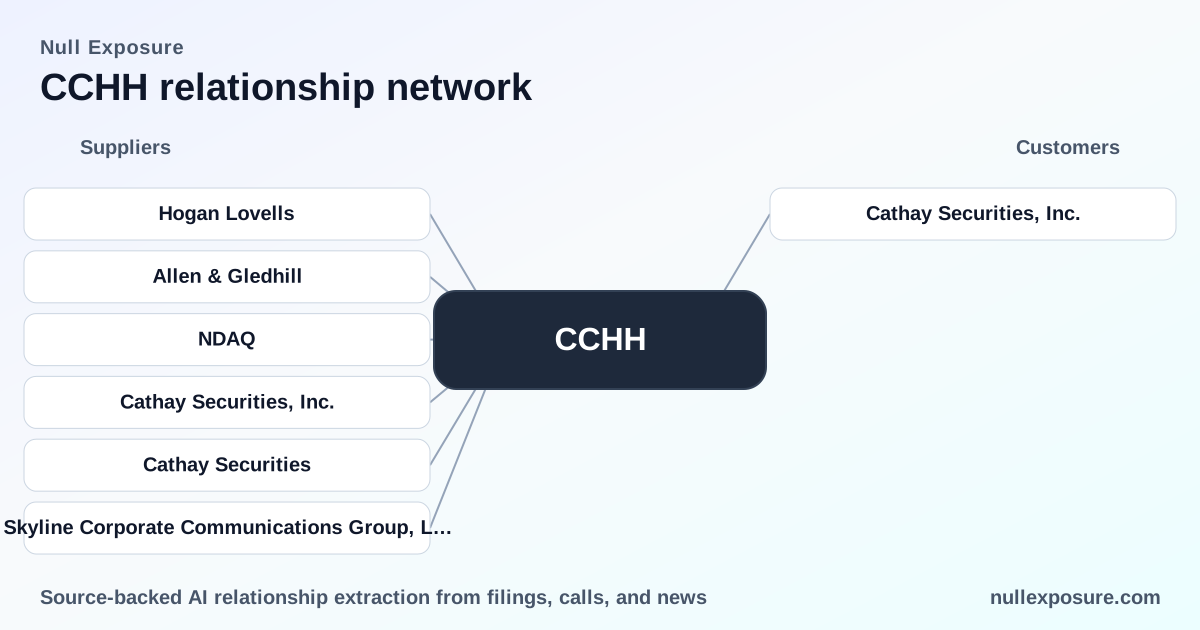
Cathay Securities, Inc. — FinancialContent (FY2025) Cathay Securities acted as the representative of the underwriters to CCHH’s offering in FY2025, a role that places the firm at the center of the transaction and its book-building process. According to a FinancialContent Markets report dated October 17, 2025, Cathay was identified as the underwriters’ representative for that offering.
Cathay Securities, Inc. — GlobeNewswire (FY2025) A GlobeNewswire press release on December 31, 2025, reporting on the offering’s outcome, also notes Cathay Securities served as the representative of the underwriters; the press release covered the full exercise of the over-allotment option tied to that offering, confirming follow-through on the financing plan. This corroborates the FinancialContent report and documents the transaction outcome.
What the single named relationship implies about contracting posture and concentration
No constraints or additional customer relationships were returned in the provided relationship data; as a company-level signal, this absence indicates limited public visibility of long-term, contractually recurring customers within the sampled results. From an operating-model perspective:
- Contracting posture: The visible relationship is transactional and capital-markets oriented — an episodic underwriting engagement rather than a multi-year commercial contract.
- Concentration: With Cathay Securities the only named counterparty in the customer scope, documented concentration of external capital-market counterparties is high, increasing the influence such counterparties exert over financing outcomes.
- Criticality: Capital raises executed through underwriters are critical to near-term liquidity and growth plans for a small-cap issuer; successful exercise of overallotment options is an operational inflection that directly impacts cash and outstanding share count.
- Maturity: The relationship is recent and event-driven (FY2025), signaling the company currently relies on discrete capital events rather than a steady stream of financing partners.
These are company-level signals derived from the relationship set and the absence of additional constraints in the results.
Financial and governance context that amplifies relationship risk
Several balance-sheet and ownership characteristics in CCHH’s public profile amplify the importance of underwriting outcomes:
- High insider ownership (≈69.7%) concentrates control and reduces institutional float, increasing reliance on discrete financing windows to broaden liquidity.
- Revenue and profitability are modest (Revenue TTM ≈ $9.14M; Profit Margin ≈ 4.14%), so equity offerings and underwriting exercises serve as meaningful levers for capital deployment or debt replacement.
- Valuation multiples are non-trivial for a small issuer (Trailing PE 23.5; EV/EBITDA 6.97), which frames investor sensitivity to dilution or follow-on issuance.
Together with the underwriting event, these factors mean capital markets partners, when engaged, materially influence CCHH’s trajectory.
Key investor takeaways and risks
- Primary takeaway: The only publicly documented customer-scope relationship in the provided results is Cathay Securities’ role as representative of underwriters for a FY2025 offering — a financing relationship that directly shapes liquidity and float. (FinancialContent, Oct 17, 2025; GlobeNewswire, Dec 31, 2025.)
- Operational risk: Reliance on episodic underwriting implies execution risk around fundraising windows, and limited visibility into recurring commercial customers reduces predictability of organic cash generation.
- Governance and control risk: High insider ownership compresses public float and can complicate price discovery; successful underwriting outcomes help alleviate liquidity stress but also create dilution considerations.
- Mitigant: The reported full exercise of an over-allotment option (GlobeNewswire, Dec 31, 2025) demonstrates investor uptake in that financing round, improving short-term capital adequacy.
A concise list for quick reference:
- Strengths: Access to underwritten capital; demonstrated ability to execute an offering with overallotment exercise.
- Weaknesses: High insider concentration; limited documented recurring customer relationships in the examined scope.
- Near-term watch items: Follow-on capital activity, insider selling patterns, and any disclosures identifying repeat financing counterparties.
How investors should use this intelligence
Treat the underwriting relationship as a liquidity signal rather than a recurring revenue indicator. Monitor subsequent filings for underwriter acknowledgements, lock-up expiries, and secondary activity that will reveal whether the FY2025 offering was a one-off solution or the start of a pattern of market-dependent financing. For a deeper view on counterparties and event sequencing, review the offering documents and press releases tied to the FY2025 transaction and track any subsequent capital-market announcements. Explore additional coverage and analytical tools at https://nullexposure.com/ to map counterparty concentration against capital outcomes.
Bottom line
CCHH’s only documented customer-scope relationship in the provided results is the FY2025 underwriting represented by Cathay Securities, which is an event-level relationship with material implications for liquidity, float and investor access. For investors, the priority is monitoring capital-market activity and governance signals rather than commercial customer churn in the near term.