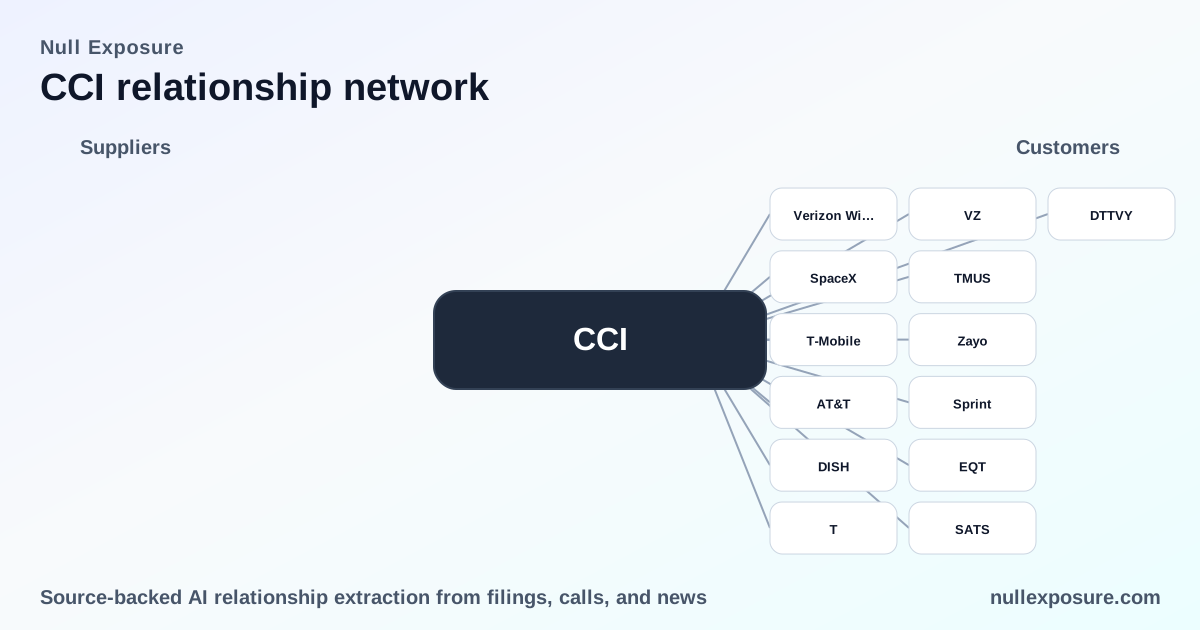
Crown Castle (CCI): Customer Relationships that Drive a Towers-First REIT
Crown Castle operates and monetizes a geographically dispersed portfolio of shared communications infrastructure by leasing tower and fiber capacity to national wireless carriers and other large organizations; its revenue model is overwhelmingly recurring site rental income under long-term tenant contracts, with a heavy concentration in T‑Mobile, AT&T and Verizon Wireless. Investors should evaluate Crown Castle as an infrastructure landlord with high cash-flow visibility from long leases, but meaningful counterparty concentration and recent customer disputes that affect near‑term billings. For deeper signals on counterparties and contract exposures visit https://nullexposure.com/.
How Crown Castle makes money — the operating model in one line
Crown Castle is a REIT that sells access to capacity (space, power, fiber) across >40,000 towers and extensive fiber routes, collecting ratable, recurring rental income from long-term leases (typically 5–15 years for towers) and occasional upfront payments; the model emphasizes stable cash yields, capital recycling (asset sales), and dividend distributions.
Key constraints shaping the customer book
- Long-term, sticky contracts are the norm. Crown Castle’s FY2024 10‑K states site rental revenues are recognized ratably over fixed, non‑cancelable tenant contract terms generally between five and 15 years; the company reports a weighted-average remaining lease term of 15 years. (FY2024 10‑K)
- Business concentration is material and critical. T‑Mobile, AT&T and Verizon collectively generated roughly three‑quarters of consolidated site rental revenues in 2024, and multiple press summaries indicate these three accounted for approximately 90% of site rental revenues in some disclosures. This concentration is a primary strategic risk and also a source of predictable cash flow. (FY2024 10‑K; TradingView news write‑ups, FY2026)
- Revenue mix is overwhelmingly recurring. Crown Castle reported that site rental revenues constituted 95% of net revenues in 2025, underscoring the landlord-like character of the business. (StockTitan summary of filings, FY2026)
- Geography and counterparty profile. Virtually all operations are U.S.-based and customers are large national carriers and enterprises (including government and health), reinforcing the company’s North American infrastructure posture. (FY2024 10‑K)
- Segment focus and recent portfolio actions. Crown Castle recently closed an $8.5 billion transaction to sell its Fiber Solutions and small-cell businesses, signaling a strategic refocus and liquidity event that changes counterparty exposure for those assets. (LightReading, May 2026)
- Relationship lifecycle. Tower tenant contracts are mature and high‑retention (historical annual retention of 98–99%), but pockets of vacant towers (~5%) and non‑recurring site development work create a small prospect pipeline. (FY2024 10‑K)
If you want the full counterparty map and primary-source excerpts used to build this view, see more at https://nullexposure.com/.
Relationship roll call — what Crown Castle’s filings and media coverage report
Below is a concise, source‑linked summary for every counterparty referenced in the data set.
-
Verizon Wireless — Crown Castle’s FY2024 10‑K lists Verizon Wireless as a top tenant, responsible for roughly 19% of consolidated revenue in 2024. This confirms Verizon is a major source of site rental cash flows. (FY2024 10‑K)
-
AT&T — AT&T is cited in the FY2024 10‑K as contributing about 19% of consolidated revenues in 2024 and is one of the three largest wireless tenants on Crown Castle’s towers. (FY2024 10‑K)
-
SpaceX — Crown Castle noted in its Q4 2025 earnings call that it is supportive of AT&T and SpaceX obtaining several spectrum bands, reflecting an engagement on spectrum-related ecosystem developments rather than a lease-specific disclosure. (Q4 2025 earnings call transcript)
-
T‑Mobile — The FY2024 10‑K attributes the largest single customer share to T‑Mobile (approximately 35% of consolidated revenues in 2024 in one table) and states many towers are leased or operated under agreements with T‑Mobile, highlighting deep commercial ties. (FY2024 10‑K)
-
Zayo Group Holdings, Inc. (ZAYO) — Multiple news outlets reported that Crown Castle completed the sale of its Fiber Solutions business to Zayo as part of an $8.5 billion transaction, transferring the fiber customer relationships to Zayo. (LightReading; DataCenterDynamics, May 2026)
-
Arium Networks — Industry coverage indicates Crown Castle sold its small‑cells business to Arium Networks, an EQT Active Core Infrastructure fund company, as part of the same strategic sale. This transfers small‑cells customers and service responsibilities to Arium/EQT. (LightReading; DataCenterDynamics, May 2026)
-
EQT Active Core Infrastructure / EQT — Market notices record that EQT’s Active Core Infrastructure fund acquired the small cells business from Crown Castle, consistent with press releases and market summaries. (MarketScreener; AlphaStreet, May 2026)
-
DISH (DISH Wireless / DISH Wireless L.L.C.) — Crown Castle publicly terminated its master lease with DISH after a default on payment obligations (default noted Jan 2026), issued notices of default and is seeking recovery of owed payments; management quantified a revenue impact and exclusions tied to DISH terminations in Q1 2026 commentary. (Q1 2026 earnings call transcript; InsiderMonkey/Globe and Mail summaries; StockTitan filing excerpts)
-
Sprint — Company commentary and Q1 2026 reporting attribute a modest negative impact to site rental revenues from Sprint cancellations (cited as roughly $5–51 million impacts across different disclosures), reflecting legacy contract adjustments after mergers and customer migrations. (Q1 2026 earnings materials; Yahoo Finance summary)
-
ATEX (Anterix / TowerX program) — A November 2025 press release announced a TowerX product that gives utilities access to tower infrastructure including Crown Castle’s sites, showing Crown Castle as an infrastructure partner in private‑network plays. (GlobeNewswire press release, Nov 2025)
-
OR (OR Royalties) — A news item in May 2026 about OR Royalties and Canadian Copper surfaced in the result set; this item is not a customer relationship with Crown Castle but appears in the aggregated news feed returned by the search. It is included here for completeness. (Resource‑Capital / IRW‑Press, May 2026)
-
SATS / EchoStar / Dish (news references) — Several third‑party summaries referenced EchoStar/Dish lease uncertainty and dividend commentary within broader Crown Castle valuation discussions; these are analyst and media notes tying Dish/EchoStar lease risk into valuation stress tests. (SimplyWall.St commentary, FY2026)
-
VZ, T, TMUS (ticker-coded mentions) — Public filings and market writeups reference ticker mappings (VZ for Verizon, T for AT&T, TMUS for T‑Mobile) when summarizing tenant concentration; these tickered mentions reaffirm the concentration disclosed in the 10‑K. (TradingView and StockTitan coverage of Crown Castle filings, FY2026)
Note: all items above are drawn from Crown Castle’s FY2024 10‑K, Q4 2025 / Q1 2026 earnings call materials, and contemporaneous media coverage captured in May 2026 (LightReading, DataCenterDynamics, MarketScreener, InsiderMonkey, Globe and Mail, TradingView, StockTitan and other news summaries).
Investment implications — read the signals correctly
- Strength: Highly recurring, long‑duration cash flows. The preponderance of long‑term, non‑cancelable leases underpins stable AFFO and dividend capacity, which is the core valuation anchor for the REIT. (FY2024 10‑K)
- Risk: Counterparty concentration and credit events. The three largest carriers represent a dominant share of site rental revenue; the DISH default and contract termination demonstrate how a single customer dispute can produce tens-to-hundreds of millions in near‑term revenue swings. (Q1 2026 disclosures; FY2024 10‑K)
- Strategy shift: Portfolio simplification via asset sales. The Zayo/EQT sale of fiber and small cells raises cash and reduces operational complexity, but also transfers revenue streams and counterparty exposures to buyers. (LightReading; DataCenterDynamics, May 2026)
- Operational posture: Landlord with selective services. Crown Castle remains a seller of infrastructure access, with spot and site development services supplementing long-term rental income. (FY2024 10‑K)
Final read for investors
Crown Castle is a towers‑first REIT whose valuation rests on contract tenure, tenant concentration, and execution on capital allocation after a major asset sale. Investors should weight the predictability of long‑term tower leases against concentrated tenant exposures and the near‑term revenue volatility introduced by customer defaults and portfolio divestitures. For a deeper examination of counterparties, primary‑source excerpts, and a downloadable map of customer exposures, visit https://nullexposure.com/.