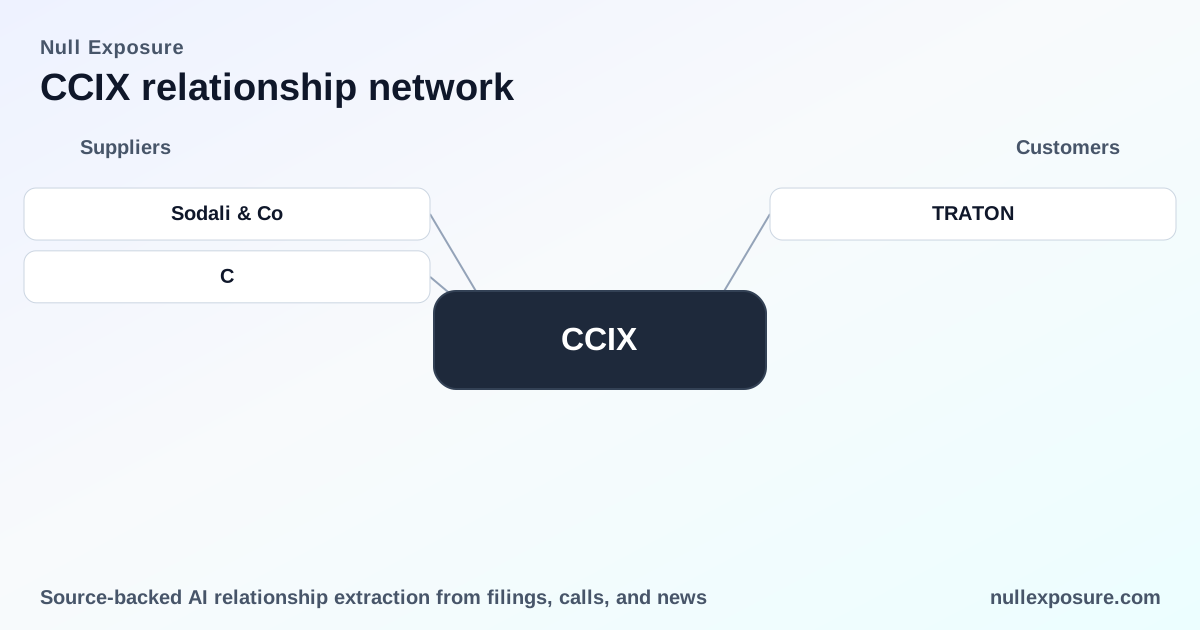
Churchill Capital Corp IX (CCIX): Customer relationships that reveal the deal thesis
Churchill Capital Corp IX is a special purpose acquisition company that sources and closes a single transformative merger to create public equity exposure in a high-growth technology target; the sponsor monetizes through sponsor shares, warrants and upside in the post-merger operating company once a transaction is completed. CCIX currently carries a pre-close SPAC profile — no operating revenue, a market capitalization concentrated around the pending combination, and strategic customer and partner commitments that are meaningful drivers of deal valuation. For investors evaluating CCIX’s customer landscape, the active third‑party commercial and financing ties reported in early 2026 are central to forecasts of post‑merger revenue prospects and dilution scenarios. Learn more about our coverage at https://nullexposure.com/.
Why customer relationships matter for a SPAC like CCIX
For a shell company that exists to merge, customer and partner agreements are the primary real-world evidence of commercial traction for the target business. Commercial commitments that include non-dilutive R&D funding, revenue‑linked warrants, and board representation materially change the risk/reward profile of a SPAC deal: they convert speculative promise into contracted economic upside and governance alignment. The relationships disclosed in news reports and earnings transcripts for CCIX’s deal pipeline provide discrete signals about contracting posture, concentration, and counterparty quality that investors must price into post‑close equity scenarios.
How to read these relationships: contracting posture, concentration, criticality, maturity
- Contracting posture: CCIX’s model means the pre-close party structure is sponsor-driven and negotiation-heavy; deal terms often include milestone‑based funding, warrants tied to deployment revenues, and governance seats that lock in partner incentives.
- Concentration: A small number of strategic partners delivering material funding or deployment commitments creates single‑counterparty concentration risk, but also increases upside if partners bring distribution muscle.
- Criticality: Where partners commit non‑dilutive R&D funding and board rights, those relationships are operationally critical to integration, certification and commercial launch timelines.
- Maturity: These are pre‑commercial to early‑commercial arrangements — commitments generally accelerate integration and sales but do not constitute broad market validation.
These are company-level signals for CCIX given its SPAC posture rather than attributes tied to a single counterparty.
Reported relationships (each entry from the collected results)
TRATON — strategic OEM funding and governance rights
A March 9, 2026 Globe and Mail report details that TRATON agreed to provide up to $25 million in non‑dilutive R&D funding to accelerate integration of PlusAI’s SuperDrive system into its truck brands, and would receive private warrants tied to up to $400 million of future deployment revenues, plus the right to designate one director to the post‑merger company’s board. This is a commercially significant OEM partnership that pairs funding with governance and future revenue participation. (Source: The Globe and Mail, March 9, 2026 — https://www.theglobeandmail.com/investing/markets/stocks/CCIX-Q/pressreleases/37259574/plusai-traton-deal-advances-ahead-of-churchill-capital-merger/)
TRATON Group — duplicate entry capturing the same strategic arrangement
The dataset also lists the same Globe and Mail disclosure under the name TRATON Group, reflecting the identical negotiated terms: up to $25 million of R&D support, private warrants linked to deployment revenues up to $400 million, and a board designation right for the post‑merger company. The duplicated entry reinforces that the OEM relationship is a focal point of the deal narrative in market reporting. (Source: The Globe and Mail, March 9, 2026 — https://www.theglobeandmail.com/investing/markets/stocks/CCIX-Q/pressreleases/37259574/plusai-traton-deal-advances-ahead-of-churchill-capital-merger/)
SACH (Sachem Capital Corp) — financing access through a Churchill facility
An earnings call transcript cited by InsiderMonkey (first seen March 10, 2026) quotes management saying “Funds are available for that through our Churchill facility, cash on hand as well as our Needham credit facility,” indicating Sachem’s access to a designated Churchill facility as a source of liquidity. This language signals a financing relationship in which Churchill‑branded capital is explicitly referenced as available funding for an affiliated company’s operational needs. (Source: InsiderMonkey transcript referencing Sachem Capital Corp Q2 2025 earnings call, reported March 10, 2026 — https://www.insidermonkey.com/blog/sachem-capital-corp-amexsach-q2-2025-earnings-call-transcript-1584686/)
What these relationships imply for investors
- Commercial validation through OEM capital and governance: The TRATON commitment is structured to align incentives — funding to accelerate integration, participation in upside via warrants, and a board seat. This converts part of the commercial risk into contractual obligations that support revenue modeling for the post‑merger company.
- Concentration of strategic exposure: TRATON’s prominence in reported disclosures creates single‑party concentration: a successful launch through TRATON’s truck brands materially reduces execution risk, but delays or underperformance would have outsized consequences for projected revenues tied to that partner.
- Financing flexibility ahead of or after close: The Sachem reference to a Churchill facility indicates that sponsor or sponsor‑linked credit arrangements are being used to underwrite working capital or project financing, which reduces near‑term liquidity risk for counterparties but concentrates financing exposure on sponsor resources and credit providers.
Risks, upside and what to watch next
- Risk: partner execution is critical — TRATON’s deployment milestones and warranty triggers will drive whether the private warrants convert into meaningful economics; any slippage directly affects post‑merger cashflows and valuation.
- Upside: non‑dilutive R&D funding and governance alignment materially de‑risks integration and shortens time to commercial launch if TRATON delivers on integration timelines.
- Near-term catalysts: formal merger agreement disclosures, definitive transaction filings, and any public release of the warrant mechanics or milestone schedules from TRATON will re‑rate deal assumptions.
Bottom line and next steps for investors
CCIX’s reported customer and financing ties are high‑impact, concentrated relationships that transform speculative promise into contractually backed commercial opportunity. Investors should prioritize diligence on the precise warrant economics, milestone conditions attached to TRATON funding, and any formal documentation of the Churchill financing facility referenced by Sachem. For a consolidated view of these developments and ongoing monitoring, visit https://nullexposure.com/.
Bold takeaways: TRATON provides meaningful non‑dilutive funding and governance rights, private warrants create contingent upside tied to deployment, and Churchill‑linked financing is being used to provide liquidity to counterparties — each of these factors will drive CCIX’s post‑merger valuation trajectory.