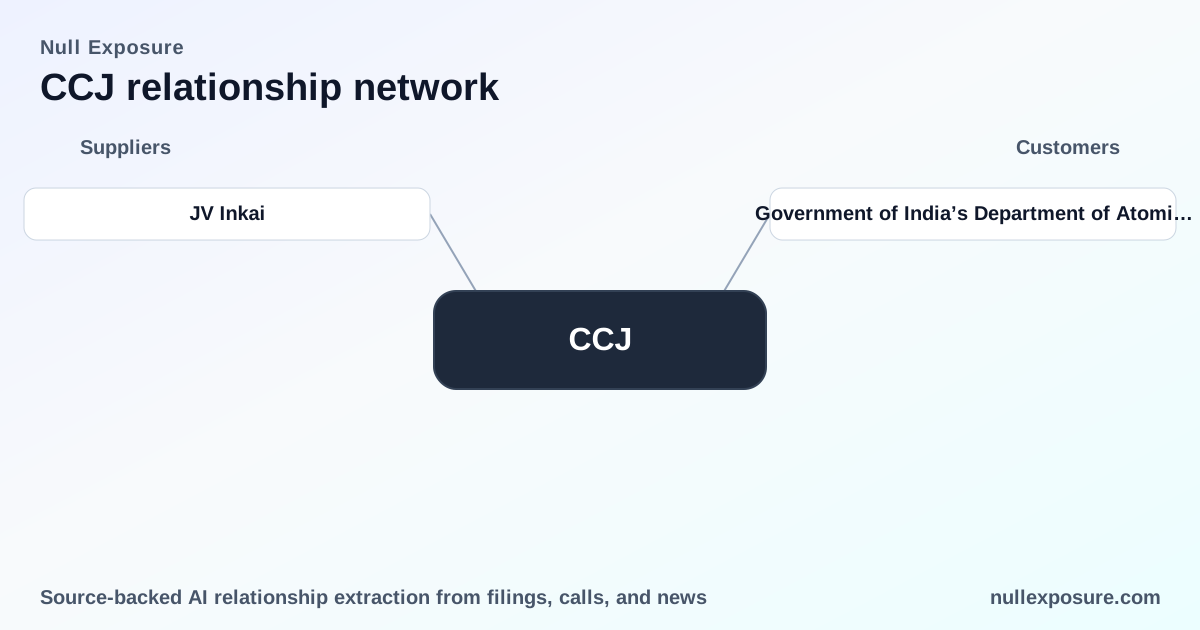
Cameco (CCJ): Customer Relationships That Underwrite a Premium Uranium Franchise
Cameco operates as a vertically focused uranium producer that monetizes through long‑term and spot sales of uranium ore concentrate (U3O8) to utilities, reactor builders, and royalty/asset managers. The company converts mining capacity, inventory and offtake contracts into predictable cash flow while capturing upside from an improving nuclear fuel market. For investors and operators evaluating counterparties, the defining features are multi‑year contracting, government counterparty exposure, and tier‑one utility demand that lends revenue stability. For deeper background, visit our research hub at https://nullexposure.com/.
How Cameco actually makes money — a concise commercial thesis
Cameco mines and sells uranium concentrate and participates across the fuel cycle via inventory management and long‑term offtake contracts. Revenue streams combine spot sales with multi‑year agreements and strategic partnerships, which smooth commodity revenue volatility and create line‑of‑sight cash flows that support capex and dividend policy. The balance sheet and valuation metrics reflect a company priced for durable secular demand: market capitalization of roughly $51.5 billion against trailing revenue of about $3.48 billion (TTM). These numbers imply the market is paying a premium for Cameco’s contract book and strategic customer position.
Customer relationships you need to know about
India’s Department of Atomic Energy — a large, long‑term offtake
Cameco has signed a $2.6 billion long‑term supply agreement to provide approximately 22 million pounds of uranium concentrate to India’s Department of Atomic Energy, creating a multi‑year revenue stream tied to India’s expanding reactor fleet. Sources reporting the agreement include Intellectia.ai (May 2, 2026) and StockTitan (March 9, 2026), which together describe the contract and its strategic importance to Cameco’s North American leadership position (FY2026).
Sources: Intellectia.ai (FY2026 reporting, May 2, 2026) and StockTitan (March 9, 2026).
Government of India’s Department of Atomic Energy — corroborating market coverage
Multiple market outlets referenced the same multi‑year transaction under slightly different labels, reinforcing market recognition that the Indian government is a named counterparty for a sizable offtake. TradingKey and other market summaries highlighted this agreement as a near‑term catalyst for CCJ’s stock performance in FY2026.
Source: TradingKey market commentary (FY2026).
IMSR / Terrestrial Energy — supply into advanced reactor projects
Terrestrial Energy’s public disclosures identify Cameco as a supplier of natural uranium for fuel programs tied to the IMSR platform, signaling Cameco’s role as a supplier to emerging advanced reactor developers in FY2024. This relationship shows how Cameco extends beyond traditional utility offtakes into new‑technology supply chains.
Source: NeutronBytes reporting on Terrestrial Energy (FY2024).
HTOO / royalty portfolio mentions — exposure via royalties and third‑party holdings
Press releases tied to royalty transactions (HTOO‑related coverage) list Cameco as an operator of projects that underpin acquired uranium and natural gas royalties. Fusion Fuel’s communications in early 2026 enumerate royalty interests associated with projects operated or developed by Cameco, underscoring an indirect commercial footprint in third‑party royalty portfolios (FY2026).
Sources: SahmCapital press releases describing Fusion Fuel’s royalty portfolio (February–March 2026, FY2026).
Westinghouse Electric Company — strategic demand linkage
Market commentary has emphasized Westinghouse’s AP1000 reactor technology as a demand amplifier for Cameco, because each new AP1000 or similar reactor creates incremental fuel requirements that flow to suppliers like Cameco. InsiderMonkey’s FY2026 coverage highlighted this strategic linkage as part of demand modeling for the firm.
Source: InsiderMonkey coverage (FY2026).
(If you want an integrated view of how these relationships translate into cash flow scenarios and counterparty risk mappings, see our more extensive research at https://nullexposure.com/.)
How these customer ties set Cameco’s operating constraints and posture
These relationships collectively produce four company‑level operating signals relevant for investors and operators:
- Contracting posture — long‑term offtakes dominate commercial risk management. Cameco’s exposure skews toward multi‑year agreements and strategic supply deals rather than pure spot concentration, which stabilizes future cash flow but increases the company’s exposure to contract negotiation dynamics with large counterparties and governments.
- Concentration — material exposure to a few large counterparties. The existence of a $2.6 billion India deal and direct supply ties to major reactor vendors implies counterparty concentration that improves revenue visibility but increases single‑counterparty negotiation risk.
- Criticality — product is mission‑critical for customers. Uranium supply is essential to reactor operations; this creates high counterparty stickiness and a defensible commercial position for Cameco relative to non‑integrated suppliers.
- Maturity — a mix of legacy utility contracts and new‑technology customers. Cameco operates as a mature supplier with traditional utility contracts while selectively participating in advanced reactor fuel chains, which diversifies but does not eliminate structural commodity exposure.
These signals affect treasury planning, hedging strategy and capital allocation: long contracts compress near‑term price optionality while improving predictability for capex and dividends.
Investment implications for operators and finance teams
Cameco’s financials show a company trading at premium multiples (trailing P/E ~121.9, EV/EBITDA ~60.9) with significant institutional ownership (~69%). That valuation reflects the market pricing of contract depth and strategic government counterparty exposure, not short‑term commodity cycles. For operators and credit investors, the combination of long‑dated supply contracts with government buyers and ties to major reactor OEMs supports a case for lower revenue volatility and higher recovery prospects in downside scenarios, while valuation premium requires continued execution on contract delivery and prudent capital discipline.
Key risk vectors remain counterparty negotiation risk, geopolitical allocation of nuclear fuel, and the pace of new reactor builds—factors that execute at the intersection of commercial contracting and public policy.
Final read: what to watch next
- Monitor delivery schedules and invoicing under the India supply agreement for near‑term cash‑flow recognition signals.
- Track reactor build pipelines (especially Westinghouse AP1000 orders) and advanced reactor fuel qualification milestones for incremental demand.
- Watch royalty announcements and third‑party portfolio sales to see whether Cameco’s name continues to underpin asset valuations.
For a concise dashboard of Cameco’s counterparty commitments and updated research, visit our research portal at https://nullexposure.com/.
Bold takeaway: Cameco’s customer book blends high‑value government offtakes, strategic OEM linkages and targeted supply to advanced reactor developers — a configuration that justifies a premium valuation if delivery and geopolitical exposure remain controlled.