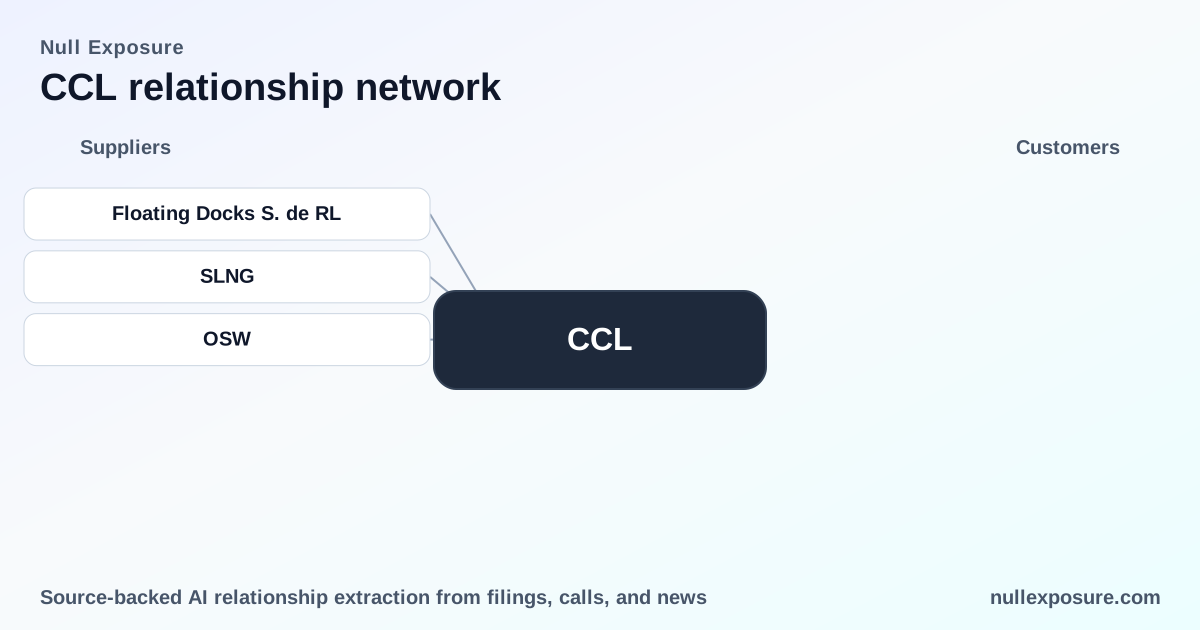
Carnival Corporation (CCL): Customer Relationships, monetization, and the Travelzoo touch
Carnival Corporation operates the world’s largest cruise platform, generating revenue primarily from passenger ticket sales, onboard spend (F&B, entertainment, casinos, retail) and third‑party distribution/marketing channels that accelerate bookings. The company converts high-volume, advance‑paid bookings into predictable cash flow but carries large customer deposit liabilities that shape its liquidity and refund risk profile. For investors and operators evaluating Carnival’s customer-side economics, the balance between scale, advance receipts, and distribution partnerships is the primary driver of margin expansion and cyclical resilience.
Explore comprehensive relationship coverage at https://nullexposure.com/
The business model through the customer lens: how Carnival monetizes demand
Carnival monetizes guests through a combination of upfront ticket sales and follow‑on revenue streams captured on board. Passenger fares generate base ticket revenue and yield the captive audience for high‑margin onboard spend. Advance payments are material to Carnival’s capital structure: company filings list total customer deposits of $7.2 billion as of November 30, 2025, underscoring the scale of prepaid obligations recorded on the balance sheet and their role as a short‑term funding source.
The company’s contracting posture with customers is transactional: individual consumers purchase specific sailings and optional packages rather than enter long‑term contracts, which creates volume sensitivity to promotion cycles and travel sentiment. At the same time, the firm's global brand portfolio—over 100 vessels across 10 cruise lines—gives Carnival maturity and diversified operational reach, with heavy concentration in North America. The company’s filings report U.S. sourced revenue listed as $14,847 (reported in the revenue-by-country table) and show North American source markets materially larger than Continental Europe (brands’ main source markets: United States & Canada 8,092 vs Continental Europe 2,754), indicating where most guest demand originates.
Distribution partners matter: the Travelzoo relationship in one paragraph
Travelzoo (TZOO) is functioning as a distribution and marketing channel for Carnival’s Princess brand, promoting exclusive member deals such as a 16‑night roundtrip California cruise to Hawaii to drive bookings and incremental demand. A Travel and Tour World article on March 10, 2026, described Travelzoo’s exclusive club deal for a Princess cruise, illustrating how third‑party leisure publishers feed inventory to the consumer funnel and boost near‑term load factors.
Why single‑deal partnerships matter to revenue quality
Distribution partners like Travelzoo perform two roles: they broaden reach into member bases and they trigger early bookings that contribute to Carnival’s deposit balance. These relationships are commercially important because they improve sailings’ load factors without capital investment, but they do not convert into durable contractual revenue — each booking remains a transactional sale to an individual guest. For investors, the key readthrough is that marketing partnerships amplify demand elasticity and short‑term revenue growth while leaving advance‑payment exposure and refund obligations on Carnival’s balance sheet.
Company‑level constraints that shape customer economics
Several operating characteristics emerge from Carnival’s corporate disclosures and customer signals:
- Counterparty is individual consumer. Carnival’s revenues are derived from individual guests (the company notes team members serve over 13.5 million guests annually), which produces high transaction volume, retail price sensitivity, and seasonality in demand.
- Advance‑payment funding with balance sheet liability. The company discloses customer deposits and advance onboard purchases as liabilities; the $7.2 billion in customer deposits reported at November 30, 2025 demonstrates material prepaid cash that supports operations but also represents potential refund and churn risk if itineraries change.
- Geographic concentration in North America with EMEA presence. Filing excerpts place the United States as the largest revenue source and identify Continental Europe as a meaningful secondary market; this concentration exposes Carnival to North American economic cycles and travel patterns while maintaining European diversification.
- Relationship stage and segment orientation. Customer relationships are generally active and short‑term at the point of sale; Carnival’s core product is the cruise vacation, supported by services (onboard experiences and advance purchases) that augment ticket revenue.
- Mature consumer leisure model. Carnival operates a high‑scale, established platform rather than experimental distribution mechanics; the company’s operating margins and return on equity (reported operating margin TTM ~9.83% and ROE ~27.9% in recent figures) reflect a business where scale and yield management are decisive.
These constraints function as company‑level signals: they explain why Carnival keeps large customer deposits, why individual consumer behavior drives quarterly volatility, and why distribution partners are complementary rather than structural revenue guarantors.
Implications for operators and investors
- Liquidity and refund risk are first‑order considerations. The $7.2 billion customer deposit balance is a working capital source that also represents potential outflows under cancellations or itinerary changes; liquidity planning must factor in peak refund scenarios and promotional elasticity.
- Distribution partnerships are tactical levers, not lock‑ins. Travelzoo‑style deals accelerate bookings but do not alter the underlying unit economics of a booking; profitability depends on mix (full fare vs discounted promotional fares) and incremental onboard spend.
- Geographic demand composition drives narrative for growth. With a dominant North American guest base, macro indicators in U.S. consumer spending and travel propensity will materially affect revenue tailwinds; European demand offers diversification during off‑US cycles.
- Margin expansion is achievable through on‑board capture and yield management. Carnival’s platform scale gives management room to lift margins by optimizing onboard offers and ancillary pricing rather than seeking dramatic changes to core ticket rates.
For modelers, treat third‑party promotions as demand accelerants with modest margin dilution risk and model customer deposits as a contingent liability line that can compress free cash flow if refunds spike.
Continue tracking relationship activity and partner deal cadence at https://nullexposure.com/
Risks and watch‑points tied to customer relationships
- High dependence on advance bookings introduces concentrated refund exposure. A sharp demand shock would turn a funding source into a liability realization event.
- Marketing‑driven discounting can erode short‑term yield. Broad use of exclusive deals risks normalizing lower price points if not offset by onboard revenue.
- Geographic concentration increases correlation with specific macro cycles. A slowdown in U.S. travel demand materially impacts occupancy and revenue per passenger.
Bottom line for investors and operators
Carnival’s customer ecosystem is a classic consumer travel model: mass individual transactions funded by large advance receipts, amplified by third‑party distribution partners and tempered by refund/liquidity risk. Travelzoo’s promotional activity is a useful indicator of demand channels but does not change the fundamental economics that flow from passenger yields and onboard monetization. The critical monitoring points are customer deposit trends, distribution mix, and geographic demand composition — these variables will determine near‑term cash flow resilience and the sustainability of margin recovery.