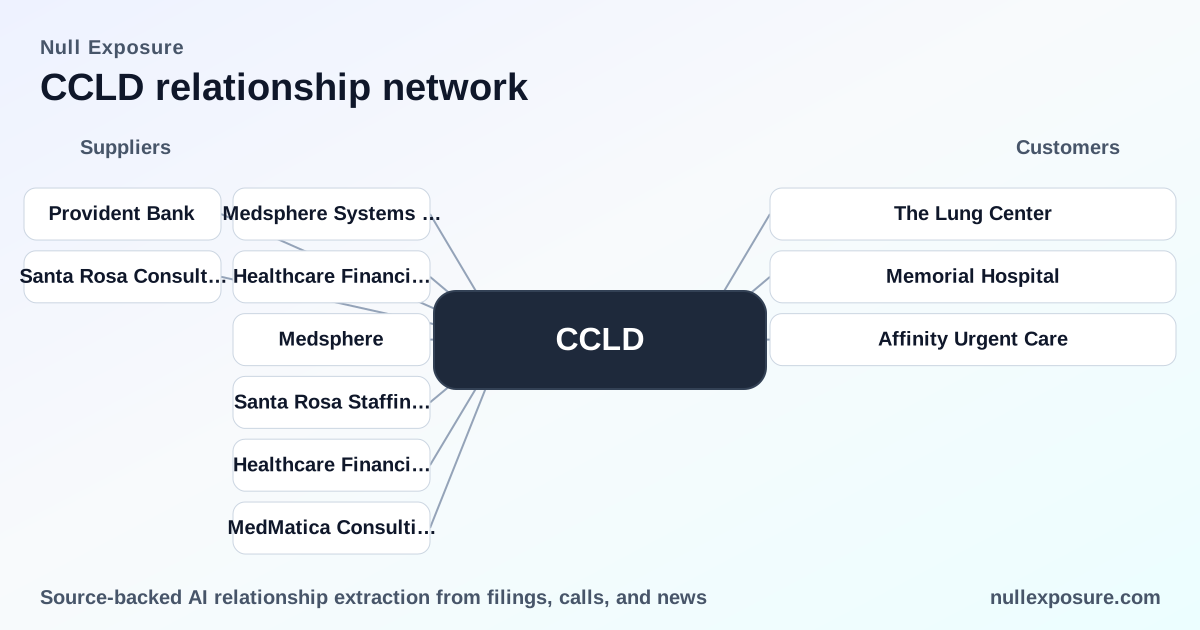
CareCloud (CCLD) — Customer Relationships That Drive Recurring, Usage-Linked Revenue
CareCloud sells cloud-native healthcare IT and related services to U.S. providers and health systems, monetizing through a mix of SaaS subscriptions and usage‑based revenue cycle management (RCM) fees (typically a percentage of collections) plus occasional implementation and professional services. The company combines software products (EHR, practice management, supply‑chain and patient access AI) with outsourced services to capture both recurring software economics and transaction-linked cash flow. For a quick view of the platform and coverage, visit https://nullexposure.com/.
Why these customer disclosures matter to investors
Recent press releases and filings show CareCloud turning product launches and name-brand pilot wins into visible commercial traction across distinct healthcare settings: urgent care, community hospital supply chain, and specialty clinics using AI front desk tools. These wins validate the multi-product strategy — software breadth (EHR, supply chain, patient access) feeding services and usage revenue — while highlighting operating characteristics that matter for valuation and risk modeling.
- Revenue profile: Mix of fixed subscription fees and variable, percentage‑of‑payments RCM fees creates both recurring base and growth-sensitized upside.
- Contracting posture: Contracts are typically treated as month‑to‑month under ASC 606 with common 90‑day termination provisions, which lowers enforceability of long-term lock‑in but preserves high renewal economics.
- Customer concentration: Company disclosures point to a broad installed base (~40,000 providers), supporting low concentration risk despite some mid‑size account spend.
- Geography and segment focus: U.S. healthcare only; products span both software and services verticals.
Operating model constraints and what they imply
CareCloud’s public disclosures provide explicit, company-level signals about how customers contract and how material individual accounts are:
- Usage-based billing is core. Management states RCM fees are frequently billed as a percentage of collections with monthly minima and one‑time setup fees, reinforcing variable revenue exposure to payment cycles and claim volumes.
- Short-term contractual treatment. Although stated terms may be a year or longer, contracts are considered month‑to‑month under ASC 606 and many clients can terminate with roughly 90 days’ notice — a structural constraint that favors customer service and product stickiness over legal lock‑in.
- SaaS and subscription elements exist. Many clients use CareCloud’s software on a SaaS basis; fees can be fixed per provider or variable, supporting predictable revenue bands for planning.
- Wide customer breadth, low concentration. As of Dec 31, 2024, CareCloud served roughly 40,000 providers across ~2,600 practices and hospitals, signaling diversified revenue sources and limited single-customer dependence.
- Service provider role and HIPAA posture. CareCloud functions as a business associate under HIPAA, embedding operational integration and compliance obligations into customer contracts — a value and risk amplifier.
- Renewals are strong. Management disclosed renewal rates of 95% (2024) and 91% (2023) for practice counts, indicating durable retention trends despite short contract economics.
- Significant mid‑range account examples exist. A related-party sale of roughly $138k in annual revenue shows some customers sit in the low‑six‑figure band, consistent with a spend band between $100k–$1M for parts of the book.
Together, these constraints define a business that is service‑intensive, renewal‑driven and exposed to volume‑sensitive revenue swings, while benefiting from broad distribution and proven retention.
Customer-by-customer: recent disclosures every investor should know
Affinity Urgent Care
Affinity Urgent Care, a multi‑site operator in the Houston‑Galveston region, selected CareCloud’s Wellsoft EDIS to support its clinics, extending CareCloud’s emergency‑grade documentation into the urgent care channel that the company highlights as a major expansion opportunity. According to a January 2026 company press release distributed on GlobeNewswire, management positioned this deal as an early marker for national urgent care adoption. (GlobeNewswire, Jan 2026)
Memorial Hospital (Marysville, Ohio)
Memorial Hospital signed for CareCloud’s HealthLine clinical supply chain platform to improve inventory integrity and supply‑chain efficiency, marking a hospital-level deployment of a product aimed squarely at operational cost control. The hospital selection was announced in a January 2026 GlobeNewswire release and reiterated in subsequent company filings and news summaries in March 2026. (GlobeNewswire, Jan 2026; company 8‑K filings summarized via StockTitan, Mar 2026)
The Lung Center
The Lung Center deployed CareCloud’s stratusAI Desk Agent for phone-based patient access, with the practice reporting the tool now handles nearly 80% of inbound calls and has materially streamlined operations; the testimonial was included in CareCloud’s December 2025 product launch release. (GlobeNewswire press release, Dec 2025)
What investors should infer about revenue quality and risk
- Quality: The product mix — EHR/EDIS, supply‑chain, and AI-driven patient access — supports diversified revenue streams where software subscriptions provide steadiness and usage-based RCM fees deliver growth leverage. High renewal rates materially support recurring revenue forecasts.
- Risk: Short contractual economics and variable billing increase churn sensitivity and cash‑flow volatility during reimbursement or macro stress. The HIPAA business-associate role heightens operational and compliance risk, making service delivery reliability a valuation driver.
- Concentration and scale: A large provider base (~40,000) reduces the likelihood of outsized customer losses; nevertheless, pockets of mid‑sized customers (example: ~$138k revenue) create pockets of revenue that should be modeled discretely.
Investment takeaways and near-term watchlist
- Positive: Wins at an urgent care network, a community hospital supply chain deployment, and a specialty clinic using AI underscore cross‑product commercial traction and the platform’s ability to sell both software and services.
- Caution: Model revenue with variable RCM percentages and assume customer termination windows can compress revenue visibility; monitor claim volumes and collections as leading indicators.
- Watchlist: track quarterly RCM take rates, churn by product line, pipeline conversion in urgent‑care and community hospital segments, and any material changes to ASC 606 disclosure or HIPAA compliance incidents.
For a deeper look at relationship-level signals, visit our research hub at https://nullexposure.com/.