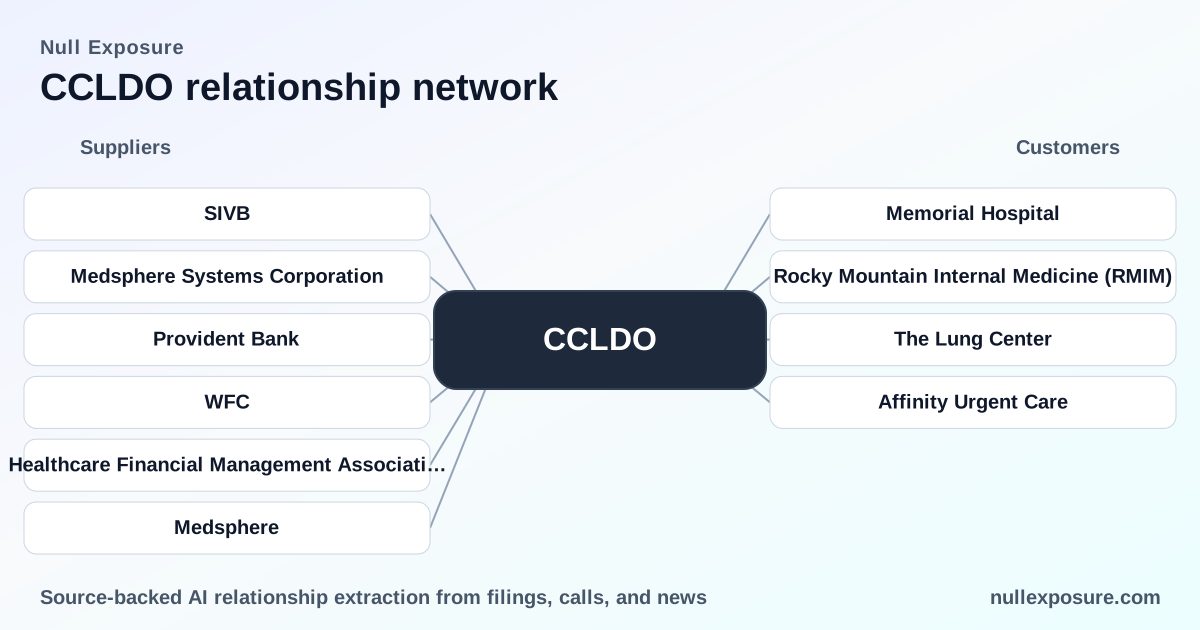
CareCloud (CCLDO) — Customer Relationships and Commercial Signals
CareCloud operates as a U.S.-focused healthcare IT and services company that monetizes through a mix of usage-based revenue cycle management (RCM) fees, recurring SaaS subscriptions, and complementary professional services. The company sells an integrated stack — RCM, EHR/PM, telehealth, inventory and supply-chain tooling, and increasingly generative-AI services — and collects fees as a percentage of client billings or as fixed SaaS charges, with add-on setup and minimums. Investors should value CareCloud as a services-led SaaS business with concentrated, usage-linked cashflows and short contractual levers that create both revenue volatility and upside from client expansion. For more detailed signal work on CareCloud relationships, visit https://nullexposure.com/.
Why customers matter for valuation: the operating model in plain English
CareCloud’s revenue mix is anchored to RCM, which historically accounted for roughly two-thirds of revenue and is typically billed as a percentage of collections. That billing posture means revenue scales with providers’ volumes and pricing pressure in healthcare reimbursement. The company also sells SaaS modules (EHR, PM, PXM, business intelligence) that are routinely bundled but comparatively smaller in contract value. Contracts present three practical constraints you must bake into any cashflow model:
- Short-term contracting posture: Contracts are treated as month-to-month for accounting (ASC 606) and many legacy acquired customers retain short termination notices (90 days or less), producing higher churn risk but simpler cost-to-serve management.
- Usage-linked economics dominate: A material portion of ongoing revenue is tied to collections percentage fees rather than fixed license fees, producing both cyclical exposure and embedded upside if client collections grow.
- Hybrid SaaS + services delivery: SaaS fees exist and provide recurring, more predictable revenue, but the SaaS component is not the material value driver relative to RCM for many contracts.
These are company-level signals: they reflect CareCloud’s commercial posture and should be applied across customer relationships unless a contract excerpt explicitly contradicts them. For a deeper set of signals and relationship mappings, check https://nullexposure.com/.
What the recent customer mentions tell investors
CareCloud’s recent public disclosures and press releases highlight a mix of hospital system supply-chain wins, urgent care and specialty clinic adoptions, and RPM partnerships. These announcements illuminate three commercial threads: (1) enterprise-targeted supply-chain and inventory wins, (2) point-solution adoption in lower-acuity markets (urgent care, specialty clinics), and (3) growing AI/automation-led product placements that reduce client operating cost while shifting CareCloud’s value capture toward platform features.
Below I summarize every customer relationship surfaced in the public results and the supporting sources.
The Lung Center / Lung Center — automation gains in scheduling
CareCloud’s stratusAI Desk Agent has been adopted by The Lung Center, where the system now handles nearly 80% of inbound scheduling calls and frees clinical staff to focus on complex patient care, indicating rapid operational lift from applied AI in outpatient settings (InsiderMonkey Q4 2025 earnings transcript; Yahoo Finance press release, Mar 9, 2026: https://finance.yahoo.com/news/carecloud-launches-stratusai-desk-agent-130000959.html). This win demonstrates product-market fit for conversational AI in scheduling and immediate efficiency capture.
Rocky Mountain Internal Medicine (RMIM) — remote patient monitoring deployment
CareCloud partnered with Rocky Mountain Internal Medicine to deploy a remote patient monitoring (RPM) solution aimed at proactive chronic disease management, reflecting the company’s expansion into longitudinal care tools beyond RCM (GlobeNewswire press release, Nov 2, 2022: https://www.globenewswire.com/news-release/2022/11/02/2546590/16541/en/CareCloud-Provides-Rocky-Mountain-Internal-Medicine-With-Remote-Patient-Monitoring-Solution-to-Improve-Patient-Care.html). RPM positions CareCloud in value-based and chronic care workflows where ongoing monitoring drives recurring service utility.
Memorial Hospital (Ohio) / Memorial Hospital — HealthLine supply chain platform adoption
Memorial Hospital selected CareCloud’s HealthLine clinical supply chain and inventory management platform in multiple announcements spanning FY2025–FY2026, citing improved supply-chain efficiency and inventory integrity (GlobeNewswire releases, Jan 21, 2025 and Dec 29, 2025; StockTitan coverage of 2025 results announcement). These contract wins illustrate CareCloud’s penetration into hospital operations tooling beyond ambulatory RCM (GlobeNewswire Dec 29, 2025: https://www.globenewswire.com/news-release/2025/12/29/3210893/0/en/CareCloud-Appoints-Chief-Strategy-Officer-to-Lead-Enterprise-AI-Platform-as-Company-Enters-2026-as-Its-Defining-AI-Year.html). Hospital-level HealthLine wins are higher ACV opportunities and signal movement upmarket into systems-level spend.
Affinity Urgent Care — emergency‑grade documentation in urgent care
Affinity Urgent Care adopted CareCloud’s Wellsoft emergency-grade documentation system, marking the vendor’s first push of that product into urgent care settings and expanding addressable market beyond EDs to point-of-care urgent clinics (InsiderMonkey earnings transcript FY2026; StockTitan Jan 8, 2026: https://www.stocktitan.net/news/CCLD/care-cloud-to-announce-fourth-quarter-and-full-year-2025-results-on-xitazn3vh2di.html). This adoption supports a strategy of cross-selling higher-margin clinical software into high-volume outpatient channels.
What these relationships imply about commercial concentration and spend
CareCloud reports that one customer represented about 9–10% of revenue in 2023–2024, which establishes a baseline single-customer concentration risk in the low double digits and suggests there are customers in the $10m–$100m spend band. Globe-level signals reinforce a U.S.-only revenue footprint and a client base ranging from solo practices to enterprise specialty groups with thousands of providers. Concentration is meaningful but not extreme; product mix volatility (usage-based RCM) amplifies earnings sensitivity to a few large clients.
Risk and upside mapped to customer dynamics
- Risk: Short-term or month-to-month termination economics and usage-based billing produce higher top-line elasticity and potential churn-driven revenue swings. A loss of a 10% customer would be material to near-term revenue and cashflows.
- Upside: HealthLine hospital wins and stratusAI placements offer meaningful upside through higher ACV, cross-sell into supply-chain and AI services, and migration of clients from pure RCM to platform bundles with better gross margins.
- Operational implication: Sales and implementation must remain tight; short termination windows reward rapid ROI on deployment and strong customer success to lock in recurring fees.
Final read for investors
CareCloud’s recent customer news demonstrates a deliberate push to broaden monetization beyond core RCM into AI-driven automation and hospital operations—areas that increase average contract value and reduce pure collection-dependency. However, the firm’s contract architecture (usage-heavy, short-term, U.S.-only) requires active retention management and creates earnings cyclicality. Investors should model upside from enterprise HealthLine and stratusAI adoption while stress-testing the revenue base for the potential loss of one or more large customers in the 10% revenue band.
For an actionable view into relationship-level signals and to track future customer announcements, explore the relationship intelligence work at https://nullexposure.com/.