Clear Channel Outdoor (CCO): Transit and Airport Contracts Recast Growth — What Investors Should Know
Clear Channel Outdoor monetizes by selling out‑of‑home advertising across displays it owns or operates, deriving revenue from a mix of short campaign buys and multi‑year venue concessions. The company’s recent cadence of airport and transit concession wins — combined with capital investments in digital displays — repositions the Airports and Transit channels as the primary commercial lever for near‑term revenue growth and margin recovery. Learn more about how these customer relationships change the investment case at https://nullexposure.com/.
A concentrated commercial play: airports, transit and the tender cycle
CCO’s model is straightforward: it signs concession and advertising management contracts with transit authorities and airport operators, then sells impressions to national and local advertisers. Revenue comes from ad selling, installation and network upgrades; margin expansion depends on digital rollouts and contract renewals at high‑traffic venues. The recent flurry of announcements in FY2025–FY2026 signals deliberate reinvestment in prime locations and a tilt toward longer airport deals alongside the company’s historically shorter campaign contracts.
Customer-by-customer roll call: the recent wins and counterparties
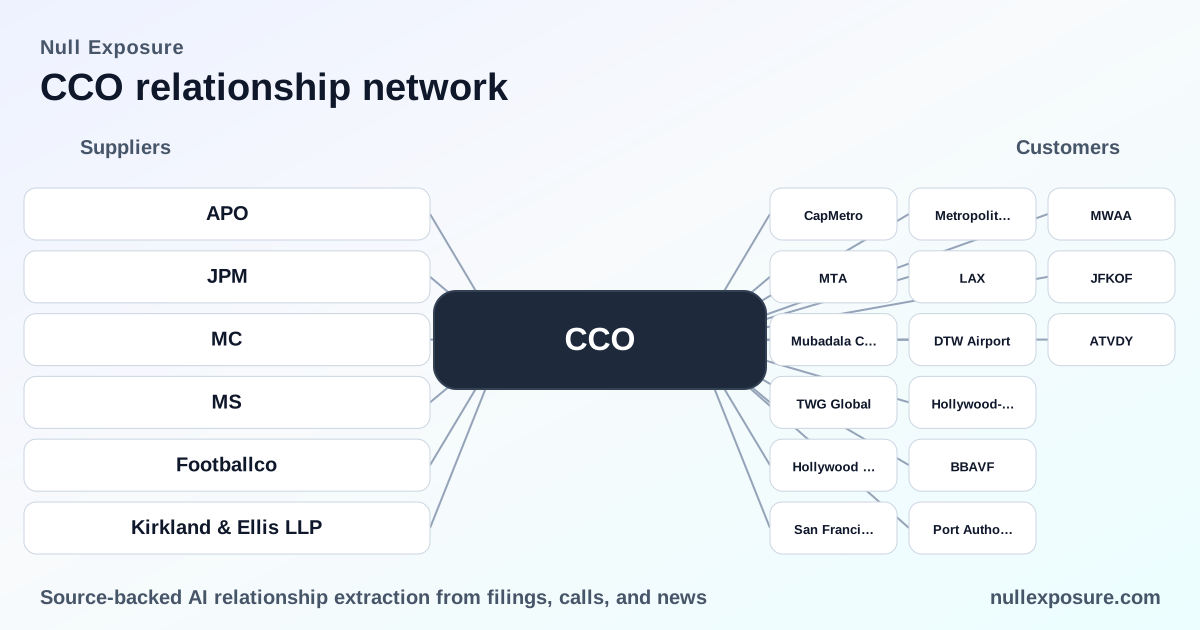
Below I cover every named relationship in the available reporting. Each entry is a concise, plain‑English take with a source citation.
-
CapMetro (Austin) — Clear Channel secured a multi‑year exclusive transit contract to modernize advertising across more than 400 buses and 10 rail stations, a program described as reaching over two million monthly riders and launching in 2026. Sources include PR Newswire and multiple market reports in FY2026 (Investing.com; StockTitan; PR Newswire).
-
Metropolitan Washington Airports Authority (MWAA) — CCO won a 10‑year extension to continue providing advertising services at MWAA airports beginning March 2026, including significant digital upgrades and a five‑year option. This was reported in company filings and news coverage in FY2026 (Investing.com; StockTitan).
-
MTA — Reporting indicates CCO secured a long‑term OOH (out‑of‑home) contract with the MTA, characterized in public coverage as a 15‑year agreement, reinforcing the company’s focus on transit network scale. The announcement appeared in Digital Signage Today and related FY2025–FY2026 coverage.
-
Omaha Airport Authority (Eppley Airfield) — CCO received a new 10‑year contract to operate airport advertising at Eppley Airfield, accompanied by a reported US$1 million investment in an integrated media program targeted at roughly 5.2 million annual passengers. The award was disclosed via PR and specialist coverage in March 2026 (PR Newswire; SAHM Capital).
-
Hollywood‑Burbank Airport (BUR) — CCO was named the exclusive media partner for the new terminal under an eight‑year agreement tied to the Elevate BUR expansion, positioning the company as the primary advertising operator for the renovated facility. Coverage ran in December 2025 and was summarized in FY2025 reports (SAHM Capital; Digital Signage Today).
-
Signature Aviation / BBAVF — The company announced a five‑year renewal with Signature Aviation for aviation‑site advertising, noted in industry press in FY2025 (Digital Signage Today).
-
Detroit Metropolitan Airport (DTW Airport) — CCO and DTW announced a 10‑year partnership for airport advertising, reflecting the company’s ongoing expansion in major U.S. hub airports; news coverage appeared in FY2025 (Digital Signage Today).
-
LAX — Reporting on airport strategy highlights new high‑resolution “hero” displays installed in renovated LAX terminals as part of broader airport innovations that drive premium inventory. These initiatives were discussed in market commentary in early 2026 (FinancialContent/Markets).
-
JFK / JFKOF — CCO’s airport program references upgraded high‑impact displays at JFK, cited alongside other airport rollouts; markets coverage in FY2026 grouped JFK with other renovation targets (FinancialContent).
-
Port Authority of New York and New Jersey — The Ports Authority figures among the airports driving a 13.7% year‑over‑year lift in the Airports segment, cited in CCO’s FY2025 results commentary (Morningstar/PR Newswire; TradingView).
-
San Francisco International (SFO) — SFO is also called out as a strong contributor to Airports segment growth, with digital demand noted in Q4/FY2025 reporting (Morningstar/PR Newswire; TradingView).
-
TWG Global — TWG Global is referenced in market reporting as a partner to Mubadala Capital in the proposed acquisition of CCO for $2.43 per share in cash, a strategic transaction reported in FY2026 market summaries (Finviz).
-
Mubadala Capital — Mubadala Capital is the lead buyer in the announced $6.2 billion acquisition agreement (in partnership with TWG Global), an important corporate event for shareholders that appeared in company press and PR Newswire in early 2026.
-
HROW (Harrow) — An outlier in the results: HROW appears in a healthcare press item and references pharmaceutical distributor channels; this is unrelated to CCO’s commercial advertising relationships and is present in the feed as an incidental match in FY2025 reporting (BioSpace press).
-
ATVDY / Atresmedia — Reporting indicates sale activity for CCO’s Spanish business unit, with Atresmedia identified as the buyer for roughly €115 million; the reference speaks to CCO’s U.S. realignment and European divestiture activity noted in FY2026 (Ad‑Hoc News).
Each of the entries above reflects the public reporting window in FY2025–FY2026 and derives from press releases, industry trade outlets, and market commentary.
What the relationship mix tells investors about the operating model
-
Contracting posture is mixed but tilted to event‑driven short campaigns with strategic long concessions. Company disclosures and coverage indicate many advertising contracts are short (campaigns of weeks to a year), while several recent airport and transit awards are multi‑year (5–15 years), creating a dual revenue profile: recurring concession cashflows plus flexible short‑term ad sales.
-
Counterparty profile spans large enterprises and small businesses. CCO targets national advertisers and agency partners while operating inside‑sales and self‑service channels for small businesses, which implies diversified customer acquisition routes and different margin dynamics by client size.
-
Geography is U.S.‑centric. FY2024 revenue splits and multiple U.S. airport/transit wins indicate a heavy North American concentration; European divestitures further align strategy toward the U.S. market.
-
Role and business segment are seller‑focused within services. The company acts as the seller/operator of ad space (out‑of‑home services), not as a media agency, and emphasizes digital upgrades and network installations as growth drivers.
-
Relationship stage is active with ongoing renewals and upgrades. Operational reporting points to active monetization and reinvestment, not passive asset disposition.
These signals reflect a business that balances cyclical ad demand with the stability of venue concessions; the strategic sensitivity is concentrated on concession renewals, capex timing for digital rollouts, and the success of monetizing high‑traffic airport inventories.
Risks and investor implications
- Renewal concentration risk: Multi‑year airport and transit wins reduce short‑term churn but elevate the importance of a handful of concession tender outcomes.
- Capex and execution risk: Digital upgrades require upfront investment to realize premium CPMs; underinvestment or execution delays would compress the expected margin uplift.
- Corporate control event: The proposed sale to Mubadala Capital/TWG Global is a material corporate event that will determine public float, strategic direction and valuation realization for shareholders.
Bottom line for allocators
Clear Channel is executing a consolidation of premium transport and airport inventory while maintaining the flexible ad‑sales engine that serves large advertisers and small businesses. Investors should treat recent airport and transit contracts as meaningful evidence of product re‑positioning toward higher‑yield, venue‑level inventory, but weigh that against capex demands and the pending acquisition by Mubadala/TWG.
For deeper relationship mapping and monitoring of tender outcomes, see our coverage at https://nullexposure.com/.
Bold takeaway: CCO’s runway is driven by concession wins and digital monetization; success hinges on execution of upgrades and the outcome of the strategic sale process.