Cross Country Healthcare (CCRN): Customer Relationships and Investment Implications
Cross Country Healthcare operates as a total talent-management and workforce-solutions provider to the U.S. healthcare sector, monetizing primarily through temporary staffing placements, managed service programs (MSPs), recruitment process outsourcing, and a SaaS offering (Intellify) for vendor management. The model generates recurring billing on hours worked for clinical staff, supplemented by framework MSP contracts and an emerging software revenue stream; corporate cashflows are therefore sensitive to utilisation, contract mix, and integration outcomes from M&A activity. For research access to structured relationship signals, visit https://nullexposure.com/.
How CCRN actually makes money and what matters to investors
Cross Country’s core economics are service-driven and volume-sensitive. The company reported roughly $1.054 billion of revenue (TTM) with EBITDA around $18.5 million, showing a profitable operating base constrained by depressed margins (negative EPS and slim operating margin). Revenue is reported on a gross basis for the physician staffing lines, reflecting a principal contracting posture where Cross Country invoices customers directly for staffing services and retains the spread. This positioning drives larger receivable and working-capital swings tied to billing cadence and payor terms.
Several structural features define the operating model:
- Contracting posture: The firm operates both framework MSPs for customers that centralize contingent labor sourcing and short-term, hour-based temporary staffing contracts (typical duration often 13-week travel assignments), so revenue mixes balance recurring program fees with volatile hour-based billing. This is a company-level signal drawn from recent corporate disclosures.
- Concentration and criticality: No single customer accounted for more than 10% of revenue in recent years, establishing low counterparty concentration; yet the services are highly critical to hospital operations, giving Cross Country durable commercial leverage.
- Geographic footprint and maturity: Operations are effectively U.S.-centric (all 50 states) with back-office presence in India, and the business blends mature staffing lines with a more nascent SaaS product (Intellify) that increases strategic optionality.
- Customer mix: The customer base includes both private and government entities, so public-sector payment terms and procurement processes are relevant for credit and collections risk.
These operating characteristics explain the company’s sensitivity to labor demand cycles, receivables volatility, and the strategic importance of MSP contract wins.
What the documents show about CCRN’s customer relationships (every listed relationship)
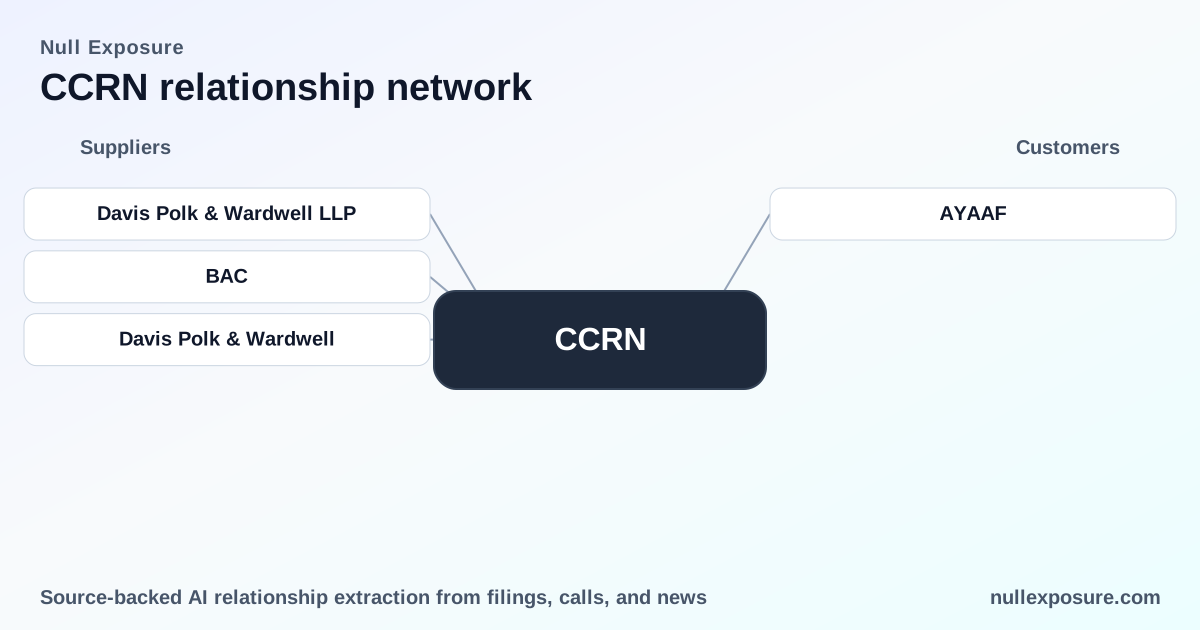
Cross Country’s relationship signals in the provided results are limited but material in tone. The source data identifies two relationship entries that reference the same transaction—Aya/AYAAF—and the company’s treatment of acquisition-related items.
- Aya — Cross Country recorded a $20.0 million termination fee paid by Parent to Cross Country in December 2025 related to the terminated Aya merger agreement; acquisition and integration-related income/costs tied to the Aya Merger are disclosed in a March 2026 8‑K. According to the company’s 8‑K filing, this termination fee and associated transaction costs were recognized in FY2026 (https://www.stocktitan.net/sec-filings/CCRN/8-k-cross-country-healthcare-inc-reports-material-event-d11440cfde11.html).
- AYAAF (inferred AYAAF) — The same disclosure is recorded under the inferred symbol AYAAF, repeating that the Aya termination fee of $20.0 million and related acquisition/integration fees were recognized across 2024–2025 and reported in FY2026 filings (see the 8‑K filed March 2026 at https://www.stocktitan.net/sec-filings/CCRN/8-k-cross-country-healthcare-inc-reports-material-event-d11440cfde11.html).
Both entries reference the same material event; investors should treat the Aya termination payment as a discrete, non-operating cash event that improved FY2026 cash flows and distorted acquisition-related income/expense presentation in that period.
Why these relationship signals matter to valuations and risk
The Aya termination fee is a one-off that improves near-term cash flow but does not alter the underlying staffing revenue base or margin trends. For investors, the signal matters for three reasons:
- Financial statement noise: Acquisition and integration-related items can mask core operating performance; the $20 million inflow should be normalized out when assessing organic EBITDA and free cash flow.
- M&A strategy and execution risk: The presence of a terminated merger and material termination fee highlights execution complexity in Cross Country’s strategic consolidation efforts, which affects future capital allocation and integration costs.
- Contract dynamics versus cash predictability: With a business built on short-term hour-based contracts and framework MSPs, reported one-off items like termination fees can temporarily bolster liquidity but do not reduce exposure to cyclical demand for travel nurses and allied professionals.
Risks, runway, and strategic levers investors should watch
- Margin leverage is limited today. Despite a market cap around $332 million and a sizable revenue base, profitability is thin (negative EPS, operating margin close to zero), so scaling services or growing higher-margin SaaS revenue is necessary to improve returns.
- Working-capital sensitivity. Acting as a principal in staffing arrangements drives meaningful accounts receivable and periodic working-capital swings that affect free cash flow.
- Customer concentration is low but government exposure is material. The company serves a mix of private and public healthcare providers; government contracts introduce procurement and payment timing constraints that require active credit management.
- SaaS optionality exists. Intellify positions Cross Country to capture recurring, less-cyclical revenue from vendor-management software, improving lifetime value per client if uptake accelerates.
Actionable investor view
- Short-term: Adjust valuations for the one-time Aya termination receipt; focus on normalized EBITDA and cash flow conversion given receivables volatility.
- Medium-term: Track MSP contract renewals and Intellify subscription growth as indicators of margin expansion and stickiness.
- Risk monitoring: Watch quarterly receivable trends and disclosure language around government contract mix and MSP rollout cadence.
For a deeper look at customer-level signals and how they map to credit and revenue risk, see our research hub at https://nullexposure.com/.
Bottom line
Cross Country Healthcare is a service-first business with a clear monetization path—hourly staffing revenue supported by framework MSPs and an emerging SaaS product—but investment returns hinge on execution: improving utilization, converting MSP wins into recurring margins, and stabilizing working capital. The Aya-related termination fee is financially material for FY2026, but it is a one-off that does not change the core cyclicality or contract mix that drives the company’s economics. Investors should focus on normalized operating results and commercial traction for Intellify when framing valuation and downside risk.