Consensus Cloud Solutions (CCSI): Customer Relationships That Drive Predictable SaaS Cash Flow
Consensus Cloud Solutions operates a secure information-delivery SaaS platform and monetizes through monthly recurring subscriptions and usage-based fees, selling cloud faxing, e-signature and information-delivery services to a global mix of individuals, small businesses, mid-market and enterprise customers. The company’s economics are driven by a high-retention SoHo base, enterprise and government contract wins, and usage-based upside — a combination that generates recurring cash flow while preserving revenue variability through per-transaction charges. For a deeper look at customer-level intelligence, visit the company page at https://nullexposure.com/.
How Consensus makes money and what that means for investors
Consensus’s revenue model is deliberately hybrid: subscription revenue provides base predictability while usage-based fees deliver growth leverage during higher activity periods. Company disclosures for FY2025 state that monthly recurring subscription revenue represented approximately 67% of total subscription revenue, and contracts explicitly combine recurring and usage components with performance obligations allocated across contract elements. These characteristics enforce a contracting posture that skews toward multi-period relationships with embedded variable economics.
Operationally, the company is a global service provider: Consensus serves roughly 703,000 customers across five continents, with product footprints in regulated verticals such as healthcare, government, financial services and legal. The customer base spans individuals and small office/home office (SoHo) users — about 638,000 SoHo customers, 78% of whom have been customers for more than two years — through to corporate and federal customers. Top-10 customer concentration is moderate: the top ten account for approximately $33 million or 9% of total revenues, which places a non-trivial but manageable amount of revenue at risk if a handful of large contracts shift.
Key company-level signals:
- Contracting posture: subscription plus usage-based fees; recurring revenue dominates.
- Customer mix: global footprint across individuals, small businesses, mid-market, large enterprise and government.
- Maturity and retention: SoHo base is mature and sticky; a large share of small customers exceed two-year tenure.
- Concentration: top 10 customers represent ~9% of revenue (spend band roughly $10m–$100m).
- Role: Consensus is the seller and service provider with active, mature relationships across segments.
Public signals on named customers and verticals
Below are every customer-relationship mention surfaced in public sources, presented exactly as reported with a one- to two-sentence plain-English summary and source note.
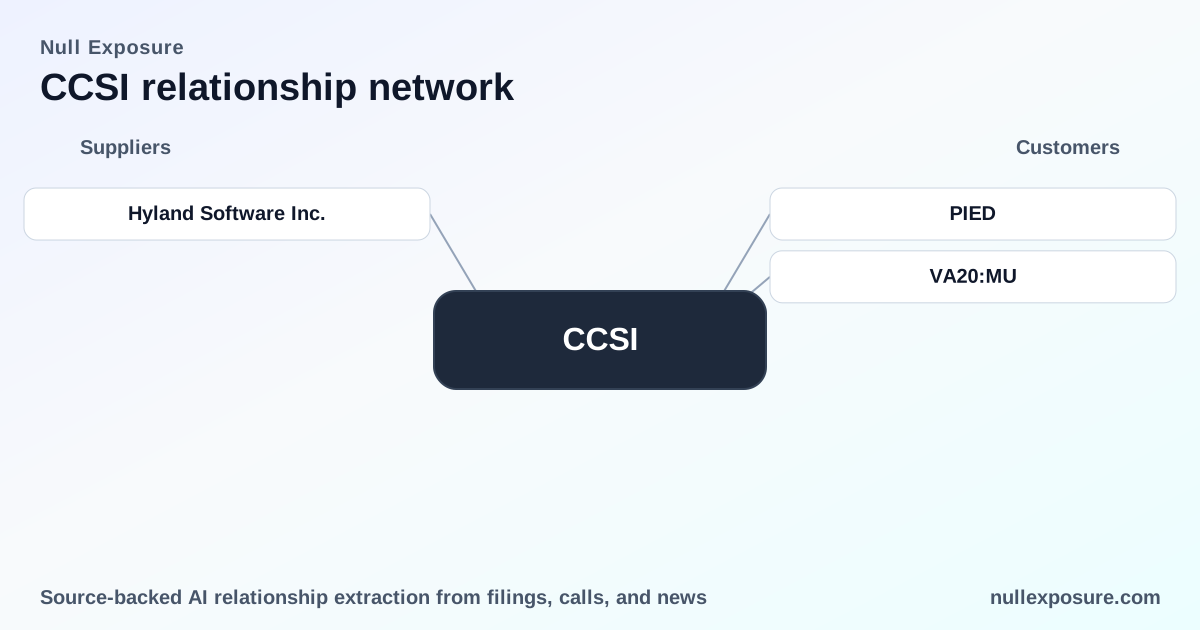
PIED — PR Newswire (FY2023)
Piedmont selected eFax Corporate’s cloud fax technology to replace on-premise fax servers, reflecting a migration from legacy on-prem infrastructure to Consensus’s cloud faxing offering. According to PR Newswire (March 9, 2026), the announcement framed the deal as part of a broader partnership with Hyland Software to streamline cloud faxing for health systems.
Piedmont — PR Newswire (FY2023)
Piedmont’s decision to adopt eFax Corporate underscores Consensus’s traction in health-system digital transformation and highlights the company’s position as the cloud replacement for legacy fax servers. The same PR Newswire release (March 9, 2026) repeated the transaction details and positioned Consensus’s product as mission-critical for healthcare document workflows.
VA — InsiderMonkey (Q3 2025 / FY2025)
Consensus reported that the VA is its main revenue driver in the healthcare vertical, and that rollout and usage continued unabated during a government shutdown period, demonstrating resilience in public-sector demand. The Q3 2025 earnings call transcript, captured by InsiderMonkey and first reported in March 2026, recorded management’s commentary about steady VA adoption and usage.
VA20:MU — InsiderMonkey (Q3 2025 / FY2025)
Management reiterated that VA rollout activity and utilization sustained through federal disruptions, indicating that Consensus’s government-facing contracts deliver durable transaction volumes and predictable usage fees tied to public-sector document exchange. The InsiderMonkey transcript (Q3 2025, posted March 2026) contains the same disclosure and highlights the federal channel as a growth and stability vector.
What these relationships imply about contract economics and business risk
The publicly disclosed customer notes validate the company-level signals: Consensus wins include health systems (Piedmont) and federal agencies (the VA), both categories that contract for regulated, high-availability services. This contract mix produces several investment-relevant implications:
- Revenue durability with upside: subscription contracts anchor recurring revenue while usage fees from institutions like the VA and large health systems provide volume-driven upside.
- Enterprise and government criticality: government and large healthcare contracts are high-criticality relationships that can support above-average lifetime value and justify enterprise-grade SLAs.
- Concentration vs. diversification: top-10 customers represent a measurable slice of revenue (~9%), which reduces idiosyncratic risk versus single-customer dependence but keeps a watch item for potential churn or contract repricing.
- Mature small-customer base: the large SoHo cohort provides scale and stable lower-ARPU recurring cash flow; the 78% >2-year tenure figure signals durable retention economics.
Investment implications and what to watch next
Investors should treat Consensus as a SaaS operator with a hybrid revenue profile that balances predictability and growth. Key monitorables:
- Retention curves and churn rates across SoHo vs. enterprise and government segments; improvements will expand operating leverage.
- Growth in usage-based revenue from the VA and health systems; rising per-customer usage will amplify top-line growth without commensurate fixed-cost increases.
- Movement in top-10 customer concentration; loss or expansion of named enterprise accounts will have outsized P&L impact.
- International expansion metrics in EMEA and APAC, where the company already conducts business but where scale economics can be earned.
For consolidated customer intelligence and ongoing monitoring of Consensus relationships, see the company hub at https://nullexposure.com/.
Bottom line
Consensus Cloud Solutions combines sticky SoHo subscriptions, material enterprise/government contracts and usage-based revenue to produce a durable and scalable revenue model. The public mentions of Piedmont and VA activity validate enterprise and federal demand and underscore the company’s role as a mission-critical provider of secure information delivery services. Investors should value the stock as a blend of recurring SaaS multiple and variable-volume upside, while tracking retention, enterprise expansion and top-customer concentration as the principal near-term drivers of downside risk and upside realization.