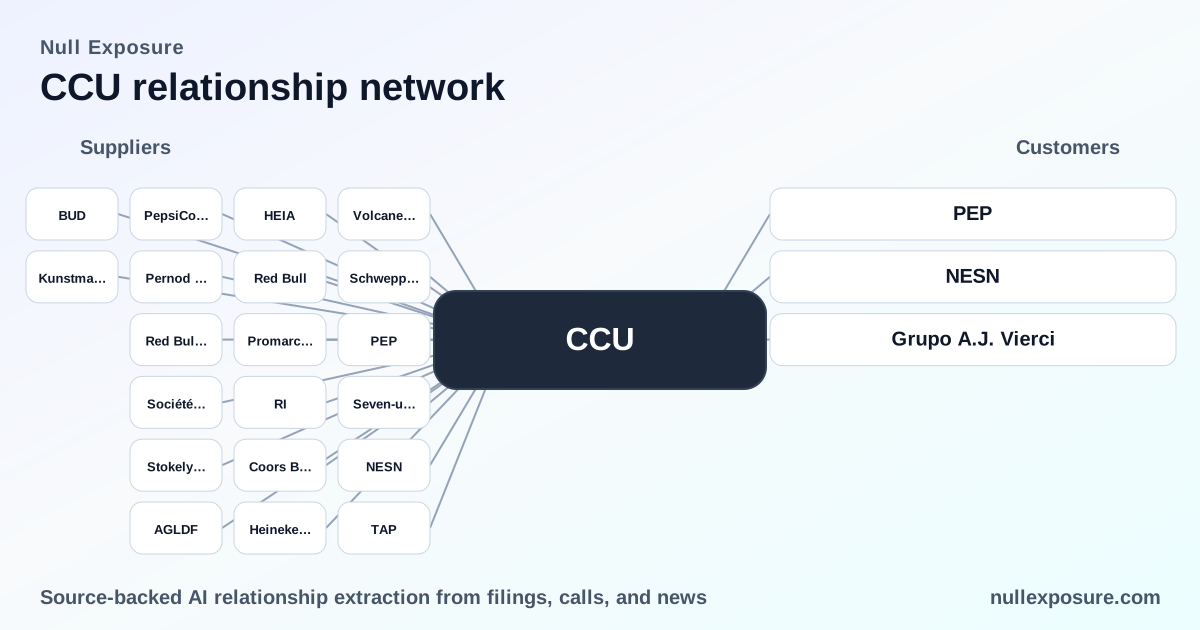
CCU: Customer relationships that underpin regional beverage distribution and growth
Compania Cervecerias Unidas SA (CCU) operates as a vertically integrated beverage and distributor across South America, monetizing through branded beer and non‑alcoholic beverage sales, licensed distribution agreements, and localized logistics and route-to-market services. CCU’s revenue mix combines core beverage margins with contract-driven distribution income, and recent disclosures emphasize strategic partnerships to extend footprint and capture higher-margin snacks and soft‑drink categories. For a concise view of how these customer ties translate into commercial leverage, see https://nullexposure.com/.
How management frames growth: partnerships, footprint, execution
CCU’s most recent public remarks position strategic alliances as a primary engine of regional growth. Management described integration work completed with global consumer goods partners as part of its “Growth pillar,” indicating that the company is pursuing scale by folding third‑party beverage and snack portfolios into its distribution network. The tone of disclosures is execution‑oriented: integration and distribution wins are presented as operating levers that expand sales density and route efficiency, rather than one-off promotional activities.
What CCU told investors about customer relationships (each mention)
PEP — integration in Paraguay (earnings call, 2025 Q4)
CCU stated it strengthened its regional footprint by integrating PepsiCo’s beverage portfolio and snacks distribution in Paraguay, signaling an expansion of its distribution responsibilities and product assortment in that market. This was disclosed in CCU’s 2025 Q4 earnings call (reported March 7, 2026).
PepsiCo — part of the Growth pillar (earnings call, 2025 Q4)
Management explicitly tied the PepsiCo integration to its Growth pillar, framing the transaction as strategic rather than purely incremental sales, which implies longer‑term operational commitments and cross‑category synergies. This framing comes from CCU’s 2025 Q4 earnings call (March 7, 2026).
NESN — analyst reference to Nestlé alliance (earnings call, 2025 Q4)
An analyst question referenced whether recent performance was helped by an alliance with Nestlé highlighted in a press release, suggesting investor attention on cross‑company promotional or distribution arrangements. The exchange is recorded in CCU’s 2025 Q4 earnings call (March 7, 2026).
Nestlé — alliance mentioned in public communications (earnings call, 2025 Q4)
Management’s remarks and associated press material referenced an alliance with Nestlé, which investors flagged during the 2025 Q4 call; that alliance was characterized in conversation as a factor worth considering when evaluating recent growth dynamics. This is included in the 2025 Q4 earnings call record (March 7, 2026).
Grupo A.J. Vierci — long‑standing local distributor relationship (news, FY2024)
CCU confirmed a multi‑decade relationship with Grupo A.J. Vierci and local importers/distributors tied to its VSPT subsidiary in Paraguay, noting partners in market execution for more than 30 years. This was reported in a Yahoo Finanzas article summarizing CCU‑PepsiCo integration plans (March 9, 2026).
What these relationships collectively tell investors
- Commercial scale through third‑party portfolios: CCU is not only selling its own brands; it is actively integrating and distributing global consumer brands. That expands SKU breadth and can lift route economics and working capital turnover.
- Distribution as a monetizable asset: The company frames distribution deals as a growth lever, indicating recurring contract revenue and potential margin capture on logistics and category management.
- Local incumbency and channel durability: Decades‑long distributor ties (for example, with Grupo A.J. Vierci) demonstrate entrenched local networks that protect shelf access and execution in fragmented markets.
- Cross‑company alliances increase strategic optionality: References to alliances with Nestlé and PepsiCo signal that CCU is leveraging global brand equity to accelerate penetration across beverage and snack categories.
Operating model and business model characteristics investors should track
CCU’s customer relationships create a distinct operating posture with four observable characteristics:
- Contracting posture — partnership and integration focused. The company negotiates distribution and integration agreements that transfer branded SKUs and route responsibilities to CCU, converting marketing strength from global principals into recurring distribution revenue.
- Concentration — geographically focused but commercially diversified. Revenue concentration is regional (Chile, Argentina, Paraguay, Uruguay, Colombia, Bolivia) while product concentration broadens via partner portfolios; that reduces single‑brand exposure but heightens country‑specific execution risk.
- Criticality — distribution network is mission‑critical. For international brands seeking South American reach, CCU’s logistics and longstanding local relationships are hard to replace quickly, making CCU a strategic channel partner.
- Maturity — established infrastructure with incremental integration upside. Existing route density and decades‑old distributor links indicate a mature platform capable of absorbing additional brands without proportionate incremental fixed cost.
These signals should guide due diligence on contract tenure, termination clauses, margin share on distributed products, and country‑level regulatory risk.
Investment implications and a pragmatic risk checklist
CCU’s execution of integrations creates clear upside to revenue and route economics, but investors must weigh operational dependency and country exposure.
Key investment implications:
- Revenue upside is structural if CCU retains favorable margin splits on distributed SKUs. Distribution of PepsiCo and alliances with other multinationals accelerate top‑line without necessarily requiring brand development spend.
- Contract terms determine durability of earnings. The economics of distribution deals—minimum purchase commitments, pricing escalators, and marketing spend allocations—will determine whether integrations flow fully to EBITDA.
- Geographic and counterparty risk requires monitoring. Country macro and partner strategy shifts can materially alter volumes; governance on local partner relationships is a competitive moat that requires active stewardship.
Risk checklist to prioritize in model and meetings:
- Contract lengths, exclusivity, and termination penalties with global principals.
- Margin split mechanics and working capital impact from third‑party SKUs.
- Local distributor dependencies and succession plans (e.g., arrangements with long‑standing partners).
- Exposure to currency, import duties, and local tax regimes across the footprint.
For further detail on how customer relationships translate into revenue streams and contract economics, see https://nullexposure.com/ for structured summaries and primary‑source highlights.
Bottom line
CCU is executing a deliberate strategy to monetize distribution capability by integrating multinational beverage and snack portfolios into its South American route network. The core investment thesis is that distribution scale plus entrenched local channels creates earnings leverage, provided contract economics preserve margin capture and country risks remain managed. Investors should focus on the durability of distribution agreements, margin allocation on third‑party SKUs, and the resilience of local partnerships as the primary determinants of upside.