ChemoCentryx (CCXI) customer relationships: commercialization map and investor implications
ChemoCentryx built a commercialization and licensing model around a single approved product, TAVNEOS (avacopan), monetizing through direct U.S. commercialization rights (for certain indications), ex‑U.S. licensing deals that generate royalty streams in the teens to mid‑20s percent, and ultimately an acquisition exit. The firm’s operating posture is partner‑centric: it licenses territories to specialized commercial partners rather than building a global sales infrastructure, and value realization for investors has come through product approval, royalties, and corporate M&A. For a concise relationship map and historical source tracking, see NullExposure’s coverage: https://nullexposure.com/
Business model and operating posture
- ChemoCentryx’s cash flow profile before acquisition depended heavily on royalties from ex‑U.S. commercialization partners and the commercial performance of a single core asset, TAVNEOS. Public filings and press releases document royalty rates described as “teens to mid‑20s percent” for ex‑U.S. sales booked to Vifor. (GlobeNewswire, FY2022.)
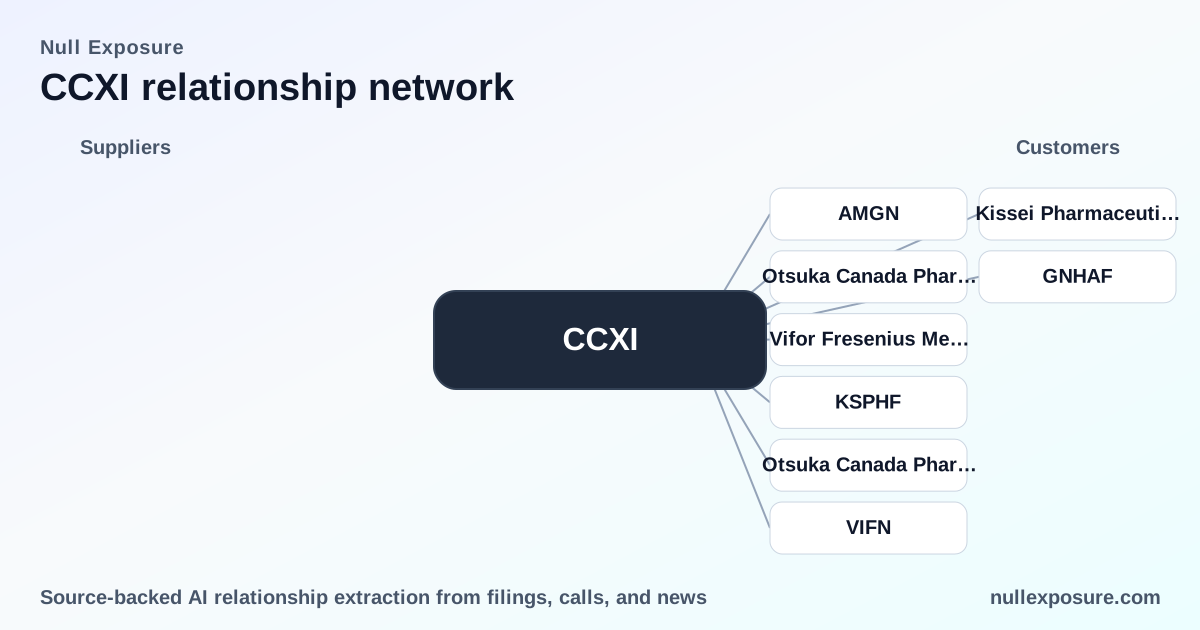
- The company maintained a contracting posture that favored localized commercialization partners: Vifor for most ex‑U.S. markets, Kissei for Japan, and Otsuka Canada for Canada—an arrangement that reduces ChemoCentryx’s go‑to‑market burden but concentrates counterparty risk into a small set of licensors and acquirers.
- Product maturity progressed from FDA approval (FY2021) to EU and other market approvals (FY2022), and culminated in a corporate exit: Amgen acquired ChemoCentryx for $52 per share (EV ≈ $3.7–4.0 billion), converting future royalty upside and pipeline optionality into cash for investors. (Yahoo Finance / PR Newswire, FY2022.)
- Concentration and criticality are the defining risks: one approved product, a handful of commercial partners, and residual litigation and regulatory scrutiny after acquisition create asymmetry between upside capture and downside operational or legal events.
Customer and commercialization relationships — what investors need to know
Below I list every relationship item surfaced in the collection of news items and filings. Each entry includes a plain‑English summary and the source reference that mentions the relationship.
Vifor Fresenius Medical Care Renal Pharma Ltd.
- ChemoCentryx granted exclusive rights to commercialize TAVNEOS outside the U.S. to Vifor Fresenius Medical Care Renal Pharma Ltd., with ChemoCentryx entitled to royalty payments on aggregate ex‑U.S. sales. (PR Newswire, FY2022.)
Vifor Pharma
- Vifor Pharma is the commercial partner with exclusive ex‑U.S. rights to avacopan and committed to royalty payments described as “teens to the mid‑20s percent” on potential ex‑U.S. sales, establishing Vifor as the company’s primary non‑U.S. revenue conduit. (GlobeNewswire and company financial release, FY2022.)
VIFN (ticker reference for Vifor)
- Market and news coverage referencing the ticker VIFN reiterate that Vifor’s licensing agreement is the material ex‑U.S. commercialization arrangement for TAVNEOS and the source of contracted royalties to ChemoCentryx. (RTTNews, FY2021.)
GNHAF (alternative Vifor listing)
- Releases that use the GNHAF designation likewise document Vifor’s territorial rights and the royalty mechanics that underpinned ChemoCentryx’s commercial strategy outside the United States. (GlobeNewswire, FY2022.)
Kissei Pharmaceutical Co., Ltd.
- ChemoCentryx granted commercialization rights for Japan to Kissei Pharmaceutical, carving Japan out of Vifor’s territory and localizing launch responsibility to a Japan‑focused partner. (PR Newswire, FY2022.)
Kissei Pharmaceutical Co. (alternate name)
- Coverage repeating the Kissei relationship confirms the same scope: Japan rights for TAVNEOS are held by Kissei, rather than the global Vifor arrangement. (European Pharmaceutical Review, Mar 9, 2026.)
KSPHF (ticker reference for Kissei)
- Mentions under the ticker KSPHF point to the Kissei commercial arrangement for Japan and highlight that ChemoCentryx structured regional exclusives rather than a single global licensee. (European Pharmaceutical Review, Mar 9, 2026.)
Otsuka Canada Pharmaceutical
- ChemoCentryx licensed Canadian commercialization rights for the TAVNEOS trademark to Otsuka Canada Pharmaceutical, enabling a local regulatory filing and market approach in Canada. (European Pharmaceutical Review, Mar 9, 2026.)
Otsuka Canada Pharmaceutical Inc.
- Canadian press releases and Health Canada notices record Otsuka Canada Pharmaceutical Inc. using the TAVNEOS trademark under license from ChemoCentryx following Canadian approval. (Newswire.ca, FY2022.)
AMGN (ticker reference for Amgen)
- Amgen agreed to acquire ChemoCentryx for $52 per share in cash, valuing the company at approximately $3.7 billion enterprise value, a transaction that folded TAVNEOS and ChemoCentryx’s pipeline into Amgen’s oncology/immune portfolio. (Yahoo Finance, FY2022.)
Amgen Inc
- News coverage notes that Amgen’s purchase converted ChemoCentryx’s royalty and product economics into an M&A exit, bringing TAVNEOS into Amgen’s product set and altering counterparty dynamics for existing licensees. (Yahoo Finance / PR Newswire, FY2022.)
Amgen (news and litigation references)
- Subsequent reporting in FY2025–FY2026 highlights investor litigation and FDA advisory scrutiny tied to TAVNEOS and trial data, matters that now sit with Amgen as the acquirer and therefore affect the realized risk profile of the original ChemoCentryx commercial relationships. (FiercePharma, Benzinga, FY2025–FY2026.)
What the relationship map tells an investor about risk and value
- Single‑asset concentration: ChemoCentryx’s commercial value was concentrated in TAVNEOS and its royalty streams; investors should treat ex‑U.S. partner performance and pricing as first‑order drivers of topline variance prior to acquisition.
- Partner dependence: the licensing model reduces ChemoCentryx’s operational cost but creates counterparty concentration, with Vifor serving as the primary engine for ex‑U.S. sales and Kissei/Otsuka managing key local markets.
- Maturity and exit: the product moved from approval (FY2021–FY2022) to commercial roll‑out agreements and then to corporate exit via Amgen, which crystallized value for shareholders but transferred operational and legal execution risk to the acquirer.
- Legal and regulatory overlay: reporting in FY2025–FY2026 about trial conduct and advisory committee reviews places residual regulatory and reputational risk under Amgen’s stewardship, but these developments retrospectively affect the risk premium investors assigned to ChemoCentryx prior to the sale.
Constraints and company‑level signals
- The dataset contains no explicit contractual constraints excerpts beyond the partnership terms summarized above; therefore, the company‑level signal is that ChemoCentryx relied on standard licensing and royalty arrangements rather than captive global commercialization. This structure implies a mature but concentrated commercial model: limited direct selling costs, predictable royalty mechanics, and elevated counterparty concentration risk.
Conclusion and investor takeaway
- ChemoCentryx monetized TAVNEOS through a focused licensing strategy and achieved value realization via acquisition, primarily through royalties from Vifor and territorial licenses to Kissei and Otsuka Canada. Investors evaluating similar small biotech stories should weigh partner quality, royalty economics, and single‑asset concentration as the primary determinants of downside and upside. For the original source mapping and to explore a visual relationship map, visit NullExposure: https://nullexposure.com/
For more granular relationship charts and timeline evidence on small‑cap commercialization strategies, consult the full NullExposure resource at https://nullexposure.com/