Coeur Mining (CDE): Commercial Relationships That Shape Cash Flow and Risk
Coeur Mining operates, develops and sells precious metals across the United States, Canada and Mexico, monetizing primarily through the sale of gold and silver bullion and concentrates to global refiners, traders and financial counterparties. Revenue stems from a mix of spot-linked concentrate contracts and select long‑term offtake arrangements, while streaming and royalty liens create third‑party cash flows and reserve adjustments. For an at-a-glance resource on commercial exposures, see https://nullexposure.com/.
The commercial architecture that drives margins and counterparty choice
Coeur’s business model blends transactional metal sales with targeted long‑dated commercial commitments. Concentrate sales are predominantly priced on short‑term quotational periods (typically one to three months after shipment), which preserves capture of prevailing metal prices but increases exposure to price volatility. Simultaneously, the Kensington mine’s gold concentrate is sold under a long‑term offtake agreement, providing a stable channel for that asset’s production.
Coeur sells finished bullion and concentrates to large multinational banks, bullion trading houses and refiners, and distributes product across global markets. Because counterparties are distributed and liquid, the company states that the loss of any single smelter, refiner or trader would not be materially adverse, a corporate signal that counterparty concentration risk is managed through breadth rather than depth. Sales contracts often include provisional payments tied to assays and quoted metal prices, and prepayments are accounted for as contract liabilities under ASC 606 with staged revenue recognition. These company‑level characteristics create an operating posture that is seller‑driven, global in reach, and mixed between short‑term pricing and select long‑term offtake commitments.
How that commercial profile shows up in filings and press
Below I cover each relationship that Coeur publicly discloses or that appears in contemporaneous press reports. Each entry is a plain‑English read of the underlying source.
Maverix Metals Inc.
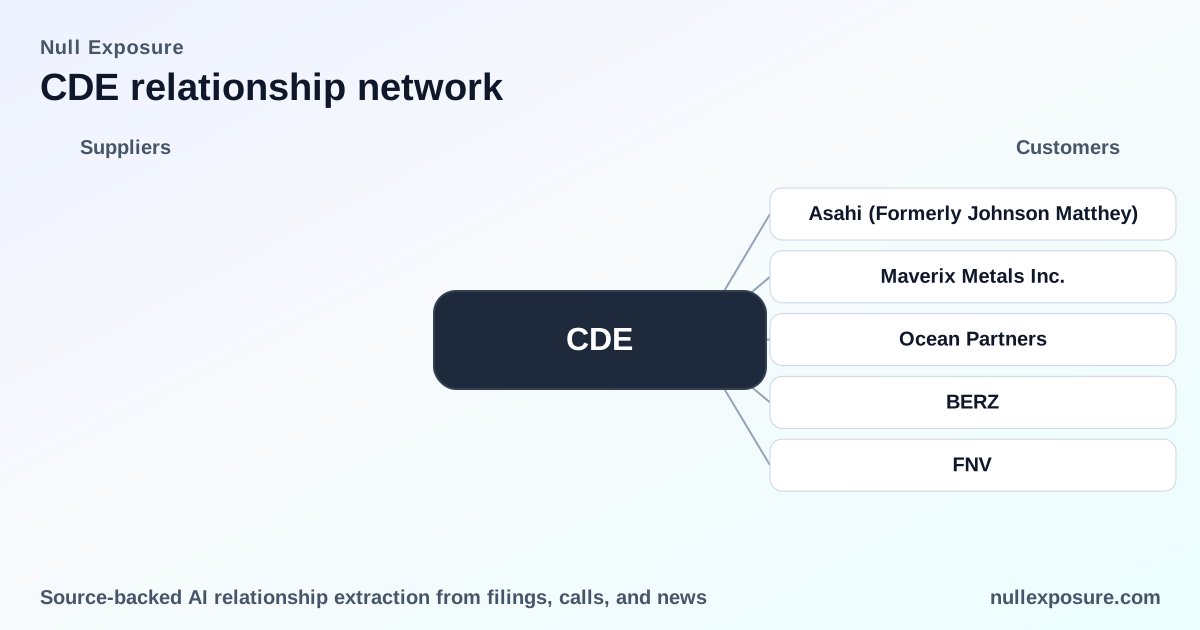
Coeur and its subsidiary Coeur Alaska entered into a settlement agreement with Maverix Metals concerning the terms of a royalty that affects a portion of the Kensington mine property; the disclosure is recorded in Coeur’s FY2024 Form 10‑K. According to the filing, the settlement resolves litigation tied to that royalty dimension and clarifies royalty economics tied to Kensington. (Source: Coeur FY2024 10‑K)
Ocean Partners
Coeur’s FY2024 10‑K includes Ocean Partners in its customer concentration risk disclosures, signaling Ocean Partners is recognized among counterparties relevant to Coeur’s sales or concentration analysis for the year. The mention is part of Coeur’s broader disclosure on counterparties that influence customer concentration metrics. (Source: Coeur FY2024 10‑K)
Asahi (Formerly Johnson Matthey)
Asahi, previously Johnson Matthey, is listed in Coeur’s FY2024 customer concentration risk statements; Coeur identifies refiners and global trading houses such as Asahi among the counterparty set used to sell bullion and concentrates. This is disclosed within the company’s FY2024 risk and counterparty narrative. (Source: Coeur FY2024 10‑K)
Bank of Montreal / BERZ
Coeur’s FY2024 filing lists Bank of Montreal (referenced alongside the identifier BERZ in the extraction) within the customer concentration risk section, indicating Bank of Montreal is a recognized financial or bullion counterparty in Coeur’s commercial disclosures for the period. The inclusion reflects Coeur’s practice of dealing with multinational banks for bullion and financing needs. (Source: Coeur FY2024 10‑K)
RELL
A supplier disclosure in RELL’s FY2025 filing identifies Coeur (CDE) among suppliers supported by RELL’s PMT program, indicating that third‑party supplier networks list Coeur as a supported participant. This is an external vendor/supplier context where CDE appears on a third party’s supplier roster. (Source: RELL FY2025 filing)
ASM / Avino‑related obligations
Multiple press releases about Avino reference that the La Preciosa obligations were initially issued to Coeur Mining in connection with Avino’s acquisition of La Preciosa in March 2022; those releases discuss the historical financing structure tied to the asset and Coeur’s prior role as the obligee. The press coverage frames the obligation as an instrument originated to Coeur during the acquisition. (Sources: Avino press releases aggregated at regional press outlets)
Franco‑Nevada (FNV)
In commentary around Coeur’s year‑end 2025 mineral reserve update, the company’s reporting explicitly excludes the impact of the Franco‑Nevada gold stream agreement at Palmarejo when calculating Mineral Reserves, indicating Franco‑Nevada’s stream is a material third‑party economic overlay on Coeur’s Palmarejo asset evaluation. (Source: Coeur press release reported in The Globe and Mail)
Metalla (MTA)
Metalla’s Q3 2025 release references Coeur’s reported production from Wharf and discloses Metalla accrued gold equivalent ounces tied to its 1.0% GVR royalty on the Wharf mine; this confirms Metalla’s royalty receipts are directly linked to Coeur’s operational output at that asset. (Source: Metalla press release via PR Newswire)
What these relationships imply for investors and operators
- Counterparty profile: large, global and liquid. Coeur’s buyers are multinational banks, trading houses and refiners, which reduces single‑counterparty exposure while keeping the firm embedded in global commodity flows.
- Contract mix preserves upside but transfers some risk. Short‑term concentrate pricing captures market rallies quickly; long‑term offtake agreements—notably at Kensington—provide revenue predictability for specific assets.
- Third‑party financings and streams matter for reserve economics. Franco‑Nevada’s stream and the La Preciosa obligations are structural cash‑flow and reserve modifiers that investors must model explicitly when forecasting attributable production and free cash flow.
- Materiality tilt: operational resilience, not dependency. Coeur states loss of an individual smelter or trader is immaterial given the liquidity of counterparties, which supports a lower counterparty concentration risk profile at the company level.
Bottom line: focus your diligence on off‑balance commitments and asset‑level deals
Coeur’s commercial network is comprehensive and deliberately broad; the critical investor focus is not counterparty breadth but the economic terms embedded in offtakes, streams, royalties and legacy acquisition obligations. The Maverix settlement, Franco‑Nevada stream, and the La Preciosa obligations are discrete legal and economic instruments that materially affect mine‑level economics and need to be modeled alongside commodity price scenarios.
For a concise delivery of commercial exposure and entity‑level relationship summaries, visit https://nullexposure.com/ for more structured visibility into how counterparties and contractual constraints interact with Coeur’s asset base.
Bold final takeaway: Coeur’s cash flows are governed by a mix of short‑dated price realizations and a handful of long‑dated contractual overlays—understanding those overlays is essential to any valuation or operational risk assessment.