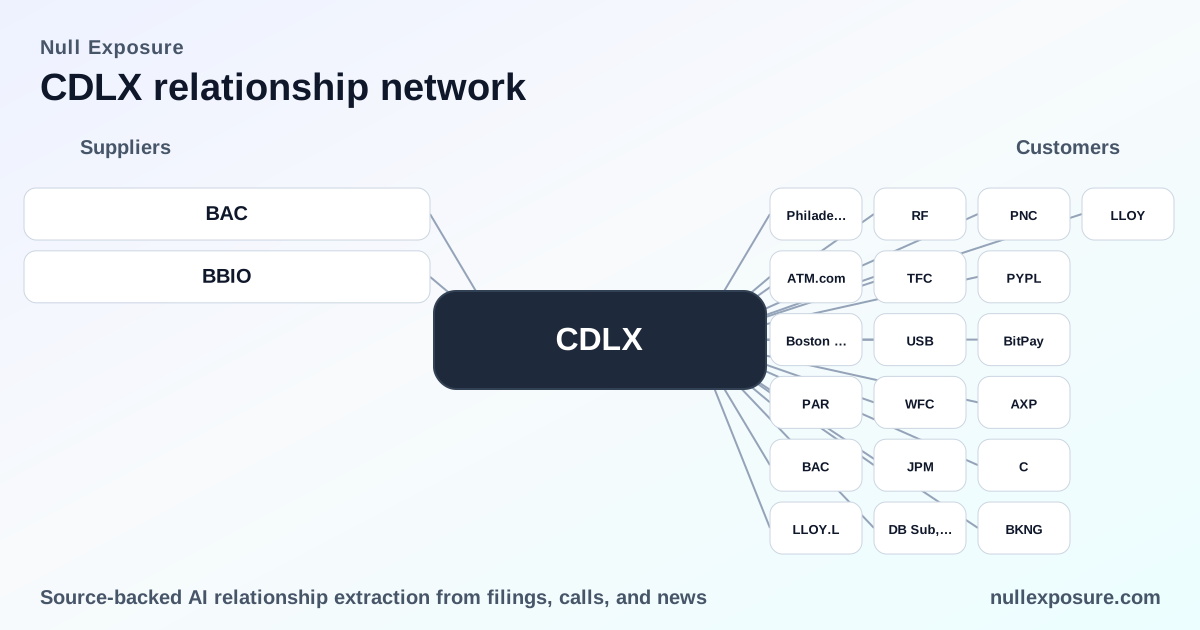
Cardlytics (CDLX) — Customer Map and Commercial Implications for Investors
Cardlytics operates an advertising and rewards platform embedded in banks’ digital channels; it monetizes by selling marketers access to bank customers through a mix of usage-based fees tied to qualifying purchases and subscription offerings (historically via the Bridg platform), plus professional services and insertion orders. For investors, the critical read is how concentrated, enterprise-grade counterparty relationships, recent asset divestitures, and a US-heavy revenue mix affect durability of cash flows and turnaround prospects. For a concise analytics and signals feed on enterprise customer activity, see NullExposure’s coverage at https://nullexposure.com/.
Executive takeaways — what the customer evidence says
- Cardlytics sells to large enterprises and marketers under commercial terms that combine usage-based billing for campaign performance and subscriptions for platform access (Bridg). This hybrid model creates immediate variability from marketer activity and recurring revenue where subscription contracts remain in force.
- Revenue concentration and geographic concentration are material risks: management states roughly 92% of revenue comes from the U.S., and public reporting and press coverage repeatedly highlight dependency on a handful of major bank partners.
- Asset-light pivots and divestitures are reshaping the customer footprint. The sale of Bridg materially reduces Cardlytics’ software subscription exposure while improving near-term liquidity, but it also reduces technology assets that previously supported merchant and marketer engagement.
- For further company-level intelligence, visit NullExposure’s homepage: https://nullexposure.com/.
How Cardlytics contracts and serves customers
Cardlytics’ public filings and management commentary reveal a dual commercial posture: subscription contracts (Bridg-era) recognized ratably over term, and monthly invoicing tied to qualifying purchases or engagement for advertising campaigns. The company explicitly designs privacy and security controls to satisfy large, multinational partners, reinforcing enterprise-grade contracting and integration costs. These are company-level signals derived from the firm’s disclosures and are not assigned to a specific counterparty except where noted in filings.
- Contracting posture: mix of subscription and usage-based revenue streams (company disclosures).
- Counterparty profile: large enterprise clients and financial institutions (company disclosures).
- Geography: U.S.-centric revenue base (~92% U.S. through FY2024).
- Segment mix: services-driven Cardlytics platform and previously software-led Bridg platform (Bridg now divested).
Customer relationships: who’s in Cardlytics’ orbit (each sourced)
Below I cover every relationship found in public mentions and transcripts. Each entry is a 1–2 sentence plain-English summary followed by the source context.
- Philadelphia Flyers — Cardlytics launched programs with the Philadelphia Flyers in the sports category as part of recent product rollouts, indicating expansion into sports-team partnerships to reach fans through banking channels (Cardlytics 2025 Q4 earnings call, March 2026).
- Boston Celtics — The company announced an official launch with the Boston Celtics in the sports category, demonstrating targeted vertical go-to-market activity with prominent regional franchises (Cardlytics 2025 Q4 earnings call, March 2026).
- ATM.com — Cardlytics reported a launch with ATM.com in financial services, reflecting partnerships beyond traditional banks to broaden distribution (Cardlytics 2025 Q4 earnings call, March 2026).
- Lloyds Bank Plc (LLOY.L) — Cardlytics UK renewed a multi-year Spending Rewards Agreement with Lloyds Bank Plc, underpinning sustained revenue from U.K. retail banking relationships (GlobeNewswire press release, Dec 19, 2023).
- PAR Technology / PAR — PAR agreed to acquire Bridg platform assets from Cardlytics in a transaction announced in January 2026 and completed in spring 2026, transferring identity and shopper-intelligence assets to PAR (CityBiz / The Globe and Mail / multiple press reports, Jan–May 2026).
- DB Sub, LLC — DB Sub, LLC (an indirect PAR subsidiary) was the acquiring vehicle for Bridg platform assets in the January 23, 2026 asset sale, per the company transaction documents reported publicly (The Globe and Mail / TipRanks press releases, Jan–May 2026).
- Bank of America (BofA / BAC) — Management confirmed Cardlytics concluded its relationship with Bank of America, a meaningful client exit that reduced MQUs and impacted near-term campaign volume (Cardlytics 2025 Q4 earnings call; MRWeb coverage, FY2026).
- PAR Technology Corporation (repeat coverage) — Multiple news outlets reported the Bridg asset sale to PAR and noted the transaction value and structure, signaling Cardlytics’ strategic shift to monetize non-core assets and shore up liquidity (Pulse2 / Finviz / Investing.com, March–May 2026).
- OpenTable (BKNG) — Cardlytics signed OpenTable as one of three new U.S. partners, reflecting efforts to deepen merchant-category reach in restaurant technology (Cardlytics 2025 Q3 earnings call, 2025Q3 disclosure).
- J.P. Morgan Chase & Co. (Chase / JPM) — Industry coverage cites J.P. Morgan Chase as one of Cardlytics’ large anchor bank partners, highlighting concentration risk around a few dominant bank relationships (DigitalTransactions reporting; AJC summary of customers, FY2025–FY2026 coverage).
- Wells Fargo — Press commentary lists Wells Fargo among Cardlytics’ major bank partners and points to its materiality in the company’s revenue mix (DigitalTransactions and AJC reporting, FY2025–FY2026).
- US Bank (USB) — Cardlytics lists US Bank as a distribution partner in U.S. channels, consistent with its strategy of embedding offers through bank digital experiences (AJC company profile / website snapshot, FY2025).
- Truist Bank (TFC) — Truist is included among Cardlytics’ U.S. financial institution partners, signaling broad but still concentrated bank relationships (AJC reporting and company disclosures, FY2025).
- PNC Bank (PNC) — PNC appears among the U.S. partners Cardlytics uses for distribution of offers to bank customers (AJC reporting, FY2025).
- Regions Bank (RF) — Regions is cited as a participating bank partner in the Cardlytics network, adding regional bank coverage to the company’s footprint (AJC reporting, FY2025).
- Venmo — Cardlytics has been referenced as working with Venmo and other processors to extend its reach beyond traditional banks (AJC article recounting partners, FY2025).
- BitPay — BitPay launched a rewards program in conjunction with Cardlytics, demonstrating Cardlytics’ integration with novel payments rails and prepaid/crypto-fronted cards (DigitalTransactions coverage, FY2022).
- AmEx (AXP) — Market commentary and activist/short-seller notes referenced AmEx as an integration partner cited among Cardlytics’ major payment integrations, underscoring breadth of issuer and network relationships (SahmCapital / Citron mentions, FY2025).
- Citi (C) — Citigroup appears in third-party coverage as part of the set of major banks integrated with Cardlytics’ platform (SahmCapital / investor commentary, FY2025).
- BitPay (repeat coverage) — Earlier strategic partnership coverage from 2022 noted BitPay’s rewards launch with Cardlytics, confirming historic diversification into alternative payment channels (DigitalTransactions, 2022).
Strategic implications for investors
- Concentration is real and consequential. Major-bank dependency (JPM, WFC, BofA historically) creates outsized sensitivity to contract renewals and campaign volume — a single major campaign exit can depress MQUs and revenue recognition. Cardlytics’ recent conclusion of the Bank of America relationship is a live example of this risk.
- Divestiture reduces subscription depth while improving liquidity. Selling Bridg to PAR reduces recurring software subscription exposure (company disclosures and press coverage) but provides immediate balance-sheet relief and focuses the business on core bank-distributed rewards.
- Commercial model mixes predictable and variable revenue. Usage-based billing aligns revenue with campaign performance but increases volatility; subscription elements (where they exist) offer smoothing — the mix that remains post-divestiture is a central driver of future margin trajectories.
If you want a structured view of how these partner shifts affect CDLX’s revenue scenarios and contract runway, NullExposure provides focused customer intelligence and trend signals at https://nullexposure.com/.