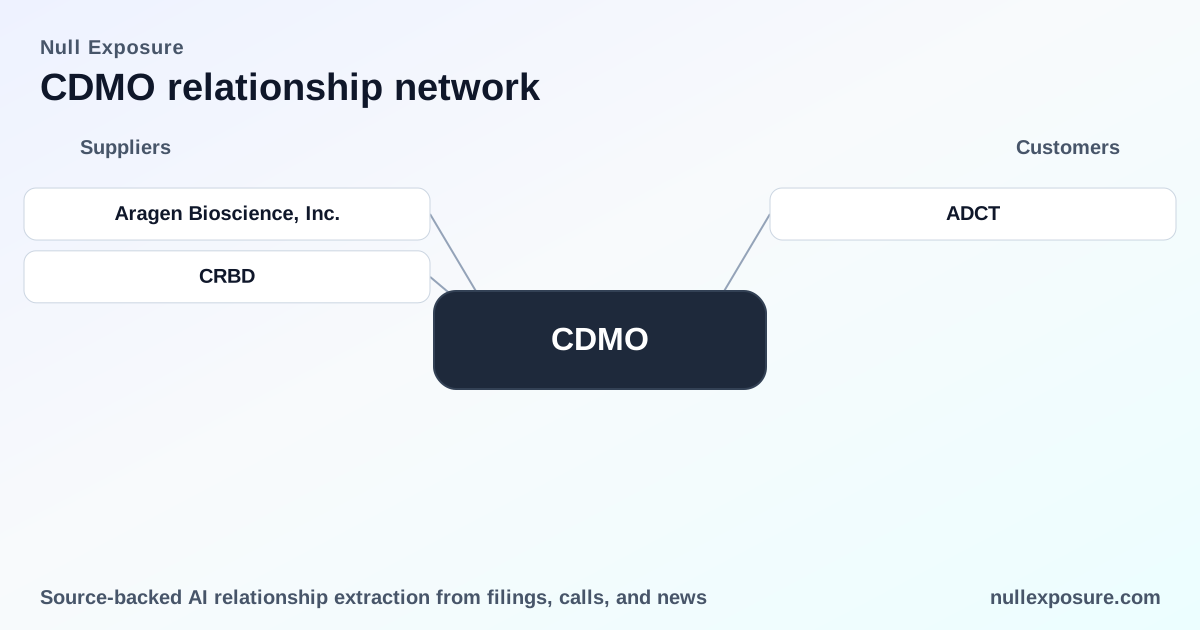
CDMO Customer Map: How contract manufacturing ties to revenue and risk
CDMO monetizes by converting development-stage partnerships into fee-based manufacturing and longer-term commercial supply contracts; the company invoices clients for process development, batch production and quality release while capturing upside when clients convert to commercial-scale supply. Revenue is driven by a mix of one-off development fees and recurring commercial supply contracts that create visibility on future cash flows when customers advance to market. For a quick company overview and deeper relationship tracking, visit https://nullexposure.com/.
Why these customer signals matter to investors
The CDMO business is a service-led, capital-intense model: facilities and compliance systems are fixed-cost assets that scale with volume, while customer contracts convert utilization into margin. Key operating characteristics for investors are contracting posture, concentration, criticality and maturity—not isolated statistics:
- Contracting posture: The firm operates primarily as a contracted supplier, executing on process transfer and multi-stage manufacturing obligations that are often codified in supply agreements.
- Customer concentration: A handful of mid-size biopharma clients can account for disproportionate utilization of capacity and near-term revenue, creating revenue volatility tied to program milestones.
- Criticality: Once validated, a CDMO often becomes an essential single or preferred supplier for a client’s clinical and commercial supply, raising switching costs and lengthening contract tenors.
- Maturity mix: Revenue profile depends on customer program stage—commercial supply generates recurring revenue while early-stage work delivers higher-margin but lumpy development fees.
These are company-level signals for assessing CDMO cash flow durability and downside risk.
What the recent customer signals show
The following relationships were flagged in recent industry reporting; each entry below is a concise, plain-English take on the underlying commercial tie and its source.
Oncologie Inc.
Avid will perform contract development and manufacturing activities for Oncologie’s bavituximab program, indicating a supplier role during late-stage development and potential handoff into commercial supply if the program progresses to approval. According to Biopharma Dive (FY2018 reporting on the asset transfer), Avid is positioned as the CDMO on that asset: https://www.biopharmadive.com/news/oncologie-snaps-up-avids-cancer-assets/516947/
Enzyvant
Avid is responsible for providing the commercial supply of Enzyvant’s RVT-801, signaling a transition from development to recurring commercial manufacturing obligations that underpin predictable revenue once product launches. Biopharma Dive reported the commercial supply arrangement in its Enzyvant coverage: https://www.biopharmadive.com/news/avid-tapped-to-produce-enzyvants-rare-disease-candidate/517658/
Roivant Sciences Ltd.
A Roivant subsidiary selected Avid Bioservices to manufacture a rare disease treatment, reflecting the CDMO’s role as a contract manufacturer for a Roivant portfolio program and adding to the roster of biopharma partners relying on Avid for supply. This selection was noted in the same Biopharma Dive article covering Enzyvant (FY2018 context): https://www.biopharmadive.com/news/avid-tapped-to-produce-enzyvants-rare-disease-candidate/517658/
ADCT
ADCT engaged Avid to produce its new blood cancer medicine Zynlonta, representing a commercial manufacturing engagement tied to a marketed oncology product and implying recurring production demand. Fierce Pharma reported the production arrangement in March 2026 coverage of Avid’s corporate developments: https://www.fiercepharma.com/pharma/biologics-cdmo-avid-bioservices-announces-11b-sale-ampersand-and-gho-capital
ADC Therapeutics
ADC Therapeutics tapped Avid for production of Zynlonta, the same operational fact noted for ADCT and confirming the CDMO’s role in oncology commercial supply for a branded product. Fierce Pharma’s March 2026 article describes this production relationship: https://www.fiercepharma.com/pharma/biologics-cdmo-avid-bioservices-announces-11b-sale-ampersand-and-gho-capital
Takeaway: these signals collectively show the CDMO executing both development-stage work and commercial supply obligations across oncology and rare-disease programs, a mix that strengthens recurring revenue potential.
How these relationships translate to revenue and valuation
The customer mix visible in recent reporting drives three valuation-relevant dynamics:
- Predictable revenue when customers shift to commercial supply. Enzyvant’s RVT-801 and ADC/ADCT’s Zynlonta both create potential recurring top-line from batch production and fill-finish services; recurring contracts support higher revenue multiples than development-only work.
- Margin leverage from capacity utilization. Commercial-scale manufacturing lifts throughput and spreads fixed costs; sustained demand from clients like ADC Therapeutics materially improves EBITDA conversion.
- Concentration risk from a limited number of high-usage customers. A small set of customers consuming large slots increases exposure to contractual churn or regulatory hold-ups; investors should price this into earnings volatility forecasts.
- Regulatory and execution risk are binary and material. Manufacturing disruptions, lot failures or regulatory observations can suspend commercial supply and immediately correct revenue expectations.
Investors should credit a premium to CDMOs that replace development fees with multi-year commercial supply contracts, but discount for client concentration and single-source dependencies.
Practical signals to monitor next
- Watch for contract term disclosures and minimum-volume purchase commitments in client filings; these convert relationship signals into revenue certainty.
- Track batch release announcements and regulatory filings for patients and markets served—commercial supply confirmations materially lower cash-flow uncertainty.
- Monitor capacity expansion or capacity-sharing agreements; increasing capital intensity without pre-sold volume increases downside risk.
For continuing coverage and to benchmark CDMO customer relationships across biopharma clients, check https://nullexposure.com/.
Bottom line
Recent reporting shows the CDMO executing a classic mixed business model: development-stage revenue today with an increasing share of recurring commercial supply opportunities that drives valuation upside if execution remains clean and client concentration is managed. Investors should reward visible, contracted commercial supply while pricing in the short-term volatility that comes from a client roster concentrated in oncology and rare-disease programs.