Cadence Design Systems (CDNS): Customer Map and Commercial Signals for Investors
Cadence sells engineering software, hardware and IP to semiconductor and systems designers, monetizing primarily through multi‑year time‑based licenses and related maintenance, hardware sales/leasing, and engineering services that together drive recurring revenue and a high-margin software mix. For investors, the key commercial facts are clear: broad, global customer penetration across leading foundries and chipmakers, long contract terms (typically two to three years), and material exposure to advanced-node design workflows driven by AI and agentic automation. Learn more about how we source relationship intelligence at https://nullexposure.com/.
How Cadence makes money and why customers stick
Cadence’s revenue model is dominated by time‑based licenses and subscription-style arrangements that grant customers access and updates for the term (generally two to three years), supplemented by perpetual licenses in a smaller portion of the business. The company functions as a licensor, seller and service provider—it licenses EDA software and design IP, sells or leases emulation hardware, and delivers engineering, methodology and hosted design services. Geographic revenue is global but skewed: North America drives nearly half of revenue, EMEA about mid‑teens, and Asia a large share—supporting diversified end markets rather than single-customer concentration. Cadence reports that no single customer exceeded 10% of revenue in 2024, underlining a dispersed commercial base. These characteristics produce a contracting posture that is sticky and long‑dated, with high renewal leverage as customers adopt full design flows and IP portfolios.
- Contracting posture: Long‑term/time‑based licenses (2–3 years) with recurring renewal economics.
- Customer concentration: Low single‑customer concentration; no customer >10% (2024).
- Criticality: Software, IP and flows are mission‑critical for leading chip designers and foundries—Cadence supplies core implementation, verification and signoff tools.
- Maturity: Mature enterprise licensing model supplemented by expanding AI‑powered workflow offerings that accelerate adoption but do not alter the underlying subscription licensing nature.
One‑line summaries of every customer relationship in the dataset
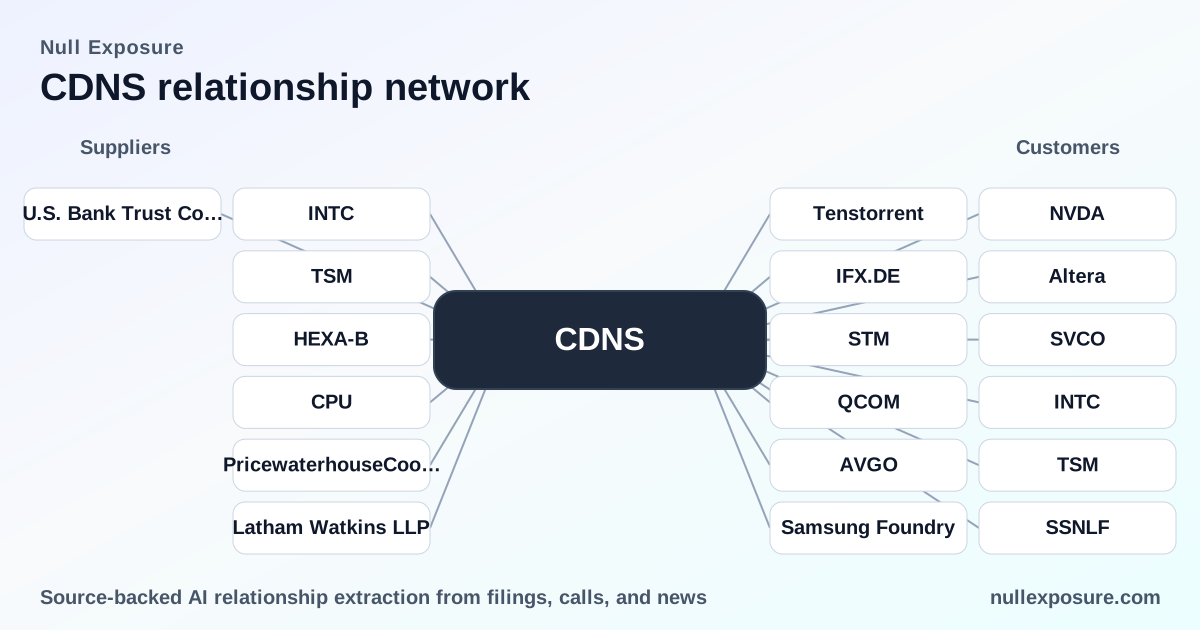
Below are concise, plain‑English summaries for every customer relationship surfaced in the research, with source citations.
- Tenstorrent — Cadence’s ChipStack product received an endorsement from Tenstorrent, signaling customer interest from emerging AI‑chip designers. Source: Cadence Q4 2025 earnings call (2025Q4).
- IFX.DE (Infineon) — Infineon standardized on Cadence’s Allegro X for PCB design earlier in the year, reflecting adoption among major power‑semiconductor vendors. Source: Cadence Q4 2025 earnings call (2025Q4).
- Infineon — Management reiterated Infineon’s move to standardize on Allegro X, underscoring enterprise uptake in the automotive/power segment. Source: Cadence Q4 2025 earnings call (2025Q4).
- Samsung Electronics — Samsung Electronics is listed among early adopters of Cadence’s NVIDIA‑accelerated agentic AI workflows, showing foundry and system OEM engagement. Source: EE Times Asia (May 2026), FY2026 coverage.
- NVIDIA — NVIDIA endorses and integrates with Cadence flows (AgentStack/Agentic AI), and Cadence cites NVIDIA as a partner for accelerating EDA/SDA workloads. Source: Cadence Q4 2025 earnings call (2025Q4) and EE Times Asia (May 2026).
- Qualcomm (QCOM) — Qualcomm provided a compelling endorsement for ChipStack, indicating strong adoption among mobile SoC designers. Source: Cadence Q4 2025 earnings call (2025Q4).
- Broadcom (AVGO) — Cadence described a deepened strategic collaboration with Broadcom to develop agentic AI workflows for Broadcom’s next‑gen products. Source: Cadence Q4 2025 earnings call (2025Q4).
- Samsung Foundry — Samsung Foundry expanded its collaboration with Cadence to leverage AI‑driven design and IP solutions, reinforcing foundry‑level partnerships. Source: Cadence Q4 2025 earnings call (2025Q4).
- STMicroelectronics (STM) — STMicroelectronics adopted Allegro X for PCB design in Q4, demonstrating traction in mixed‑signal and power device makers. Source: Cadence Q4 2025 earnings call (2025Q4).
- Altera — An Altera engineering lead reported that Cadence’s system reduced verification effort by roughly 10× in some areas, indicating meaningful productivity gains for FPGA/system vendors. Source: Insider/Bank‑of‑America coverage referenced in FY2026 news sentiment.
- MediaTek — Cadence expanded its long‑standing relationship with MediaTek across agentic AI offerings, core EDA and system analysis, showing broad product usage. Source: InsiderMonkey (FY2026 news coverage).
- Intel — Management reported progress with Intel on advanced nodes (18A and 14A), and IP revenue growth tied to Intel and other foundry deals, reflecting cooperation on node transitions. Source: InsiderMonkey and Tikr reporting (FY2026).
- TSMC (TSM) — Cadence expanded its alliance with TSMC to deliver silicon‑proven IP and certified flows for advanced AI chips on N3/N2 and other nodes, reinforcing foundry alignment. Source: TradingView/Zacks summarizing FY2026 press coverage.
- Google (GOOG) — Google is partnering with Cadence to accelerate automated chip design (Gemini integration), a strategic relationship relevant to in‑house silicon efforts. Source: MarketBeat news summary (FY2026).
- Arm Holdings (ARM) — Cadence’s expanded foundry partnerships were noted as including Arm Holdings, supporting ecosystem alignment for advanced designs. Source: TradingView/Zacks (FY2026).
- Rapidus — Rapidus is cited as a customer for IP and advanced-node work, indicating Cadence’s footprint in national foundry initiatives. Source: InsiderMonkey/Tikr coverage (FY2026).
- Honda R&D — Honda R&D is listed as an early adopter of NVIDIA‑accelerated Cadence workflows, illustrating cross‑industry usage beyond traditional chipmakers. Source: EE Times Asia (May 2026).
- SK Hynix — SK Hynix is among early adopters benefiting from NVIDIA-accelerated Cadence workflows, reflecting memory‑industry engagement. Source: EE Times Asia (May 2026).
- Silvaco Group, Inc. (SVCO) — Silvaco completed an asset acquisition of Cadence’s PPC/OPC business, indicating selective divestiture of legacy product lines. Source: Silvaco (SVCO) press filings and Globenewswire coverage (FY2026).
- Intel Foundry — Cadence joined the Intel Foundry Accelerator Design Services Alliance, formalizing deeper design‑services engagement with Intel’s foundry initiative. Source: FXDailyReport summary (FY2026).
- Samsung (alternate references) — Multiple citations note Samsung’s use of Cadence Innovus and Allegro X, including a 4× productivity improvement on an SF2 tape‑out. Source: Cadence Q4 2025 earnings call and FY2026 news coverage.
- NVDA / Nvidia (news duplicates) — News sources repeatedly reference NVIDIA as both a customer and partner, with management outlining NVIDIA’s internal adoption of AgentStack flows. Source: EE Times Asia and multiple FY2026 news items.
What this customer map signals for investors
- High renewal visibility and recurring revenue: Time‑based licenses and services create durable revenue streams and predictable renewal economics.
- Ecosystem lock‑in: Adoption by foundries and leading chip designers (TSMC, Samsung Foundry, Intel, NVIDIA, Qualcomm, Broadcom) reinforces Cadence’s role as a critical vendor for advanced‑node, AI‑centric chip design.
- Low single‑customer concentration but high strategic importance: No single customer drives >10% of revenue, yet many customers are strategic partners whose design wins translate to multi‑year revenue.
- Product and go‑to‑market breadth: Cadence competes across software, IP, hardware and services, giving investors multiple levers for growth as customers adopt agentic AI workflows.
If you want a visual map of these relationships and the underlying evidence, visit https://nullexposure.com/ for the full research interface.
Authoritative investor takeaway: Cadence’s commercial footprint is broad, sticky and strategically aligned with the world’s leading chip designers and foundries; the company’s long‑term license posture and expanding AI workflow partnerships make revenue both recurring and positioned for multiple node‑transitions ahead.